
 Aksh
Aksh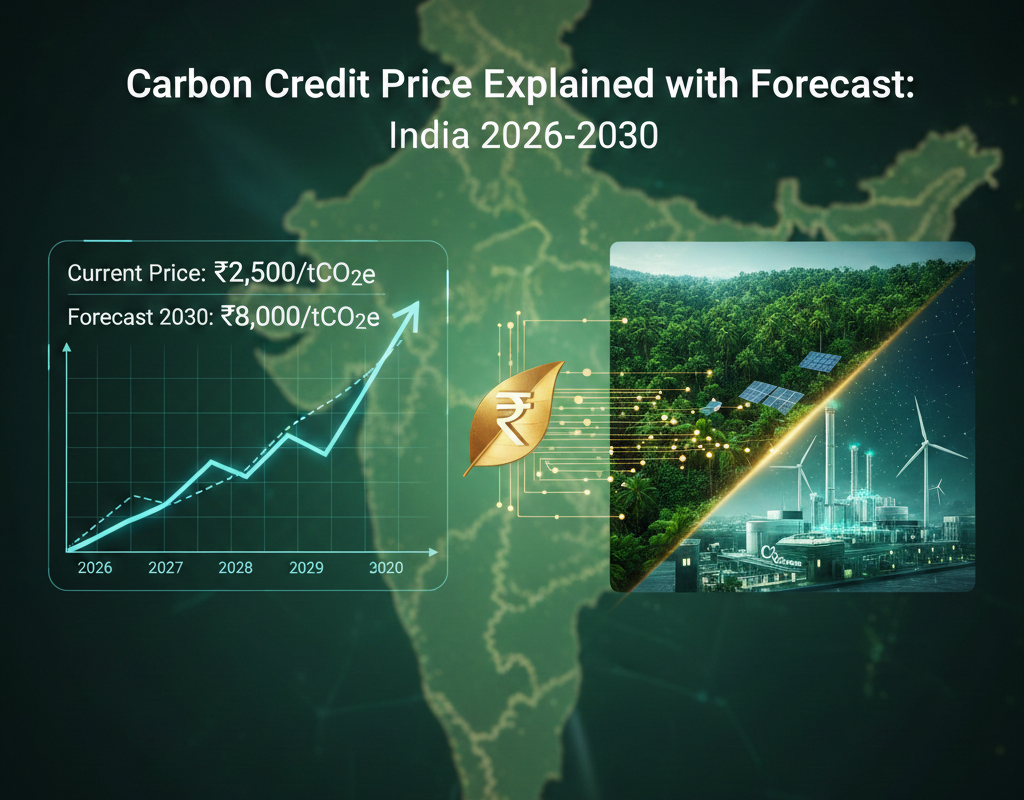
Carbon Credit Price Explained: Current Trends
Carbon Credit Price Explained: Current Trends
Carbon credits are now one of the most talked-about financial and environmental tools of the decade due to the global shift toward low-carbon growth. Understanding changes in carbon credit prices has become essential for investors, companies, legislators, and sustainability experts as nations step up their climate pledges and corporations embrace net-zero goals.
Carbon credits are quickly becoming commonplace financial assets and are no longer specialized environmental tools. Their pricing is influenced by a wide range of factors, including market demand, business climate objectives, technology advancements, regulatory legislation, and worldwide economic conditions. In this extensive guide, we describe the factors that influence the volatility of carbon credit values, how the Indian carbon market is developing, and what projections for the upcoming ten years suggest.

A Carbon Credit: What Is It?
One metric ton of carbon dioxide (CO₂) or its equivalent greenhouse gas that has been decreased, eliminated, or avoided from the atmosphere is represented by a carbon credit. Verified environmental projects like methane collection, afforestation, renewable energy installations, energy efficiency improvements, and industrial emission reductions are the source of these credits.
There are two main markets in which carbon credits operate:
- Market for Compliance (Regulated Market)
- Market for Voluntary Carbon (VCM)
The way that each market functions has a direct impact on the cost of carbon credits.
How Do They Calculate the Price of Carbon Credits?
The cost of carbon credits is variable. It varies according to a number of fundamental factors:
- Demand and Supply
Carbon credits are impacted by supply and demand, just like any other commodity. Demand increases as business sustainability ambitions rise and climate restrictions tighten. Prices rise if project development is unable to keep up.
On the other hand, an excess of supply or lax enforcement might drive down costs.
- Rules and Regulations
Climate policies from the government are important. The demand for credits rises in response to stronger emission limitations and more stringent reporting requirements. Price volatility might result from policy uncertainty.
- Standards for Verification
Because of their transparency and integrity, credits that have been validated in accordance with internationally accepted criteria sometimes fetch higher rates.
- Commitments to Corporate Net-Zero
Global firms’ commitment to net-zero goals is driving up demand for premium financing. The long-term price increase is a result of this rising demand.
- International Economic Situation
As businesses restrict their discretionary spending, recessionary conditions may momentarily lower demand for carbon credits. Long-term climate pledges, however, frequently keep the market stable.
The cost of carbon credits in India
India is becoming a major force in the world market for carbon. The Indian carbon credit market is anticipated to grow quickly due to the country’s aggressive renewable energy targets and industry decarbonization plans.
The following are the main factors affecting the price of carbon credits in India:
- Establishment of a formalized domestic carbon trading scheme
- Mechanisms for trading carbon credits supported by the government
- Corporate pledges to be sustainable
- Increasing the capability for renewable energy
- Mandates for reducing industrial emissions
It is anticipated that price stability and transparency will increase when India formalizes its carbon trading mechanism.
Early on, India’s voluntary carbon credit pricing might still be competitive when compared to averages worldwide. However, over the next ten years, carbon credit prices are probably going to rise consistently as domestic compliance mechanisms get stronger.
Factors Affecting the Price of Future Carbon Credits
We must examine the structural factors influencing the market in order to comprehend the carbon credit price forecast.
- Worldwide Roadmaps toward Net-Zero
More than 100 nations have set net-zero goals. Carbon offset programs and significant emission reductions are needed to meet these goals. Pressure to raise prices is supported by this sustained demand.
- Mechanisms for Adjusting the Carbon Border
Exporters are encouraged to buy credits or lower emissions by nations that impose carbon levies on imports. In emerging markets, this generates more demand.
- Growth of Markets for Compliance
Emissions trading schemes are being introduced in new nations. The demand for carbon credits is expected to increase as compliance marketplaces spread around the world.
- Innovation in Technology
Technological developments in carbon capture and removal may lead to an increase in supply. However, the hefty cost of these technologies at the moment keeps removal credit rates high.
India’s Place in the Upcoming Carbon Market
India is positioned to be a significant future provider and user of carbon credits due to its expanding industrial base, legislative changes, and rising renewable energy sector.
The expansion of the carbon market in India may result in:
- Price increases for domestic carbon credits
- Demand for Indian credits abroad
- Growth of green financing
- Increased involvement of corporations
Mechanisms for price discovery will improve as carbon trading infrastructure is strengthened.
Comparison of Carbon Credit Prices by Project Type
The price ranges for various project types vary:
- Credits for renewable energy are typically less expensive.
- Credits for energy efficiency: moderately priced
- Solutions based on forestry and nature: moderately to highly priced
- The most expensive carbon removal technology
Over the next ten years, high-impact, long-term carbon removal initiatives are anticipated to see the largest price growth.
In conclusion: Carbon Credit Price Explained: Current Trends
Trends in carbon credit prices show how urgent it is to address climate change on a global scale. Long-term fundamentals are still solid, notwithstanding the inevitable short-term volatility.
It is anticipated that between 2026 and 2035, the growth of voluntary commitments, the development of compliance markets, technology advancements, and more stringent regulatory monitoring will all push carbon credit prices upward.
To successfully navigate the changing climate economy, companies, investors, and legislators must have a solid understanding of carbon credit price mechanisms. India is positioned to play a significant role in international carbon trading as it fortifies its carbon market infrastructure.
The maturity of carbon markets will probably be determined during the next ten years. Those that comprehend pricing dynamics now will be in a better position to take advantage of the carbon economy’s potential tomorrow.
2 Comments