
 Aksh
Aksh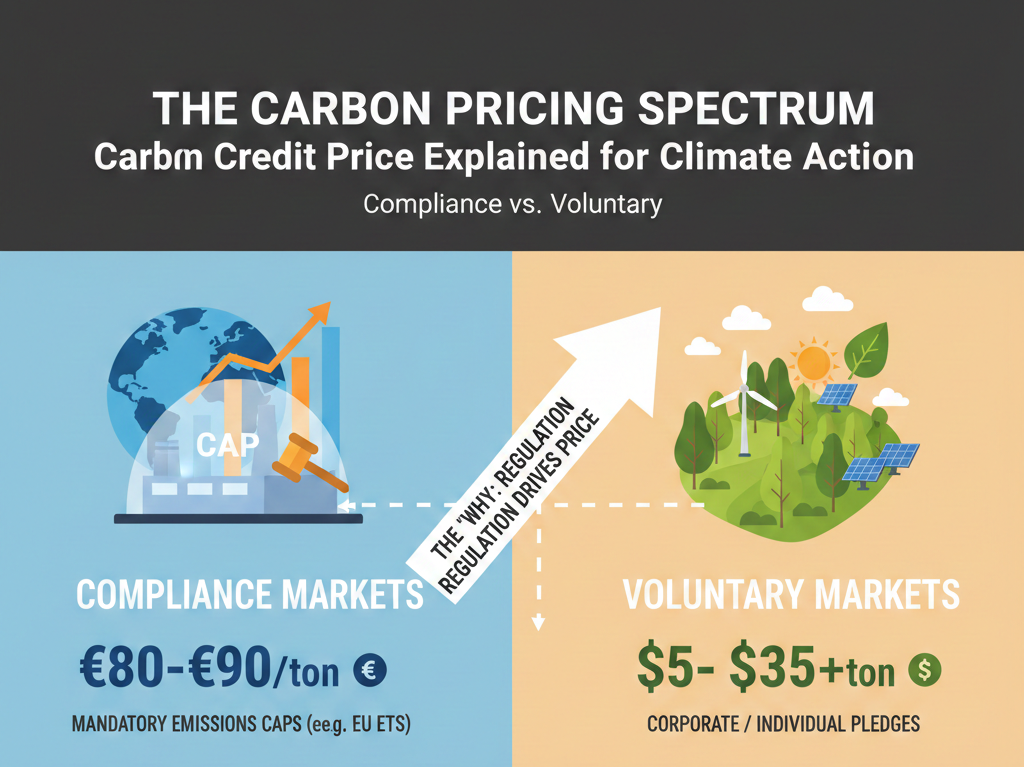
Carbon Credit Price Explained for Sustainability
Carbon Credit Price Explained for Sustainability
Carbon credits are now at the forefront of financial and environmental discussions due to the global push for sustainability and climate action. Knowing how carbon credit prices fluctuate has become crucial as countries, businesses, and investors strive for net-zero goals. Carbon credit pricing represents a complex mix of policy, demand, environmental integrity, and global climate ambition, ranging from government-regulated compliance markets to voluntary carbon offset programs motivated by business ESG purposes.
The market for carbon credits is expanding quickly both in India and globally. Companies are investing in afforestation and renewable energy projects, governments are implementing structured trading mechanisms, and financial institutions are incorporating green finance into their regular business plans.

A Carbon Credit: What Is It?
One metric ton of carbon dioxide (CO₂) or its equivalent in other greenhouse gases is reduced or removed from the atmosphere to create a carbon credit. Verified projects including methane capture programs, reforestation efforts, renewable energy installations, and energy efficiency upgrades produce these credits.
Carbon credits are available for purchase by organizations that emit greenhouse gases in order to offset their emissions. This enables them to fulfill their sustainability objectives by voluntarily lowering their carbon footprint or by complying with legal regulations.
Comprehending the Price of Carbon Credits
The monetary value attributed to a single carbon credit—one metric ton of CO2 equivalent that has been reduced or eliminated—is known as the carbon credit price. Market type, project quality, verification criteria, location, and demand are some of the variables that affect the pricing.
In certain voluntary markets, prices can be as low as a few dollars per ton, while in compliance systems, where demand is driven by regulatory enforcement, prices can be much higher.
The following factors affect how different carbon credit prices are:
- Dynamics of supply and demand
- Type of project and credibility
- Frameworks for regulations
- Location
- Co-benefits like community development or biodiversity
- ESG pledges made by corporations
- Policies for the global climate
Pricing of the Compliance Carbon Market
Governments set emission caps and award or auction emission allowances to businesses in compliance markets. Firms that exceed their allowances must purchase additional credits or face penalties.
The European Union Emissions Trading System, one of the biggest carbon markets in the world, is a well-known example. Because of the legally binding regulations, prices in such controlled systems are typically higher.
In keeping with its obligations under the Paris Agreement, India is likewise working toward structured carbon trading within its national climate framework. India’s carbon credit prices are anticipated to steady and possibly rise as the nation fortifies its compliance systems.
Pricing for the Voluntary Carbon Market
Businesses and people can buy carbon credits through the voluntary carbon market without being required by law. Voluntary offsets are frequently used by businesses striving for carbon neutrality or net-zero emissions.
In voluntary marketplaces, prices vary greatly according on:
- Project type (blue carbon, forestry, renewable energy, etc.)
- Standard of certification
- Carbon removal’s permanence
- Co-benefits for the environment and society
- Location
Premium fees are usually charged for high-quality nature-based projects, particularly those that support biodiversity and community development.
Important Elements Affecting the Cost of Carbon Credits
- Demand and Supply
Credible carbon credits are becoming more and more in demand as more businesses pledge to meet net-zero goals. A shortage of high-integrity credits may cause prices to rise.
- Type of Project
The scalability of renewable energy plants may result in lower-priced credits. On the other hand, because of their permanence and complexity, afforestation and carbon removal technologies like direct air capture can fetch higher costs.
- Standards for Verification
Projects that are validated in accordance with globally accepted standards typically fetch higher prices. Third-party auditing and transparency boost buyer confidence.
- Regulation and Policy of the Government
The demand for credits rises with stricter climate legislation. Pricing is directly impacted by national carbon markets and emission caps.
The cost of carbon credits in India
India’s growing forestry potential, government-led environmental measures, and expansion of renewable energy are making it a prominent player in the global carbon market.
Important advancements consist of:
- National carbon trading mechanisms are introduced.
- Goals for the expansion of renewable energy
- Requirements for corporate ESG compliance
- Increase in demand for voluntary offsets
The cost of carbon credits in India varies according to the market sector and kind of project. Forestry and nature-based solutions typically fetch greater premiums, although renewable energy credits could trade at comparable rates.
It is anticipated that pricing stability and transparency will increase as India fortifies its regulatory structure.
In conclusion: Carbon Credit Price Explained for Sustainability
The price of carbon credits is more than just a figure; it represents the changing global commitment to climate action and sustainability. Pricing mechanisms will become more open, controlled, and consistent with environmental integrity as markets develop.
India is positioned as a major contributor to the global carbon markets due to its expanding involvement in forestry projects, renewable energy, and ESG compliance. To make wise judgments, companies, investors, and legislators need to comprehend pricing dynamics.
Carbon credit price is anticipated to be crucial in determining the future of the green economy due to growing demand, stricter restrictions, and increased sustainability obligations. Early and planned action by organizations will not only help mitigate climate change but also provide them a competitive edge in a world where carbon emissions are becoming more and more of a concern.
Carbon Credit Price India vs USA: Current Rates, Trends, and Market Insights
Carbon Credit Price India vs USA: Current Rates, Trends, and Market Insights