
 Aksh
Aksh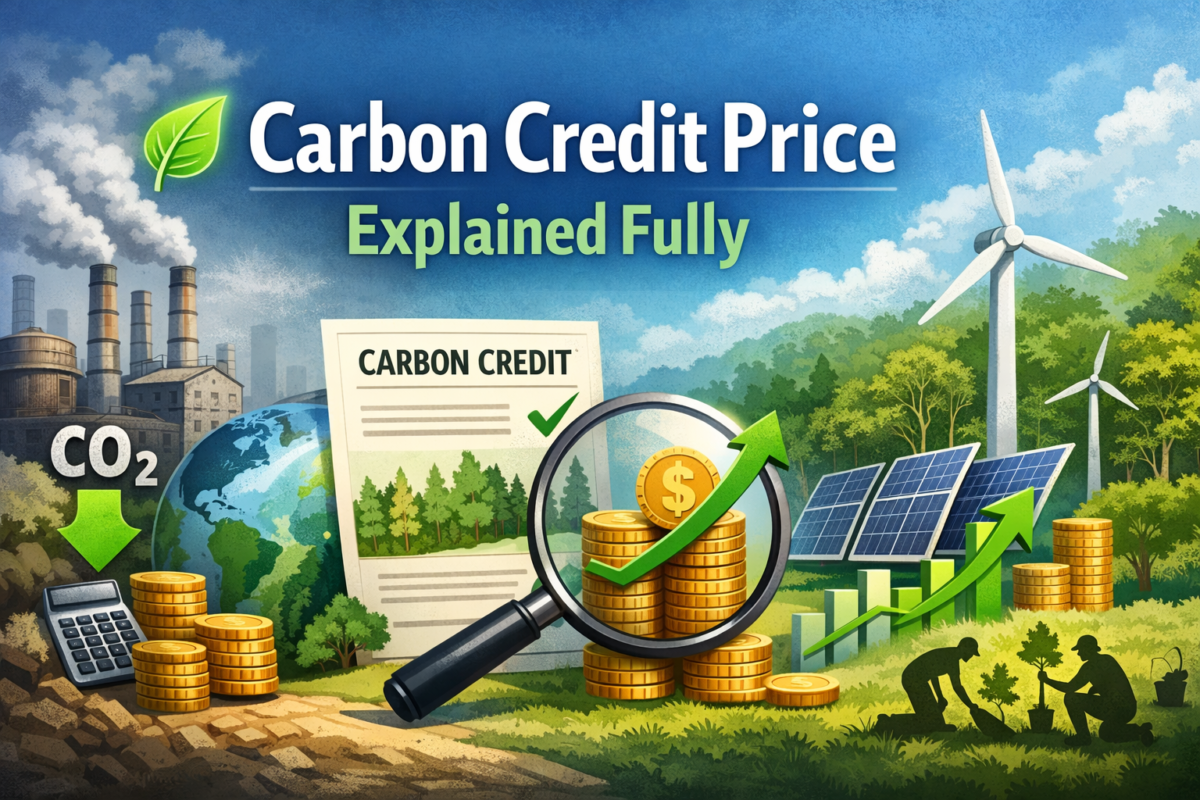
Carbon Credit Price Explained: Complete Guide to Carbon Market
Carbon Credit Price Explained: Complete Guide to Carbon Market
Carbon credits have become a key tool in the global battle against climate change, helping to promote environmental sustainability. The price of carbon credits has emerged as a crucial indicator impacting investment choices, project development, and climate policy as governments and businesses seek to lower greenhouse gas emissions. Businesses, investors, and people wishing to navigate India’s expanding carbon market must comprehend the subtleties of carbon credit price.

A Carbon Credit: What Is It?
A permit that permits a business or organization to emit a certain quantity of carbon dioxide or other comparable greenhouse gases (often one metric ton) is known as a carbon credit. These credits are a component of larger strategies to lower carbon emissions worldwide. Businesses that over their emission restrictions can purchase credits from organizations that have achieved greater emission reductions than they have. This strategy generates a market-driven incentive to fund projects aimed at reducing carbon emissions.
The voluntary and compliance markets in India are compatible with the carbon credit system. The government regulates the compliance market through programs like Renewable Energy Certificates (RECs) and the Perform, Achieve, Trade (PAT) scheme, but the voluntary market enables businesses to proactively offset emissions.
Comprehending the Price of Carbon Credits
The cost of buying or trading a carbon credit on the market is known as the carbon credit price. It takes into account a number of variables, such as the type of project, market maturity, regulatory regulations, and the supply and demand for credits. Global patterns in carbon pricing have an impact on prices, which differ between voluntary and compliant markets.
Factors Affecting the Cost of Carbon Credits
- Carbon Credit Type
Projects centered on methane capture, energy efficiency, reforestation, or renewable energy can produce carbon credits. Because of their legitimacy and environmental advantages, credits from validated, high-impact projects frequently fetch higher rates.
- Supply and Demand in the Market
Demand from businesses and industries trying to offset emissions has a big impact on prices. While an abundance of low-quality credits may decrease prices, a shortage of high-quality credits may push prices higher.
- Regulations
The cost of carbon credits in India is influenced by international standards and compliance requirements. Market price may be impacted by policies that mandate emission reductions or offer incentives for environmentally friendly initiatives.
The Average cost of carbon credits in India
Depending on the kind of project and market niche, the average cost of carbon credits in India varies. While compliance market prices, which are influenced by more stringent laws, can be higher, voluntary carbon credits now vary between ₹300 and ₹1,200 per ton of CO2 equivalent. Due to their proven ability to reduce emissions, renewable energy and forestry initiatives typically draw the higher end of the price range.
Carbon Credit Initiatives That Affect Cost
Projects involving reforestation and afforestation remove CO2 from the environment and produce carbon credits. Because of the long-term environmental benefits and co-benefits like biodiversity protection, the cost is typically higher.
- Renewable Energy Projects: Carbon credits can be earned by replacing fossil fuel-based energy with solar, wind, and small hydro projects. Although prices are constant, they may change depending on the incentives offered by renewable energy policies.
- Methane collection Projects: Methane collection from industry or agriculture greatly lowers greenhouse gas emissions, which frequently results in higher-priced credits because of their considerable impact.
- Energy Efficiency Projects: These initiatives provide affordable carbon credits by lowering energy use and emissions in transportation, commercial buildings, and industries.
The Mechanism of Carbon Credit Trading
Buying, selling, or exchanging carbon credits in the voluntary or compliance markets is known as trading. Numerous important aspects impact the process:
- Marketplaces for Carbon Credits
Trading is facilitated by both domestic and foreign platforms. Both regulated frameworks and voluntary carbon markets are used for trading in India.
- Mechanism of Pricing
Project type, supply-demand dynamics, and regulatory constraints all affect the cost of carbon credits. Prices are frequently negotiated by market participants according to project volume, credibility, and verification criteria.
- Confirmation and Accreditation
In carbon trading, credibility is crucial. Gold Standard, Verified Carbon Standard (VCS), and other certifications guarantee that the credits reflect actual reductions in emissions. Price increases are usually the result of greater verification standards.
Advantages of Knowing the Price of Carbon Credits
There are several advantages to comprehending the price and trade dynamics of carbon credits:
- Financial Planning for Businesses: Businesses can incorporate carbon offset expenses into their sustainability plans and budget for them.
- Making Well-Informed Investment Decisions: Investors are able to recognize superior carbon initiatives that have the potential to yield profits and support environmental sustainability.
- Enhanced Corporate Social Responsibility (CSR): Businesses can show their dedication to lowering their carbon footprint and being carbon neutral by using carbon credits.
- Climate Goal Support: Appropriate pricing encourages investments in initiatives that really cut greenhouse gas emissions, thereby promoting both national and international climate objectives.
India’s Trends in Carbon Credit Prices
Government laws and heightened corporate ESG consciousness have contributed to the continuous rise of the carbon market in India. Important trends consist of:
- Corporates striving for net-zero emissions are increasingly participating in the voluntary carbon market.
- Price increases for credits originating from high-impact initiatives such as forestry and renewable energy.
- integration with global carbon trading systems, which will boost pricing competitiveness and transparency.
- Emergence of carbon credit investing as a practical financial tool for investors who care about the environment.
Important Takeaways: Carbon Credit Price Explained: Complete Guide to Carbon Market
- Carbon credits, which facilitate emission reduction efforts, are permission to emit a certain quantity of greenhouse gases.
- Supply, demand, project type, verification requirements, and legal frameworks all affect the cost of carbon credits.
- Both the voluntary and compliance carbon markets in India have unique pricing dynamics.
To sum up, the price of carbon credits is more than just a figure; it is a representation of the legislative, economic, and environmental framework that motivates emission reduction initiatives both internationally and in India. Stakeholders may invest in worthwhile projects, make wise decisions, and help create a sustainable, low-carbon future by having a thorough grasp of carbon credit pricing.
Carbon Credit Price for Businesses in 2026: Trends, Market Rates, and Strategic Buying Guide
Carbon Credit Price for Businesses in 2026: Trends, Market Rates, and Strategic Buying Guide
2 Comments