
 Aksh
Aksh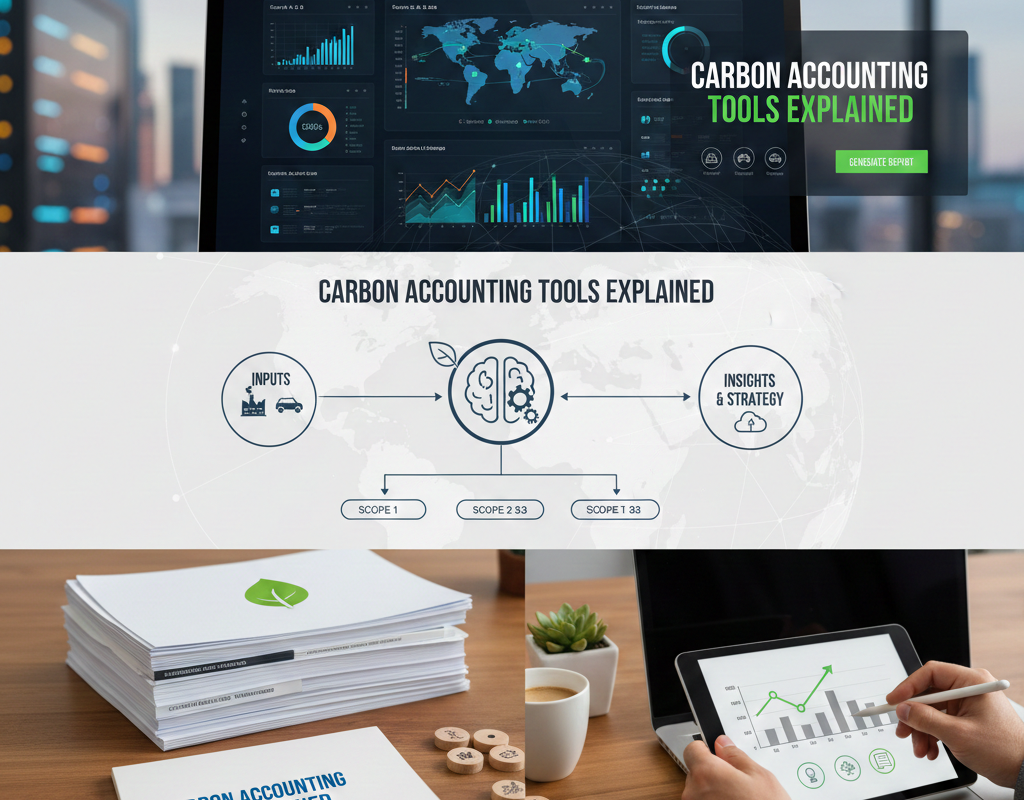
Carbon Accounting Tools Explained
Carbon Accounting Tools Explained
Businesses, industries, and governmental entities are using carbon accounting technologies more frequently to monitor and control their environmental impact as India speeds up its commitment to sustainability and reaching net-zero emissions. Carbon accounting has become a crucial procedure for ethical corporate governance and environmental compliance as a result of increased awareness of climate change, carbon emissions, and the part that corporations play in reducing environmental harm.
Everything you need to know about carbon accounting tools is covered in this article, including their types, uses, advantages, and best practices in India. This thorough manual is intended to assist companies in properly measuring, tracking, and lowering their carbon footprint.

Carbon accounting: what is it?
The process of measuring, documenting, and evaluating greenhouse gas (GHG) emissions generated by a company, project, or activity is known as carbon accounting, or greenhouse gas accounting. It gives companies a methodical way to evaluate their environmental effect, locate emission hotspots, and put plans in place to reduce their carbon footprint.
For businesses pursuing sustainability reporting, ESG compliance, and climate action projects, carbon accounting is becoming more and more important. Businesses may demonstrate their commitment to sustainability and gain a competitive edge by precisely quantifying emissions, in addition to adhering to national and international requirements.
The Significance of Carbon Accounting for Indian Companies
India is become a key participant in international sustainability projects. Government rules that promote the use of renewable energy and carbon neutrality are putting more and more pressure on businesses to efficiently control their emissions. With the use of carbon accounting systems, Indian companies can:
- Respect regulations: Accurate carbon reporting is necessary to comply with governmental mandates and reporting systems like the Perform, Achieve and Trade (PAT) scheme and potential carbon tax policies.
- Fulfill stakeholder expectations: Transparency in carbon emissions and sustainability practices is becoming more and more demanded by partners, investors, and consumers.
- Maximize operational efficiency: Monitoring emissions frequently shows areas where energy use, operational waste, and expenses can be cut.
- Reach carbon credit markets: Under programs like as the Indian carbon credit programs, companies can claim credits for reducing their emissions through proper carbon accounting.
In summary, carbon accounting is a strategic corporate advantage as well as an environmental obligation.
How Carbon Accounting Instruments Operate?
Generally, carbon accounting software adheres to a set procedure to guarantee precision and openness in emissions monitoring:
- Data collection: Compile information on the use of fuel, energy, raw materials, waste production, and other sources of emissions.
- Application of Emission Factors: Use standardized emission factors to translate activity data into carbon emissions.
- Analysis and Reporting: Produce reports to determine compliance status, emission hotspots, and areas for reduction.
- Implementing a Reduction Strategy: Create workable plans for process optimization, energy efficiency, renewable energy adoption, and carbon offsetting.
Essential Elements of Powerful Carbon Accounting Instruments
A range of capabilities are available in contemporary carbon accounting software to support thorough carbon management:
- Automated Data Integration: Provides real-time tracking by connecting to enterprise systems, smart sensors, and energy meters.
- Emission Calculators: To guarantee accuracy, they use internationally accepted emission factors.
- Scenario modeling: Assesses how operational modifications or energy-saving measures affect carbon emissions.
- Regulatory Compliance: Complies with regional Indian laws as well as global standards like ISO 14064 and CDP.
- Dashboard visualization and reporting give stakeholders concise, useful information.
- Carbon Credit Accounting: Keeps track of acceptable offsets and reductions for involvement in carbon trading schemes.
Advantages of Carbon Accounting Software
There are several advantages of using strong carbon accounting tools:
- Improved Transparency and Accuracy: Prevents human error and guarantees accurate reporting.
- Savings: Lowers operating expenses by identifying energy inefficiencies.
- Increased ESG Ratings: Shows a dedication to sustainability, boosting investor trust and the company’s standing.
- Regulatory Compliance: Assists companies in adhering to national and worldwide climate rules.
- Carbon Credit Optimization: Makes it possible to participate in carbon markets and reap the financial rewards of lowering emissions.
Making strategic decisions helps to implement sustainable practices, lower carbon intensity, and optimize processes.
India’s Carbon Accounting Frameworks and Standards
Indian companies frequently adhere to internationally accepted standards that have been modified for local circumstances in order to guarantee consistent and reliable carbon accounting:
- The basis for Scope 1, 2, and 3 emission accounting is provided by the GHG Protocol.
- An international standard for measuring and disclosing greenhouse gas emissions is ISO 14064.
- The global disclosure framework for environmental impact reporting is known as CDP reporting.
- The Perform, Achieve and Trade (PAT) Scheme is an Indian program that promotes carbon trading and energy efficiency.
By adhering to these guidelines, carbon accounting is guaranteed to be precise, comparable, and appropriate for involvement in compliance or voluntary carbon markets.
In conclusion: Carbon Accounting Tools Explained
For Indian companies dedicated to sustainability, ESG compliance, and operational efficiency, carbon accounting technologies are now required, not optional. Organizations can measure, track, and lower their carbon footprint, gain access to carbon markets, increase stakeholder trust, and make a significant contribution to India’s climate goals by utilizing these technologies.
Businesses can turn carbon accounting from a legal requirement into a strategic advantage that promotes innovation, cost reduction, and sustainable growth with the right implementation.
Purchasing strong carbon accounting software now guarantees that businesses are ready for the future of a low-carbon economy.
Carbon Credit Price Volatility Explained: Causes, Trends, Impacts & Future Outlook
Carbon Credit Price Volatility Explained: Causes, Trends, Impacts & Future Outlook
3 Comments