
 Aksh
Aksh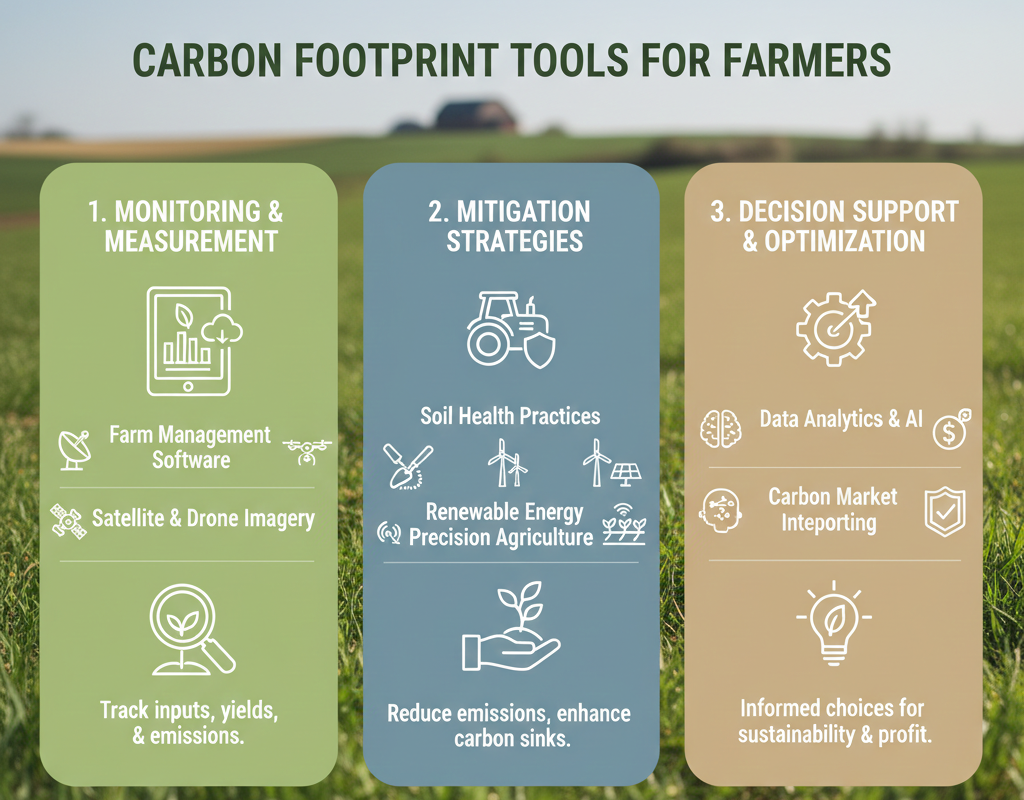
Carbon Footprint Tools for Farmers
Carbon Footprint Tools for Farmers
Farmers are under growing pressure to assess and lessen their environmental impact as climate change worsens and sustainability becomes crucial to agricultural policy and international trade. Methane from cattle, nitrous oxide from fertilizers, and carbon dioxide from changes in land use are the main ways that agriculture contributes to global greenhouse gas emissions. However, through regenerative practices and soil carbon sequestration, the sector has enormous potential to contribute to the climate solution. Tools for measuring farmers’ carbon footprints are becoming essential tools for bridging the gap between economic opportunity and environmental responsibility.
The use of carbon footprint technologies is changing the game in India, where millions of people rely on agriculture for their livelihoods. Farmers are able to compute, track, and control emissions thanks to these online tools and farm carbon accounting systems.

Recognizing Agriculture’s Carbon Footprint
The total amount of greenhouse gas emissions produced by agricultural activities, both directly and indirectly, is referred to as the “carbon footprint” in farming. This includes emissions from burning crop residue, manure management, livestock digestion, fertilizer use, irrigation energy use, and fuel used in farm equipment. The first step in lowering these pollutants is precise measurement.
In the past, farmers evaluated the environmental impact using generalized data and approximations. But today’s agricultural carbon calculators provide accurate, farm-specific information. Farmers can obtain comprehensive emission reports specific to their operations by inputting information such as crop type, acreage, fertilizer application rates, irrigation techniques, and livestock numbers.
The Development of Carbon Calculators for Agriculture
From basic spreadsheets to complex digital platforms driven by artificial intelligence, satellite images, and data analytics, agricultural carbon calculators have undergone significant development. Instead of merely offering static reports, these solutions give farmers insights that can be put to use.
Crop rotation histories, weather trends, soil health data, and irrigation efficiency are just a few of the data sources that are integrated into modern farm sustainability software. The tools create precise carbon footprint estimates and recommend changes in line with climate-smart agriculture by merging these datasets.
Easy-to-use carbon footprint technologies are particularly crucial in India, where smallholder farmers predominate. Regional language-supporting mobile platforms guarantee accessibility and broad use. Usability is further improved by the capability to function offline in locations with poor connectivity.
Carbon Footprint Tools’ Function in the Production of Carbon Credits
The ability to obtain carbon credits is among the biggest benefits of employing carbon footprint technologies for farmers. Verified decreases or eliminations of greenhouse gas emissions are represented by carbon credits. Farmers can lower methane emissions or sequester carbon in the soil by implementing techniques including improved manure management, agroforestry, reduced tillage, and cover crops.
However, precise measurement, reporting, and verification are necessary for the creation of carbon credits. By keeping open records of agricultural practices and emission reductions, carbon footprint technologies make this process easier. For certification under voluntary or compliant carbon markets, this documentation is essential.
Precision Farming and Cutting Emissions
By optimizing resource consumption, precision agricultural techniques enhance carbon footprint platforms. Farmers can accurately administer water and fertilizer where it is required thanks to satellite monitoring, soil sensors, and GPS-guided equipment. By doing this, unnecessary input use is decreased, lowering expenses and emissions.
Emission accuracy is improved by integrating precision agriculture data with farm carbon accounting systems. For instance, applying fertilizer at a variable rate lowers emissions of nitrous oxide, one of the strongest greenhouse gases. These advancements are recorded by carbon footprint tools and are reflected in revised emission profiles.
Farmers may boost yields while lessening their impact on the environment by balancing sustainability and production. The business case for implementing digital carbon management systems is strengthened by these two advantages.
Carbon Sequestration in Soils: Unlocking Untapped Potential
One of the planet’s biggest carbon sinks is soil. Farmers can raise soil organic carbon levels by using regenerative farming techniques like crop rotation, cover crops, organic amendments, and reduced tillage.
Tools for measuring carbon footprints track changes in soil carbon over time, which aids in estimating sequestration potential. Accurate tracking is ensured by routine soil testing in conjunction with digital monitoring. Farms become more tolerant to drought and other harsh weather events when soil carbon levels grow, increasing long-term productivity.
Soil carbon sequestration holds great promise in India’s varied agroclimatic zones. Digital assessment techniques can be used to apply region-specific carbon management strategies from dryland farming in the west to rice fields in the east.
Climate-Smart Farming and Policy Assistance
To fulfill their national climate pledges, governments everywhere are encouraging climate-smart agriculture. Policy measures in India are pushing for the adoption of renewable energy, sustainable practices, and water efficiency.
These policy goals are supported by carbon footprint technologies, which yield quantifiable results. Farmers are able to prove that they are meeting the sustainability requirements needed for export markets. Traceability and low-carbon production practices are becoming more and more important to international buyers.
Indian farmers can achieve premium pricing for ecologically conscious produce and improve market access by implementing farm sustainability software. This synchronizes financial incentives with climate objectives.
In conclusion: Carbon Footprint Tools for Farmers
India’s agricultural future is being redefined by carbon footprint tools for farmers. These digital technologies enable farmers to become climate champions by offering precise emission measurement, enabling the creation of carbon credits, and encouraging climate-smart behaviors.
Adoption is expected to increase as knowledge rises and technology becomes more widely available. Incorporating carbon accounting into routine farm management will boost rural incomes, promote sustainable growth, and make a substantial contribution to both national and international climate goals.
The agricultural industry is at a critical juncture. Indian farmers may turn obstacles into opportunities and build a more sustainable and profitable future with the help of cutting-edge carbon footprint tools.
Carbon Credit Price India vs USA: Current Rates, Trends, and Market Insights
Carbon Credit Price India vs USA: Current Rates, Trends, and Market Insights