
 Aksh
Aksh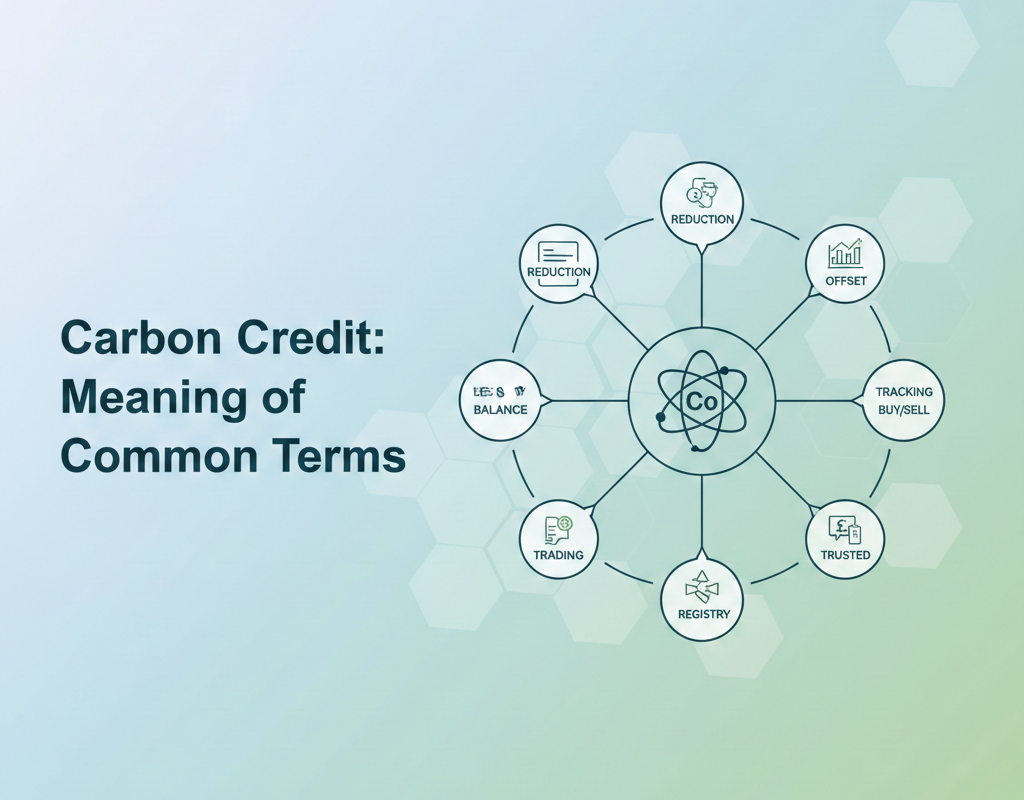
Carbon Credit Meaning of Common Terms
Carbon Credit Meaning of Common Terms
Carbon markets are becoming one of the most effective instruments for lowering greenhouse gas emissions as climate change becomes a defining global issue. Carbon trading, carbon credits, and net-zero commitments are becoming more and more popular in India and around the world among businesses, investors, legislators, and sustainability experts.
However, the jargon used to describe carbon credits can frequently seem complicated and sophisticated. Anyone involved in carbon markets, whether in compliance systems or the voluntary carbon market, must be able to define common phrases related to carbon credits.
With particular reference to the Indian carbon ecosystem, this thorough book explains the key topics related to carbon credits in plain, useful language.

A Carbon Credit: What Is It?
One metric ton of carbon dioxide (CO2) or its equivalent greenhouse gas (CO2e) that has been avoided, decreased, or eliminated from the atmosphere is represented by a carbon credit.
To put it simply, a validated project receives one carbon credit for preventing or eliminating one ton of CO2 emissions. Businesses or individuals wishing to offset their own emissions can purchase these credits.
In addition to being essential to business ESG compliance, sustainability reporting, and climate finance, carbon credits are at the heart of global climate action.
Meaning of Carbon Offset
Reducing greenhouse gas emissions in one location to offset emissions in another is known as a carbon offset.
A manufacturing company, for instance, can buy 10,000 carbon credits from a renewable energy or afforestation project if it emits 10,000 tons of CO2 a year. This helps the business achieve carbon neutrality by offsetting its emissions.
Carbon offsets are the process of using carbon credits to offset emissions, even if carbon credits are marketable units.
The Carbon Footprint
The entire amount of greenhouse gases released, either directly or indirectly, by a person, business, product, or event is known as their “carbon footprint.”
It consists of:
- Direct emissions from manufacturing operations and fuel combustion
- Supply chain emissions and electricity use are examples of indirect emissions.
Before businesses commit to net-zero emissions or buy carbon credits, they must first calculate their carbon footprint.
Emissions of Net Zero
Emissions of greenhouse gases must be balanced with their removal from the atmosphere in order to achieve net zero emissions.
A business can reach net zero by:
- Whenever feasible, lowering emissions.
- Using carbon credits to offset any residual emissions.
Under international climate agreements, numerous governments and corporations from around the world, including India, have committed to long-term net-zero targets.
Market for Voluntary Carbon (VCM)
Businesses and people can buy carbon credits freely, outside of legal constraints, through the voluntary carbon market.
Within the VCM:
- To achieve ESG objectives, businesses purchase credits.
- Businesses improve their sustainability reporting by offsetting emissions.
- Projects to reduce carbon emissions are funded by investors.
India’s voluntary carbon market is expanding quickly as ESG compliance and business sustainability gain traction.
Market for Compliance Carbon
Government regulations oversee a compliance carbon market, which mandates that businesses cut emissions.
The European Commission-run European Union Emissions Trading System is one of the most well-known compliance programs.
Government policies that are in line with climate commitments are driving the evolution of carbon trading mechanisms in India.
The Paris Agreement’s Article 6
International carbon markets and international collaboration are established by Article 6 of the Paris Agreement.
Countries can exchange emission reductions to satisfy national climate objectives under the agreement enacted by the United Nations Framework Convention on Climate Change.
The global carbon credit markets, especially India’s position as a key provider of high-quality credits, are anticipated to be greatly impacted by Article 6.
Finance for Climate Change
Funding allocated for initiatives addressing climate change adaptation and mitigation is referred to as climate finance.
By directing private funds toward emission reduction initiatives, carbon markets are a significant source of climate funding.
Carbon finance helps developing nations like India advance sustainable development and renewable energy projects.
Why It’s Important to Know What Carbon Credit Means in 2026
As carbon markets develop:
- Rules are becoming more stringent.
- Transparency is a must for investors.
- High-integrity credits are sought for by buyers.
- Carbon pricing methods are integrated by governments.
Knowing the definitions of common terminology related to carbon credits enables firms to:
- Make wise investment choices.
- Steer clear of greenwashing dangers.
- Comply with ESG guidelines.
- Engage in carbon trading in an efficient manner.
India’s Carbon Markets’ Future
India has set high climate goals, such as lowering the intensity of emissions and boosting the capacity of renewable energy.
India is well-positioned to become a significant player in the voluntary and compliance carbon markets because to its expanding policy framework and promising project development potential.
Companies will be more equipped for the climate economy of the future if they are familiar with the jargon around carbon credits now.
In conclusion: Carbon Credit Meaning of Common Terms
Carbon credits aren’t specialized environmental tools anymore. They are effective financial instruments influencing company sustainability plans and global climate action.
Businesses and investors can traverse the changing carbon ecosystem with confidence if they know what popular terminology like carbon offset, voluntary carbon market, cap and trade, carbon registry, additionality, and net zero emissions mean.
Knowledge will be the primary factor that separates compliance from leadership in the green economy as carbon trading grows in India and throughout the world.
The shift to a world with lower carbon emissions is speeding up. The first step to meaningful climate participation and sustainable growth is to understand the jargon around carbon credits.