
 Aksh
Aksh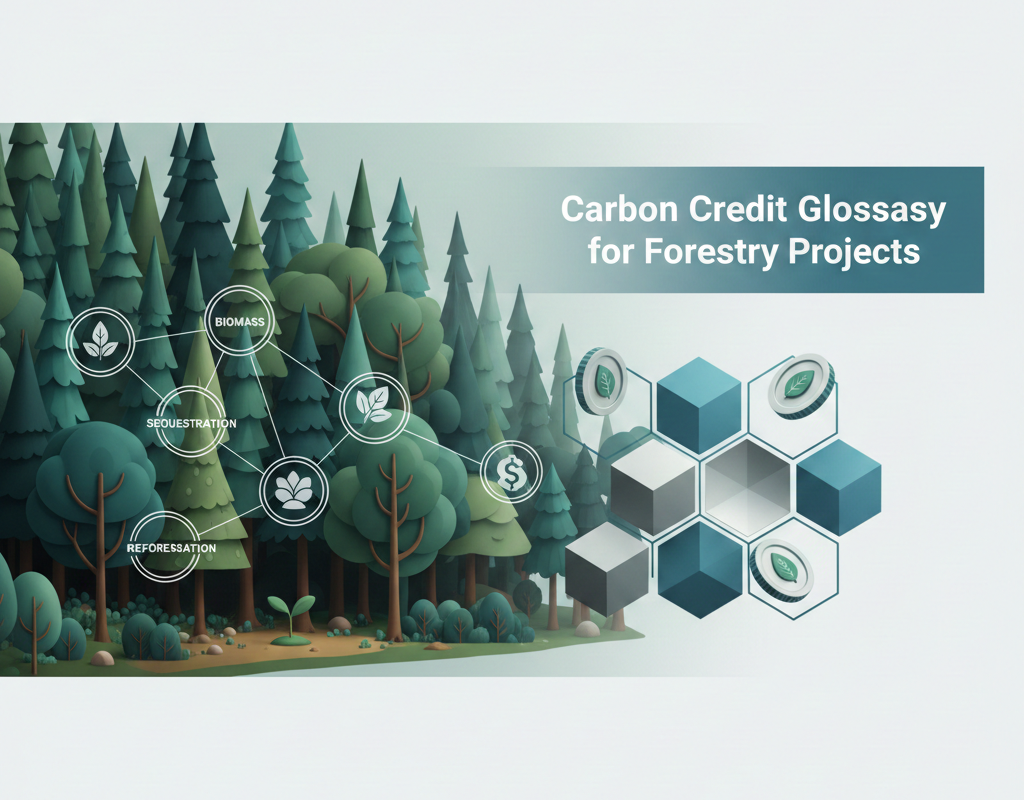
Forestry Carbon Credits Explained
Forestry Carbon Credits Explained
Because forestry operations collect carbon dioxide from the atmosphere and store it in trees, soil, and biomass, they are essential to the fight against global warming. Developers, investors, legislators, and landowners must all be familiar with the jargon used in relation to forest carbon credits as carbon markets gain prominence.
Key phrases used in voluntary and compliance carbon markets are defined clearly in this extensive carbon credit dictionary for forestry projects. This book will assist you in navigating the complicated language of forest carbon finance, regardless of your involvement in afforestation, reforestation, REDD+, or sustainable forest management.

The Significance of Forestry Projects in Carbon Markets
Carbon is naturally absorbed by forests. Trees absorb carbon dioxide through photosynthesis, storing it as carbon in their biomass and the soil around them. This carbon storage is measured by forestry carbon projects, which then turn it into tradeable carbon credits.
Forestry carbon credits are fast becoming as a key component of climate mitigation plans in India and around the world. They provide co-benefits like biodiversity preservation, watershed protection, soil health improvement, and the improvement of rural livelihoods in addition to lowering greenhouse gas concentrations.
Comprehending the jargon used in forest carbon credits guarantees openness, legitimacy, and adherence to global norms.
A-Z Forestry Project Carbon Credit Glossary
- Additionality
The need that a carbon project produce reductions or removals of greenhouse gases that would not have happened in the absence of the project is known as additionality. In terms of forestry, this means that the trees that are planted or preserved must store more carbon than would have occurred in a typical situation.
Valid carbon credits cannot be issued by a project that fails the additionality criteria.
- Baseline Situation
What would occur if the carbon project didn’t exist is represented by the baseline scenario. It serves as a crucial point of reference when figuring out carbon credits.
The baseline for forestry projects could be ongoing land degradation, deforestation, or other land use practices.
- Credit for Carbon
One metric tonne of carbon dioxide equivalent that has been cut, avoided, or removed from the atmosphere is represented by a carbon credit. Usually produced by carbon sequestration, forestry carbon credits are removal-based credits.
- Deforestation
The permanent removal of forest cover for other land uses, such urbanization or agriculture, is referred to as deforestation. It is a significant contributor to greenhouse gas emissions worldwide.
One important tactic for mitigating climate change is avoiding deforestation.
- Emissions of Reduction
The reduction of greenhouse gases discharged into the atmosphere is known as an emission reduction. Avoided deforestation is a common way for forestry to reduce emissions.
- The Forest Carbon Project
An organized program created to produce carbon credits by afforestation, reforestation, or forest protection is known as a forest carbon project.
- Leakage
The term “leakage” describes the unanticipated rise in emissions caused by project activity outside the project boundaries. For instance, logging may move to another area if a forest area is protected.
- Measurement, Reporting, and Verification (MRV)
Measurement, Reporting, and Verification are the acronyms for MRV. Quantifying, recording, and validating carbon removals or reductions is a methodical process.
- Nature-Based Solution (NbS)
Actions that preserve, manage, and restore ecosystems sustainably in order to solve social issues are known as nature-based solutions. One of the most well-known NbS projects is forestry carbon.
- Project Limitations
The geographic region where carbon activities take place is delineated by the project boundary. It avoids double counting and guarantees precise measurement.
- Planting new trees
Planting trees on previously forested but cleared land is known as reforestation. Carbon stocks and ecological functions are restored.
- Sustainable Development for Goals (SDGs)
Forestry carbon programs support a number of SDGs, such as poverty alleviation, life on land, and climate action.
- Verification and Validation
Validation is done to ensure design conformance prior to project implementation. Periodically, verification is carried out to confirm real carbon reductions.
A Carbon Credit Glossary’s Significance for Indian Forestry Projects
India’s extensive degraded lands and community-managed forest areas present a substantial opportunity for forestry carbon projects. Stakeholders benefit from a uniform carbon credit glossary:
- Boost the transparency of the project
- Boost investor trust
- Comply with global carbon regulations
- Encourage adherence to national climate policies
- Boost efforts for sustainable rural development
Landowners, corporations, NGOs, and climate entrepreneurs can all take an active role in the carbon economy by being aware of these words.
Market Trends for Forestry Carbon Emerging
The carbon markets for forestry are changing quickly due to recent advancements:
- Digital MRV technology integration
- Carbon registries based on blockchain technology
- Programs for Jurisdictional REDD+
- Integration of climate finance
- Demand is being driven by corporate net-zero promises.
Forestry carbon credits are anticipated to be crucial in helping India meet its climate pledges by balancing emissions and promoting ecological restoration.
In conclusion: Forestry Carbon Credits Explained
One of the most effective ways to fight climate change while promoting biodiversity, the economy, and society is through forestry carbon credits. However, precise nomenclature, open accounting, and strict oversight are critical to the industry’s legitimacy.
A basic overview of the words influencing forest carbon markets is provided by this glossary of carbon credits for forestry projects. In the quickly growing carbon economy, understanding these ideas—from additionality and baseline to MRV and permanence—allows for well-informed decision-making.
Forestry projects are seen by stakeholders in India and abroad as investments in resilient ecosystems, sustainable landscapes, and a low-carbon future rather than just climate tools.
4 Comments