
 Aksh
Aksh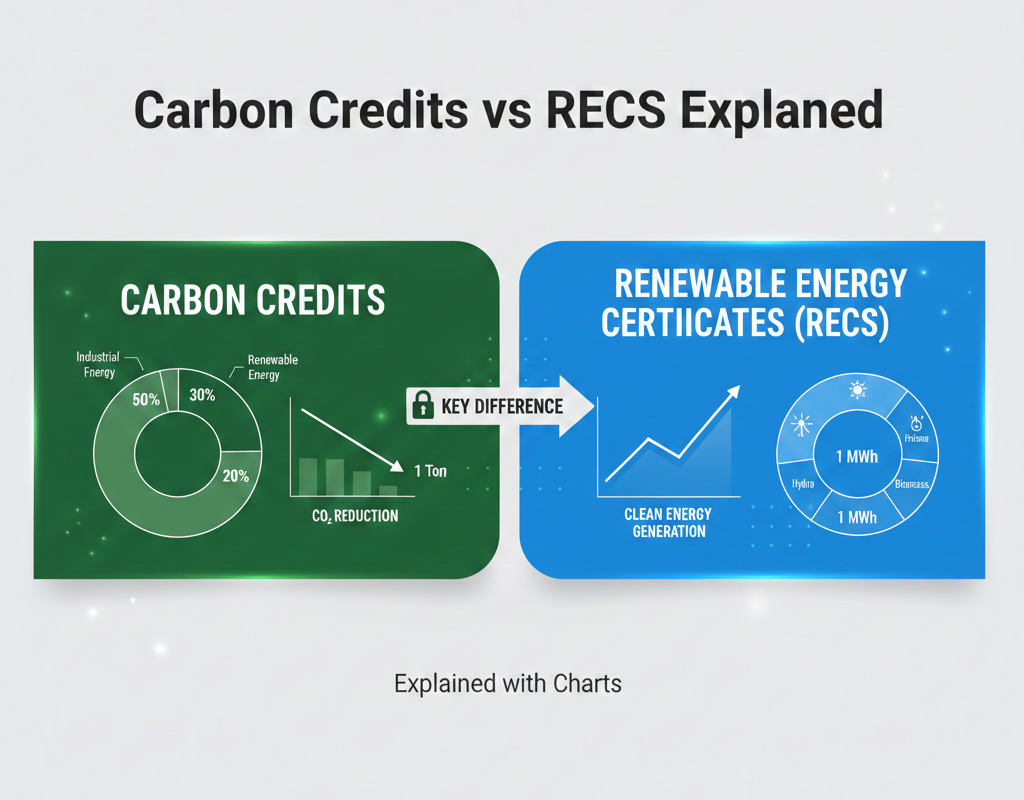
Carbon Credit vs REC Market in 2026
Carbon Credit vs REC Market in 2026
Businesses and governments are looking for more ways to lessen their environmental effect as the pace of global climate change increases. Renewable energy certificates (RECs) and carbon credits are two frequently debated tools in this endeavor. Both support sustainability, but they have different functions, operate in various markets, and offer special advantages to businesses trying to reach net-zero emissions.
This article examines the main distinctions between carbon credits and RECs, discusses their function in carbon trading, and offers charts to help readers better grasp how they work in real-world scenarios.

Carbon Credits: What Are They?
The right to emit one metric ton of carbon dioxide (CO₂) or its equivalent in other greenhouse gases is represented by carbon credits, which are tradable certificates or licenses. They are an essential instrument in carbon markets, enabling businesses to invest in initiatives that lower or eliminate greenhouse gas emissions from the atmosphere.
Crucial Elements of Carbon Credits:
- One metric ton of CO2 or an equivalent greenhouse gas that has been reduced or eliminated is represented by each credit.
- Reforestation, renewable energy, methane capture, and energy efficiency projects are among the projects that qualify for carbon credits.
Carbon credits can be compliance-based (governed by government initiatives like the EU Emissions Trading System) or voluntary (purchased by businesses to achieve environmental goals).
Renewable Energy Certificates: What Are They?
Market-based Renewable Energy Certificates (RECs) attest to the fact that one megawatt-hour (MWh) of electricity was produced using renewable energy sources like biomass, solar, or wind. RECs, as opposed to carbon credits, reflect energy generation as opposed to emissions reductions.
Important REC Features:
- One MWh of renewable electricity is equivalent to one REC.
- Companies can claim the environmental advantages of renewable energy without actually using it by purchasing a REC.
By giving green energy providers additional revenue streams, RECs aid in the expansion of the markets for renewable energy.
How RECs and Carbon Credits Interact?
Even though RECs and carbon credits are different tools, they can work in tandem to create a comprehensive sustainability plan. Many businesses use two strategies:
- Utilize RECs to Source Renewable Energy: Use renewable energy certificates to offset your electricity use.
- Offset Emissions Using Carbon Credits: Take care of any leftover emissions from production, transportation, and other non-renewable energy sources.
Compliance vs. Voluntary Markets
Though their scope and regulations are different, carbon credits and RECs both function inside voluntary and regulated frameworks:
- Credits for Carbon
- Compliance Market: Required programs such as California Cap-and-Trade or the EU ETS.
- Voluntary Market: Businesses buy credits to reach their own ESG or net-zero targets.
- RECs
- Compliance Market: Some nations or jurisdictions require the use of renewable energy (for example, the United jurisdictions’ Renewable Portfolio Standards).
- Voluntary Market: Businesses purchase RECs to declare their use of renewable energy without being bound by the law.
Market Patterns and Prospects
Government laws and increased climate awareness are driving the rapid growth of the carbon credit and REC markets:
- Global carbon credit sales are predicted to reach $200 billion by 2030. Carbon trading, business net-zero pledges, and global accords like the Paris Accord all drive growth.
- REC Market: State-level renewable mandates, corporate sustainability commitments, and the use of renewable energy are driving growth.
Important Motivators
- Corporate ESG Initiatives: Businesses are disclosing more information on their use of renewable energy sources and carbon emissions.
- Government Policies: Market expansion is fueled by subsidies, renewable energy requirements, and carbon pricing laws.
- Investor Pressure: ESG-conscious investors push businesses to employ RECs and carbon credits.
How Companies Can Use RECs and Carbon Credits?
For businesses looking to increase their effect on sustainability:
- Determine the sources of emissions from all operations to evaluate the carbon footprint.
- Establish Specific Objectives: Select renewable or net-zero energy goals.
Choose the Right Instruments:
- Carbon credits: For emissions that cannot be avoided.
- RECs: For claims pertaining to renewable energy and electricity consumption.
- Verify and Monitor: For both carbon credits (VCS, Gold Standard) and RECs, use third-party certification.
- Report Openly: Incorporate purchases of renewable energy and offsets into ESG reports.
In conclusion: Carbon Credit vs REC Market in 2026
Knowing the difference between carbon credits and RECs is essential in the fight to net-zero emissions and sustainable operations. While RECs encourage the deployment of renewable energy, carbon credits concentrate on mitigating greenhouse gas emissions. Businesses can benefit greatly from both techniques, but for the greatest financial and environmental impact, they must be wisely combined.
These distinctions are made clear by charts and other visual aids, which assist businesses in making well-informed decisions regarding sustainability planning. Since markets are growing quickly and regulations are becoming more stringent, it is imperative for companies who want to be prepared for the future to incorporate carbon credits and RECs into their corporate strategies.
Analyst’s Guide to Carbon Credits: Comprehensive Glossary & Market Terms
Analyst’s Guide to Carbon Credits: Comprehensive Glossary & Market Terms