
 Aksh
Aksh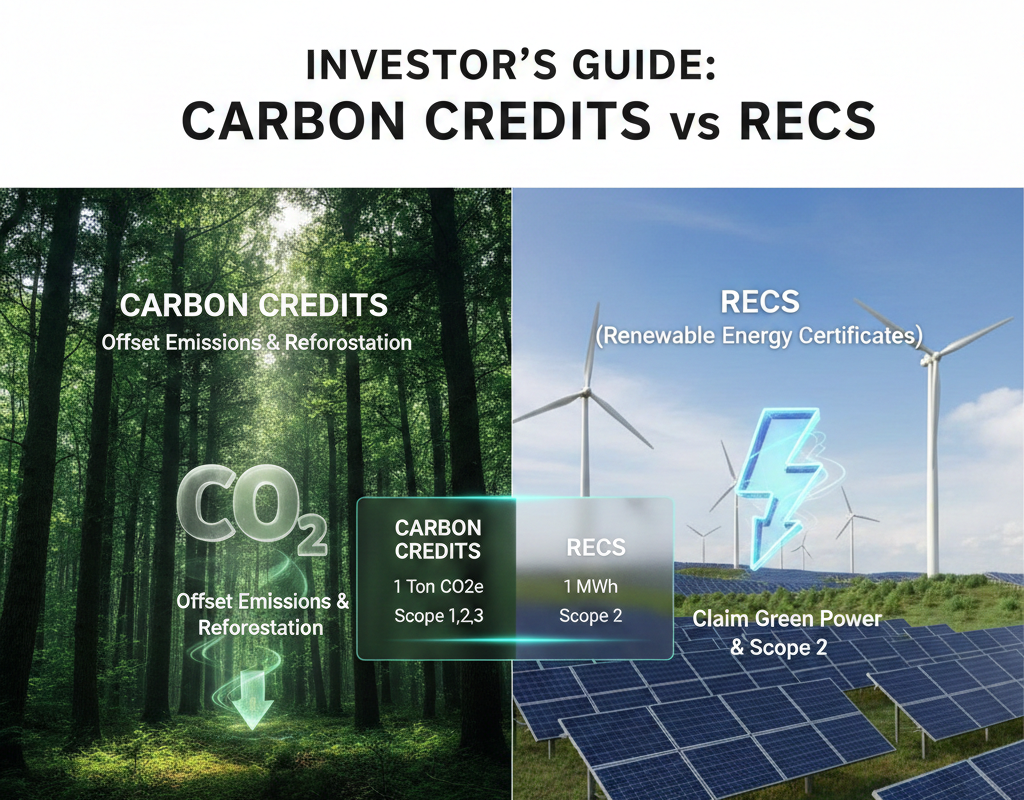
Investors for Carbon Credits vs RECs
Investors for Carbon Credits vs RECs
Carbon credits and Renewable Energy Certificates (RECs) are the two environmental tools that dominate corporate sustainability strategies and investment portfolios in the rapidly changing field of climate finance. Both asset classes are essential to emerging climate markets, corporate net-zero pledges, and emissions reduction. Understanding the distinctions, dangers, growth drivers, and strategic value of carbon credits versus RECs is crucial for investors looking to invest in climate finance.
This thorough news analysis breaks down these processes, makes sense of investor viewpoints, and offers a look ahead at how these markets interact, differ, and influence sustainable investing in the future.

-
Carbon Credits: What Are They? Knowing the Fundamentals
According to established procedures, a carbon credit is the decrease or removal of one metric ton of carbon dioxide (CO₂) or CO₂ equivalent (CO₂e) from the atmosphere. Projects that actively remove carbon (such as afforestation/reforestation, soil carbon sequestration, or carbon capture technology) or avoid emissions (such as renewable energy or energy efficiency projects) produce these credits.
Companies and institutions buy carbon credits to offset their emissions or meet regulatory requirements, providing investors with a monetizable environmental asset. Either voluntary carbon markets, where businesses and individuals choose to offset emissions, or compliance markets, where governments impose emissions limitations, are used to issue credits.
-
What Are Certificates of Renewable Energy (RECs)? Essentials for Investing?
The environmental characteristics of electricity produced from renewable energy sources like solar, wind, biomass, or hydroelectric power are represented by Renewable Energy Certificates (RECs), often known as green tags, in contrast to carbon credits. A REC is generated for each megawatt-hour (MWh) of renewable power that is added to the grid.
Although RECs and carbon credits both promote climate action, RECs are designed to address Scope 2 emissions, or indirect emissions related to electricity use, and they enable businesses to claim the use of renewable energy even if they are not producing it directly.
-
Crucial Distinctions Between Carbon Credits and RECs That Investors Need to Understand
Since they are both tradable environmental assets linked to climate action, carbon credits and RECs seem to be similar at first glance. Nonetheless, investors who want to distribute capital as efficiently as possible need to be aware of these key distinctions:
- Impact and Purpose
- Carbon credits are used to offset overall greenhouse gas footprints and represent particular emissions reductions or removals across scopes 1, 2, and 3.
- RECs: Prioritize reducing the carbon footprint of power use (Scope 2).
- The Dynamics of the Market
- Historically, carbon credits have included a wider range of projects, including avoidance, technology, and nature-based solutions.
- RECs are intimately linked to the production of renewable energy, and the dynamics of the power market, the use of renewable energy, and regulatory frameworks all affect how much they are worth.
-
Carbon Credits as an Investment Consideration
- Growth of the Market and Investor Interest
The markets for carbon credits are changing quickly. A renewed chance for foreign investors and climate finance stakeholders to get involved in emissions reduction initiatives is being signaled by certain countries’ reintroduction of international trade in carbon credits.
Additionally, companies are being pushed toward carbon credit purchases as a crucial tactic to reduce emissions that cannot be reduced through operational adjustments due to CSR-driven investment strategies and net-zero promises.
- Opportunities for Strategic Investors
High-quality carbon credits may present an attractive value proposition for long-term investors, especially those linked to removals and verifiable nature-based programs. Credits that promote co-benefits including resilience, sustainable community development, and biodiversity conservation are attracting more and more investors.
-
RECs: Investment Considerations
- Corporate Demand and Market Stability
Due to their direct alignment with businesses’ renewable energy procurement strategy, Renewable Energy Certificates present a more reliable value proposition for investors. Businesses can declare using renewable energy without having to produce it on-site by purchasing RECs.
Because of long-term renewable energy purchase agreements and business environmental goals, RECs frequently offer steady revenue streams.
- Dangers and Criticisms of “Greenwashing”
Critics contend that RECs can be exploited as a kind of greenwashing, enabling businesses to claim renewable consumption while maintaining high emissions elsewhere, even though they clearly demonstrate renewable energy credentials.
Investors ought to think about:
- The RECs’ geographic origin
- Vintage and additionality of REC
Whether REC purchases are a component of standalone accounting systems or comprehensive decarbonization plans
-
Investor Comparative Analysis
The choice between carbon credits and RECs is not binary for diversified climate investment portfolios. Everybody plays a part:
- Carbon Credit for Extensive Decarbonization
For businesses and investors aiming to reduce deep emissions in industries like heavy manufacturing, aviation, or supply chain footprints where direct reductions are not feasible, carbon credits are frequently more pertinent.
- RECs for the Adoption of Renewable Energy
For investors looking to get exposure to the deployment of renewable energy and the decarbonization of electricity consumption, RECs are the most efficient option. Institutional investors and companies with renewable energy objectives find them especially appealing.
-
Strategic and Regulatory Perspective
The rules governing RECs and carbon credits are changing:
- In nations like India, new national carbon trading programs may incorporate current REC frameworks into more comprehensive carbon credit systems, boosting investor trust and market depth.
- The goal of new accounting rules for environmental credits in major economies is to improve investor transparency by standardizing reporting and valuation.
-
Conclusion: Investors for Carbon Credits vs RECs
Both carbon credits and RECs present attractive but different opportunities for climate-aligned investment for investors navigating climate finance. While RECs encourage the expansion of renewable energy sources and business clean energy claims, carbon credits address larger emissions scopes and can finance deep decarbonization projects.
Market fundamentals, regulatory changes, risk factors, and strategic investment objectives can all help investors improve their portfolios for both financial resilience and environmental impact.
The complex relationship between carbon credits and RECs will continue to influence climate finance narratives and investment flows globally as sustainability becomes a key component of international investment strategy.
India Carbon Credit Glossary for Regulatory Compliance: Terms Every Company Should Know
India Carbon Credit Glossary for Regulatory Compliance: Terms Every Company Should Know