
 Aksh
Aksh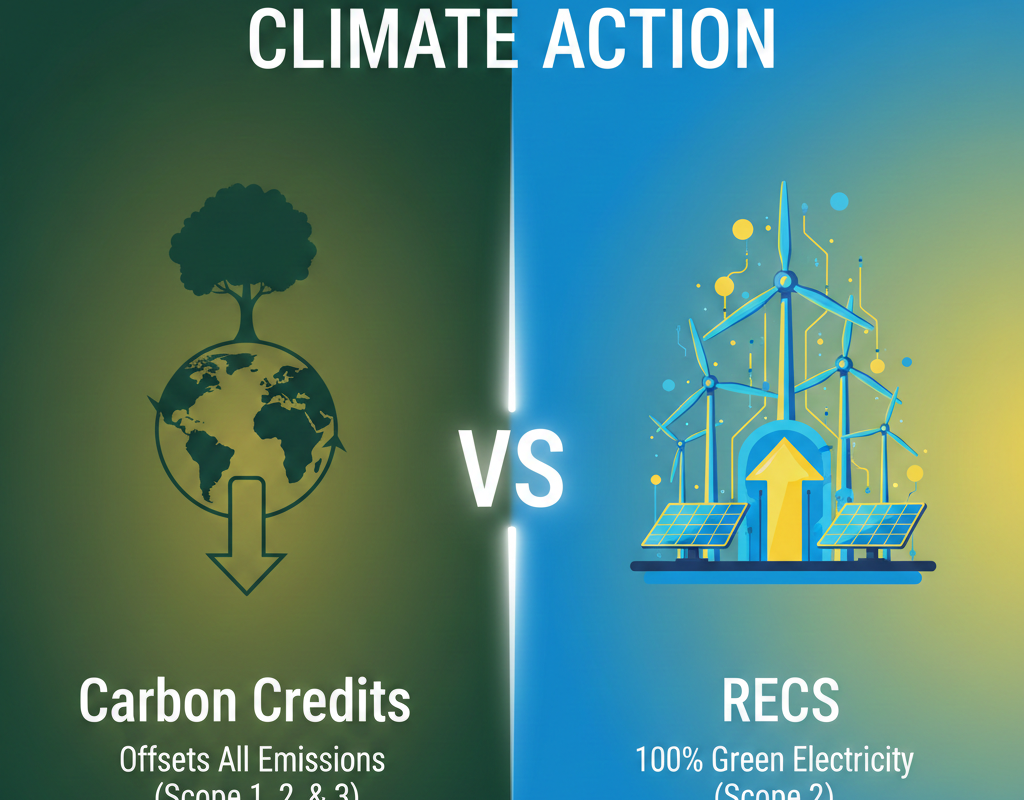
Climate Action in India: Carbon Credits vs RECs
Climate Action in India: Carbon Credits vs RECs
Climate action is becoming a business, environmental, and economic priority rather than a far-off legislative goal. Market-based tools like Carbon Credits and Renewable Energy Certificates (RECs) are crucial as India reaffirms its commitment to cutting greenhouse gas emissions and moving toward clean energy.
Structured climate solutions that not only lower emissions but also produce quantifiable financial value are being investigated more and more by companies, investors, project developers, and legislators. However, when comparing RECs with Carbon Credits, confusion frequently occurs. While both support sustainability goals, they serve distinct purposes within India’s evolving climate ecosystem.

India’s Dedication to Climate Action
India has established itself as a leader in climate responsibility on a global scale. The nation wants to raise the proportion of non-fossil fuel energy capacity and drastically lower emissions intensity as part of its international obligations. These lofty goals necessitate business involvement, transparent trading systems, and creative financing methods.
India uses two important tools to accomplish this:
- Emission Reduction Units, or carbon credits
- Certificates of Renewable Energy (RECs)
Despite being frequently brought up simultaneously, these tools serve distinct sustainability goals and function in various markets.
Carbon Credits: What Are They?
Verified decreases or eliminations of greenhouse gas emissions are represented by carbon credits. One metric ton of carbon dioxide (CO₂) or its equivalent that has been decreased or removed from the atmosphere is usually equivalent to one carbon credit.
These credits are produced by initiatives that actively cut emissions, like:
- Renewable energy initiatives (biomass, wind, and solar)
- Initiatives for energy efficiency
- Methane capture initiatives
- Reforestation and replanting
- Enhancements in waste management
These credits can be exchanged in voluntary carbon markets or compliance markets after being validated in accordance with accepted standards.
India’s Carbon Market Types
- Market for Compliance Carbon
The government regulates this market. In order to comply with rules, companies that exceed emission limitations are required to purchase carbon credits.
- Market for Voluntary Carbon
As part of their ESG responsibilities, businesses voluntarily buy carbon credits to offset their emissions and reach net-zero goals.
In order to increase credibility, liquidity, and transparency, India is actively fortifying its domestic carbon market infrastructure.
Renewable Energy Certificates (RECs): What Are They?
Market-based tools known as Renewable Energy Certificates (RECs) attest to the fact that power was produced using renewable energy sources.
One megawatt-hour (MWh) of renewable power produced and sent to the grid is represented by one REC.
RECs do not directly reduce emissions, in contrast to carbon credits. Rather, they enable obligated firms fulfill Renewable Purchase Obligations (RPOs) by proving that renewable power has been generated.
The Indian RECs’ Objective
Large industrial users and distribution corporations are among the electrical consumers in India who are required to buy a set proportion of their electricity from renewable sources. With RECs, you can achieve these goals without having to make direct investments in renewable infrastructure.
The mechanism of REC:
- Promotes the development of renewable energy
- Gives producers of green energy more money.
- Aids required entities in achieving compliance goals
- Encourages the growth of clean energy
The Role of Carbon Credits in Climate Action
A strong financial incentive to lower emissions is offered by carbon credits. By making emission reductions profitable, they promote:
- Deployment of clean energy
- Land use that is sustainable
- Investments in energy efficiency
- Control of industrial emissions
- Conversion of waste to energy
Businesses that are unable to instantly eliminate emissions might buy carbon credits from verified projects to offset any remaining emissions.
This adaptability encourages green investment and speeds up national carbon reduction initiatives.
How RECs Promote the Growth of Renewable Energy?
RECs are essential to India’s efforts to increase its capacity for renewable energy. They enable producers of renewable energy to make more money than just selling power.
Renewable energy projects are more financially feasible and draw private investment because to this dual revenue model.
RECs guarantee the continued economic viability of renewable power generation as India increases its solar and wind power capacity.
Market Trends: India’s Carbon Credits
India’s carbon market is expanding as a result of:
- Corporate net-zero commitments have increased.
- Growing requirements for ESG reporting
- Investor interest in sustainability is growing.
- Demand for superior credits worldwide
- Development of a carbon market supported by the government
Carbon offset plans are being included into the sustainability frameworks of major Indian enterprises. In the upcoming years, there will likely be a major increase in demand for high-integrity carbon credits.
Prospects for Investing in Carbon Credits
There are various benefits to investing in carbon credits.
- Diversification of Revenue
An extra source of revenue is generated for project developers.
- Worldwide Demand
Global consumers go to emerging economies for high-quality financing.
- Integration of ESG
Credible carbon plans are a top priority for investors.
- Value Over Time
Demand for borrowing may rise as carbon laws become more stringent.
India is positioned as a powerful source of carbon credits due to its varied project portfolio, which includes forestry, renewable energy, and methane capture.
In conclusion: Climate Action in India: Carbon Credits vs RECs
In India’s framework for climate action, carbon credits and renewable energy certificates have distinct but complementary functions.
Carbon credits help achieve net-zero emissions by lowering greenhouse gas emissions.
RECs encourage the production of renewable energy and guarantee that renewable procurement commitments are met.
Businesses need to know how to strategically employ both tools in a comprehensive climate roadmap if they want to ensure a sustainable future.
Carbon Credit Terminology for Corporates: A Complete Guide to Offsetting and Net Zero
Carbon Credit Terminology for Corporates: A Complete Guide to Offsetting and Net Zero