
 Aksh
Aksh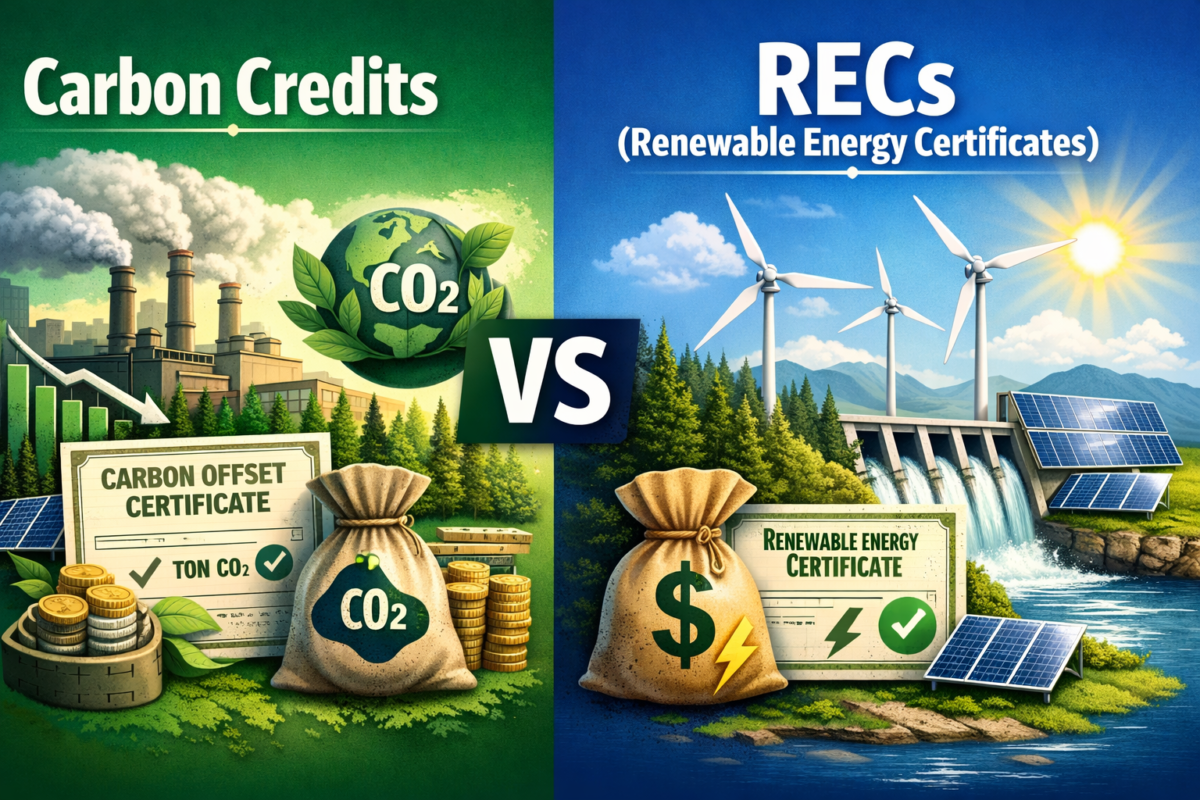
Policy Makers Shape Future of Carbon Credits vs RECs
Policy Makers Shape Future of Carbon Credits vs RECs
The urgency of the global climate agenda has increased in recent years, forcing countries to implement all-encompassing plans to reduce greenhouse gas emissions and make the transition to low-carbon economies. The efficient use of market-based tools like carbon credits and renewable energy certificates (RECs), which are essential policy instruments for cutting emissions and encouraging the growth of clean energy, is essential to this shift.

Recognizing Carbon Credits and RECs: Policy Background and Differences
A key difference between carbon credits and renewable energy certificates is at the heart of climate market policy. Quantified decreases in greenhouse gas emissions attained through validated climate programs are represented by carbon credits. These credits allow organizations to offset emissions that cannot be directly reduced and are exchanged in voluntary and compliance markets. Renewable energy certificates, on the other hand, attest to the fact that one megawatt-hour of power was produced using renewable energy. RECs serve mainly as an accounting and tracking tool that encourages the production of renewable energy and is independent of carbon reduction initiatives.
Although both methods support environmental goals, policy makers in India and around the world understand that their functions are fundamentally distinct. By giving emission reductions a monetary value, carbon credits directly address emissions mitigation. Conversely, RECs guarantee that the production of renewable energy is acknowledged and valued economically in energy markets. Harmonizing these frameworks to minimize market distortions, overlap, and double counting while optimizing climate effect is the policy problem.
India’s Climate Policy Environment: Objectives for Renewable Energy and Carbon Credits
Ambitious goals, such as a large decrease in emissions intensity and an expansion of renewable energy capacity, serve as the foundation for India’s commitment to climate action. In order to speed up the energy transition and emission reductions, policymakers have integrated carbon credits and renewable energy certificates into this larger plan by utilizing incentives and regulatory tools.
National goals and legal requirements supporting solar, wind, and other clean energy sources have driven India’s renewable energy narrative. RECs have been essential to this endeavor because they provide proof of renewable generation and make it possible for utilities and major consumers to comply with renewable purchasing requirements.
RECs vs. Carbon Credits: How Do Policymakers View Market Integrity?
Keeping the market integrity of carbon credits and RECs is one of the top priorities for policymakers. The legitimacy, openness, and environmental efficiency of the trading systems supporting these instruments are referred to as market integrity. When poorly regulated, either market can become vulnerable to loopholes, inflating perceived environmental benefits without actual impact.
Due to problems including duplicate counting, dubious baseline assumptions, and a lack of standardized verification, carbon credits have come under fire. To guarantee that carbon credits actually aid in climate mitigation, policymakers are reacting by strengthening regulatory control, including strict accounting requirements, and mandating independent verification.
Overlap, Double Counting, and Market Confusion as Policy Challenges
Despite improvements in policy, it is still difficult to distinguish carbon credits from RECs and get rid of accidental overlap. The legitimacy of both markets is threatened by double counting, which occurs when the same environmental benefit is reported in several methods. Theoretically, for instance, the production of RECs from renewable energy sources may also lower carbon emissions, which could then be sold as carbon credits. In the absence of well-defined policy limits, organizations may assert both, so exaggerating the environmental advantage.
Policymakers are attempting to create explicit regulations that prohibit the simultaneous use of RECs and carbon credits in order to address this issue. This entails outlining the parameters of carbon accounting, elucidating the ways in which the production of renewable energy contributes to the reduction of emissions, and determining which industries and project kinds are eligible to get carbon credits.
International Teachings and Domestic Adjustment: Techniques for Policymakers
India’s policymakers are not functioning in a vacuum; they are keeping a careful eye on world events and using what they learn to their own internal concerns. A model for enhancing carbon market governance and renewable energy incentives is provided by international climate accords and market developments.
The growing use of economy-wide carbon pricing schemes is one worldwide trend impacting policymakers. By giving greenhouse gas emissions a cost, these systems generate market signals that incentivize sector-wide emission reductions. Policymakers are investigating sector-specific pricing schemes and carbon trading platforms that could supplement current frameworks for carbon credits and RECs, even though India has not yet put in place a national carbon pricing mechanism.
Effects on Corporate Sustainability and India’s Energy Sector
Corporate sustainability initiatives and India’s energy sector are significantly impacted by the policy frameworks governing carbon credits and RECs. RECs give utilities and consumers a vital way to show that they are meeting renewable energy targets as India grows its potential for renewable energy. By using RECs to account for clean energy usage, companies with ambitious sustainability targets are strengthening their environmental obligations.
For businesses looking to become net zero or carbon neutral, carbon credits increase their toolkit. Companies can invest in verified carbon reduction projects to generate credits that offset inevitable emissions if they are unable to completely eliminate emissions through operational adjustments. Making sure that these credits are transparent, believable, and in line with the national climate is a major responsibility of policymakers.
Future Paths: Market Development and Policy Innovation
Policymakers are concentrating more on innovation and improvement in carbon credit and REC governance as the urgency of climate change increases. Future policy directions include expanding market mechanisms to cover more sectors, integrating blockchain technology to minimize double counting, and improving digital infrastructure for certificate tracking and issuance.
The relationship between carbon credits, RECs, and new sustainability frameworks like green bonds and environmental, social, and governance reporting criteria is also being investigated by policymakers. Transparency may be increased and funding for climate solutions can be directed by combining the carbon and renewable energy markets with more comprehensive sustainability reporting.
Conclusion: Policy Makers Shape Future of Carbon Credits vs RECs
One of the key policy opportunities and challenges for India’s climate agenda is the interaction between carbon credits and renewable energy certificates. Enabling strong market mechanisms that draw investment, protect the environment, and hasten carbon reductions while avoiding overlap, misunderstanding, and market distortions is a difficult balance that policymakers must achieve. Policymakers in India are influencing the development of carbon credits and RECs as supplementary instruments in the country’s shift to a sustainable future by establishing clear legislative frameworks, strict verification requirements, and incentives that are in line with each other.
Policymakers will continue to be at the forefront of innovations that propel effective climate action as the global climate picture changes. India’s progress in improving renewable energy subsidies and carbon market regulations provides insights into how other countries might use market forces to accomplish challenging environmental objectives.
Carbon Trading and Carbon Offset Glossary Explained for Beginners
Carbon Trading and Carbon Offset Glossary Explained for Beginners