
 Aksh
Aksh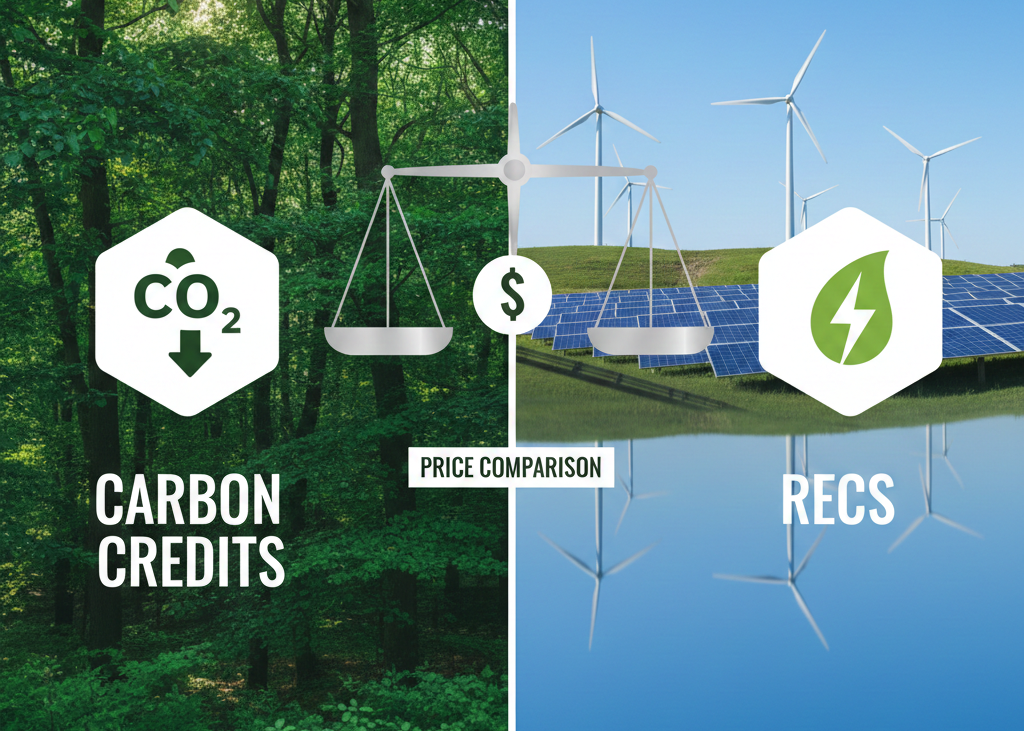
Detailed Analysis of Carbon Credits vs RECs Prices
Detailed Analysis of Carbon Credits vs RECs Prices
Environmental commodities like carbon credits and renewable energy certificates (RECs) have become essential components of business sustainability plans as India moves closer to its net-zero pledges and fortifies its climate action legislation. The market potential, regulatory frameworks, and price dynamics of these two instruments are being assessed more and more by companies, investors, and legislators.
Businesses looking for affordable alternatives to decarbonize must comprehend how carbon credits and RECs compare in terms of price. Both tools promote environmental objectives, although they differ greatly in terms of pricing, demand, and market dynamics. Their pricing trends, impacting variables, regulatory environment, and investment forecast in India for 2026 and beyond are all examined in this thorough analysis.

Comprehending Carbon Credits
A quantifiable decrease of one metric ton of carbon dioxide (CO₂) or its equivalent in other greenhouse gases is represented by carbon credits. Verified climate projects like methane capture, afforestation initiatives, renewable energy installations, and energy efficiency upgrades are the source of these credits.
Carbon credits are available in two main marketplaces worldwide:
- Marketplaces for compliance that are governed by emission trading programs.
- Companies buy credits in voluntary carbon markets (VCM) to reach sustainability goals they have set for themselves.
In accordance with international frameworks like the Paris Agreement, India is now developing its carbon trading systems under the Carbon Credit Trading Scheme (CCTS). It is anticipated that pricing transparency and liquidity would greatly improve as regulatory certainty grows.
Understanding Certificates of Renewable Energy (RECs)
A Renewable Energy Certificate (REC) is evidence that one megawatt-hour (MWh) of electricity was produced using renewable resources like biomass, solar, wind, or hydropower. The main purpose of RECs is to fulfill Renewable Purchase Obligations (RPOs) that are required by regulatory bodies.
The Central Electricity Regulatory Commission (CERC) oversees the REC market in India. Compared to voluntary carbon markets, power exchanges make trading easier and pricing more transparent.
India’s REC Price Trends
Over the last ten years, supply surpluses, shifting RPO targets, and regulatory actions have all contributed to the volatility of REC pricing.
According to current trading trends:
- Depending on the balance between supply and demand, REC prices normally range from ₹800 to ₹2,500 per certificate.
- Price stability was impacted by past price floors and caps.
Market Transparency and Liquidity
India’s carbon markets are still developing. Because of bilateral negotiations and different certification requirements, voluntary markets might not have standardized pricing. Digital trading platforms, however, are increasing efficiency and transparency.
Standardized contracts and well-established power exchanges help REC markets by providing more transparent procedures for price discovery.
It is anticipated that carbon credit markets will experience comparable liquidity benefits when India formalizes its carbon trading mechanism.
Regulatory Environment and Prospects
Establishing a structured carbon market in line with international best practices is the goal of India’s climate policy agenda. The demand for domestic carbon credits may rise sharply as compliance carbon trading mechanisms are expanded.
In order to better enforce Renewable Purchase Obligations and align with more general sustainability objectives, REC markets are also undergoing adjustments.
Among the major themes influencing 2026 and beyond are:
- Carbon market integration with global frameworks
- Increased requirements for corporate ESG disclosure
- More stringent enforcement of renewable compliance
- Expansion of the clean energy and green hydrogen industries
- Digitization of commerce in environmental commodities
Prices for carbon credits may progressively increase as regulatory certainty grows, closing the affordability gap with respect to international markets.
Strategic Suggestions for Indian Companies
- Make a thorough inventory of emissions.
- Analyze your responsibilities for regulatory compliance.
- Examine the cost of carbon abatement per ton.
- Diversify your approaches to acquiring environmental assets.
- Keep an eye on changing carbon market regulations.
In order to comply with international sustainability reporting rules, businesses striving for global competitiveness may favor premium carbon credits more and more.
In conclusion: Detailed Analysis of Carbon Credits vs RECs Prices
The “better” choice relies on business goals, according to a price comparison of carbon credits and RECs in India.
- Carbon credits offer wider effect coverage for net-zero commitments and direct carbon offsetting.
- RECs continue to be crucial for power consumption claims and renewable energy compliance.
When compared to international standards, carbon credits are now reasonably priced in India, offering a compelling case for early adoption. Although RECs provide structured compliance benefits, they are impacted by changes in domestic policy.
Both markets are anticipated to grow dramatically as carbon trading mechanisms develop and India fortifies its climate obligations. Businesses will be better prepared for a low-carbon future if they strategically participate in environmental commodity markets today.
In India’s sustainable economy, the changing landscape of carbon credits and renewable energy certificates signifies a radical change in the way environmental value is quantified, exchanged, and monetized. It is not only about compliance.
2 Comments