
 Aksh
Aksh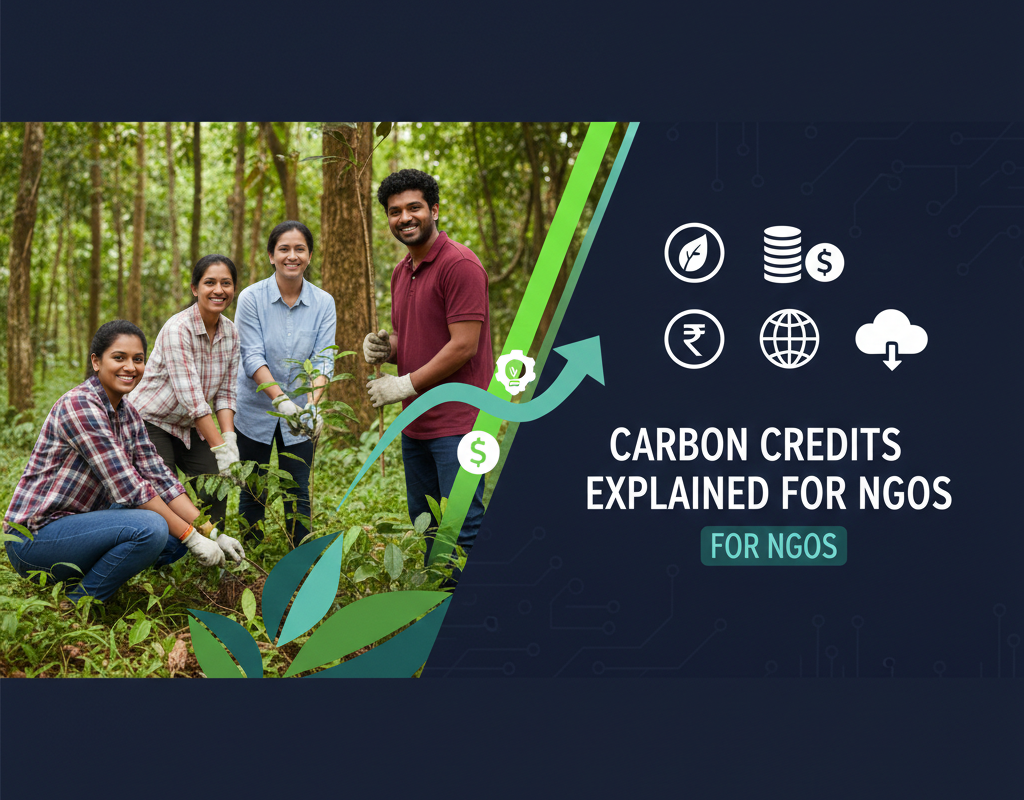
A Comprehensive Guide to Carbon Credits for NGOs
A Comprehensive Guide to Carbon Credits for NGOs
One of the most pressing issues of our day is climate change, which has an impact on ecosystems, livelihoods, public health, and economic stability. By carrying out grassroots initiatives, influencing legislation, and raising awareness, non-governmental organizations (NGOs) play a crucial part in tackling these issues. Carbon credits have been more well-known in recent years as a potent instrument for balancing financial sustainability with environmental impact.
Understanding carbon credits has become crucial for NGOs involved in waste management, forestry, renewable energy, climate action, rural development, and social upliftment. This article provides a thorough explanation of carbon credits with an emphasis on how NGOs can use them to improve environmental results and open up new financing opportunities.

The Fundamentals of Understanding Carbon Credits
One metric tonne of carbon dioxide or its equivalent in other greenhouse gases is reduced or removed from the atmosphere to create a carbon credit. These decreases are made possible by particular initiatives that actively remove carbon from the atmosphere or stop emissions from happening.
In order to lower global greenhouse gas emissions, carbon credits are a component of larger climate plans. Carbon credit producers can sell their credits to organizations looking to offset their emissions, generating a market-driven incentive for climate-friendly behavior.
The Importance of Carbon Credits to NGOs
Because of their long-term involvement with local ecosystems, community reach, and trust, NGOs are in a unique position to carry out effective carbon reduction projects. NGOs can benefit from carbon credits by:
- Profit from environmental effect without sacrificing the integrity of your mission
- Achieve long-term climate projects’ financial sustainability
- Expand effective therapies in different areas
- Draw in global climate funding and collaborations
- Increase impact reporting’s legitimacy and openness
Carbon credits help many NGOs close the gap between relying on donors and doing independent environmental action.
How Carbon Credits Operate: A Comprehensive Guide?
The following phases are commonly included in the carbon credit lifecycle:
- Identification of the Project
An NGO finds a project that has the potential to eliminate or drastically cut greenhouse gas emissions. Examples include methane capture projects, clean cooking solutions, afforestation, and renewable energy installations.
- Initial Evaluation
To determine what emissions would have happened in the absence of the project, a baseline is set. To show genuine influence, this is essential.
- Observation and Quantification
Approved methods and data gathering procedures are used to quantify emissions reductions.
- Confirmation
The fact that the emissions reductions are actual, quantifiable, and extra is confirmed by an impartial third party.
- Carbon Credit Issuance
Carbon credits are given after verification and are then available for purchase or sale on carbon markets.
Carbon Credit Project Types That Are Important to NGOs
- Projects involving forestry and reforestation
While sustaining biodiversity and livelihoods, projects that preserve existing forests or plant new forest cover remove carbon from the atmosphere.
- Projects Using Renewable Energy
Access to renewable energy is made possible by solar, wind, biomass, and small hydro projects, which lessen reliance on fossil fuels.
- Energy Efficiency and Clean Cooking
Energy-efficient devices and better cookstoves lower emissions while enhancing rural households’ health.
- Methane Reduction and Waste Management
High-impact greenhouse gas emissions are greatly decreased by projects that extract methane from agricultural waste or landfills.
- Initiatives for Climate and Water Resilience
Climate-resilient agriculture and water conservation indirectly lower emissions and improve adaption capabilities.
Co-benefits for the environment and society
The capacity of NGOs to provide co-benefits, such as the following, is one of their greatest advantages in carbon markets:
- Reduction of poverty
- Empowerment of women
- Better education and health
- Conservation of biodiversity
- Adaptability to climate change for communities at risk
These co-benefits raise the value of carbon credits and are very compatible with the objectives of sustainable development.
Carbon Credits as a Nonprofit Funding Source
Conventional NGO funding frequently relies on donations and grants, both of which are subject to change. A performance-based revenue stream that is closely linked to quantifiable impact is offered by carbon credits.
Advantages consist of:
- Long-term financing for projects
- Decreased reliance on donors
- Capacity to put money back into community development
- Greater scalability of the project
NGOs may look beyond short-term financing cycles thanks to carbon finance.
Climate Justice and Carbon Credits
Vulnerable groups that contribute the least to global emissions are disproportionately impacted by climate change. NGOs’ carbon credit initiatives help rectify this disparity by allocating climate funds to the most underserved communities.
This strategy ensures that climate solutions are inclusive and equitable by balancing social justice with climate reduction.
Carbon Credits’ Future for Nonprofits
NGOs will become even more important in providing high-caliber, impact-driven programs as the demand for reliable carbon credits rises globally. Participation is becoming more accessible thanks to advancements in satellite data, digital monitoring, and transparency tools.
It is anticipated that corporate net-zero pledges and policy changes will increase the potential for NGO participation in carbon markets.
In summary: A Comprehensive Guide to Carbon Credits for NGOs
Carbon credits serve as a spur for community-driven, sustainable, and scalable environmental action in addition to being a tool for climate finance. They present NGOs with a special chance to secure long-term support while coordinating social development and climate mitigation.
NGOs can increase their influence, build resilience, and make a significant contribution to the worldwide battle against climate change by comprehending how carbon credits operate and carefully incorporating them into their initiatives.
NGOs with expertise in carbon credits will be at the forefront of promoting just and practical climate solutions as the globe transitions to a low-carbon future.
Carbon Credits in India Explained: Complete Guide to India’s Carbon Market, Policies, and Future
Carbon Credits in India Explained: Complete Guide to India’s Carbon Market, Policies, and Future