
 Aksh
Aksh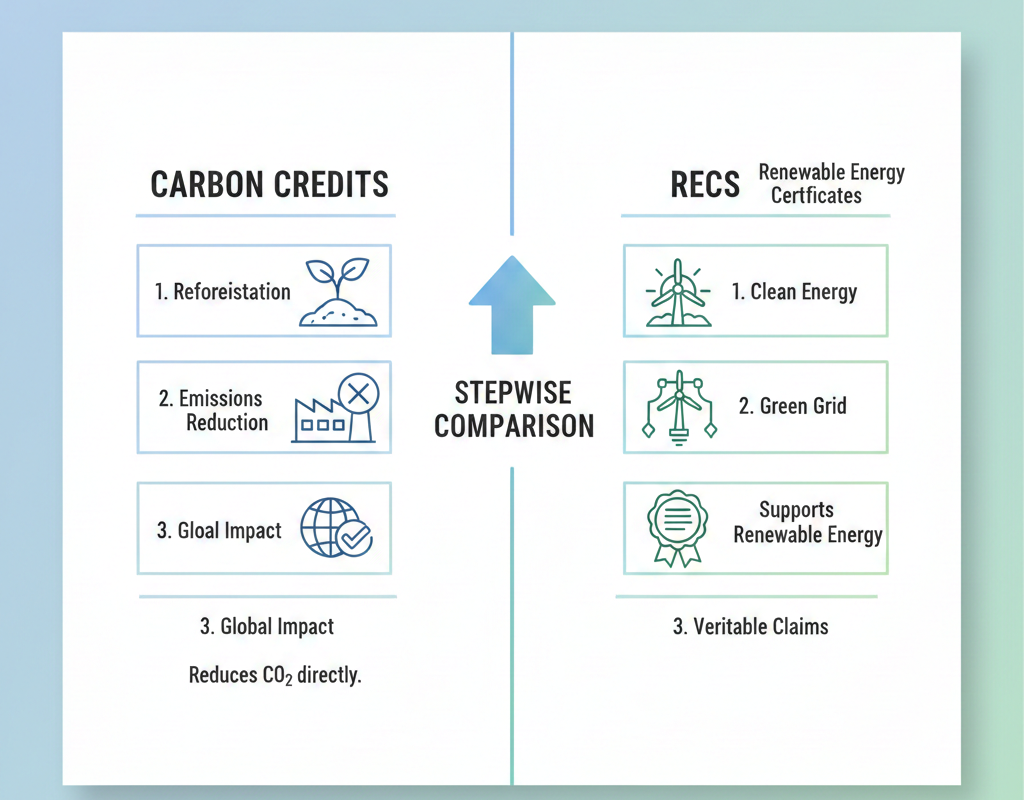
Stepwise Comparison of Carbon Credits vs RECs
Stepwise Comparison of Carbon Credits vs RECs
Governments, businesses, and organizations throughout the world are implementing strategies to lower greenhouse gas emissions and hasten the adoption of renewable energy sources as climate change emerges as one of the major issues of the twenty-first century. Carbon credits and Renewable Energy Certificates (RECs) are two of the most talked-about market-based instruments. Although they both support environmental sustainability, their functions and operating environments are different.
Building a successful ESG and net-zero strategy requires businesses and investors navigating India’s changing sustainability landscape to comprehend the step-by-step comparison of carbon credits vs. RECs.

Step 1: Recognizing the Fundamental Definitions
- Carbon Credits: What Are They?
One metric ton of carbon dioxide (CO₂) or its equivalent in other greenhouse gases can be reduced or removed with the use of carbon credits, which are tradable certifications. These credits are produced by validated climate initiatives like:
- Reforestation and replanting
- Installations of renewable energy
- Initiatives for methane capture
- Enhancements in energy efficiency
- Technologies for carbon capture
In order to achieve voluntary climate commitments or regulatory compliance requirements, organizations buy carbon credits to offset their emissions.
- Renewable Energy Certificates (RECs): What Are They?
One megawatt-hour (MWh) of electricity produced by a renewable energy source is attested by Renewable Energy Certificates (RECs), which include:
- Sunlight
- Wind
- Hydro
- Biomass
The environmental attribute of renewable energy is separated and granted as a REC when it is generated and delivered to the grid. In order to achieve renewable energy targets and claim renewable electricity usage, businesses buy RECs.
Step 2: Environmental Impact and Core Purpose
- Carbon Credits: Emphasis on Emission Reduction
Reducing total atmospheric greenhouse gas emissions is the main objective of carbon credits. A quantifiable and confirmed decrease in emissions relative to a baseline is represented by each credit.
Carbon credits are able to:
- Industrial emissions offset
- Aid businesses in becoming carbon neutral
- Encourage international efforts to mitigate climate change
- Both the voluntary and compliance carbon markets make use of them.
- RECs: Promoting Clean Energy
The purpose of RECs is to encourage the production of electricity from renewable sources. Although they don’t measure carbon reduction directly, they do indirectly reduce emissions by substituting electricity derived from fossil fuels.
RECs are used by organizations to:
- Fulfill your obligations for renewable purchases (RPOs)
- Reach goals for renewable energy
- Show your dedication to clean power.
Step 3: Trading Mechanism and Market Structure
- Market Structure for Carbon Credits
There are two primary markets for carbon credits:
- Market for Compliance
Required by law. Emission caps require businesses to either cut emissions or buy credits.
- Market for Voluntary Carbon (VCM)
Businesses willingly purchase credits to fulfill net-zero or ESG obligations.
The carbon credit market in India is developing quickly as a result of legislative changes that support organized carbon trading platforms.
- India’s REC Market Structure
The power regulatory bodies in India have created standards for the regulation and issuance of RECs. They are subject to Renewable Purchase Obligations and are exchanged through power exchanges.
REC trading entails:
- Certificates are produced by renewable energy producers.
- RECs are being purchased by distribution companies and required entities.
- Supply and demand determine market clearing prices.
Step 4: The Framework for Regulation
- India’s Carbon Credits
With organized structures to promote emission reductions and global carbon markets, India is fortifying its carbon trading environment. Companies need to be aware of changing regulations pertaining to:
- Mechanisms for trading carbon
- International transfers of carbon
- Requirements for ESG reporting
- Standards for climate disclosure
- In India, RECs
The regulatory framework for renewable energy in India governs RECs. Renewable Purchase Obligations must be complied with by required entities, including distribution corporations and specific industrial users.
Strategic Choice: RECs vs. Carbon Credits
Business goals determine whether to use RECs or carbon credits:
- Carbon credits are necessary if complete carbon neutrality is the aim.
- RECs are required if the objective is compliance with renewable electricity.
- Both tools are complementary for an all-encompassing ESG strategy.
In order to boost investor confidence and sustainability reporting, forward-thinking Indian businesses are incorporating both techniques.
In conclusion: Stepwise Comparison of Carbon Credits vs RECs
Businesses, legislators, and sustainability experts in India must comprehend the step-by-step comparison of carbon credits and RECs. Both tools promote climate action, but they have distinct functions in environmental markets.
Carbon credits allow businesses to offset emissions that cannot be avoided and directly reduce greenhouse gas emissions. RECs assist in fulfilling renewable procurement commitments and encourage the production of electricity from renewable sources.
Companies should see carbon credits and RECs as complementing parts of a strong sustainability and ESG strategy, rather than as competing tools. These tools will be crucial in determining a low-carbon future as India fortifies its carbon trading system and renewable energy environment.
How NGOs Can Leverage Carbon Credits vs RECs to Reduce Emissions and Promote Renewable Energy
How NGOs Can Leverage Carbon Credits vs RECs to Reduce Emissions and Promote Renewable Energy