
 Aksh
Aksh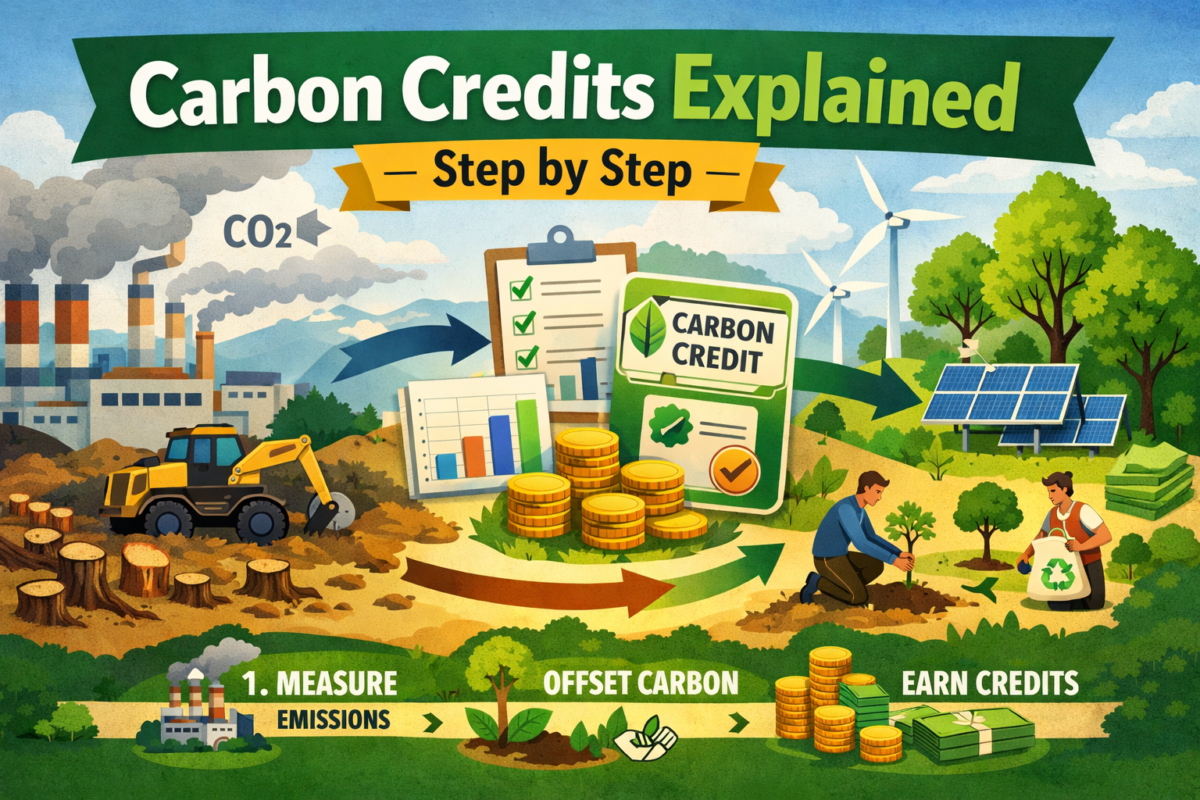
Understanding Carbon Credits Step by Step
Understanding Carbon Credits Step by Step
There is growing pressure on governments, corporations, and individuals to cut back on greenhouse gas emissions as climate change picks up speed and global temperatures continue to climb. The carbon credit is one of the best market-based solutions created to deal with this issue. Although the phrase is frequently used in climate debates, people frequently misunderstand what it actually means and how it operates.
This thorough manual breaks down complicated topics into easy-to-understand, useful ideas, explaining carbon credits step-by-step. Understanding carbon credits is crucial in today’s low-carbon economy, regardless of your role as a corporate leader, legislator, investor, or environmentally conscientious citizen.

Step 1: Recognizing the Issue of Climate Change
The excessive release of greenhouse gases into the atmosphere, including carbon dioxide, methane, and nitrous oxide, is the main cause of climate change. Rising sea levels, harsh weather, biodiversity loss, and economic instability are all consequences of global warming brought on by these gases’ trapping of heat.
Construction, manufacturing, transportation, agriculture, and power generation are some of the industries that contribute significantly to these emissions. Emissions cannot be totally eliminated overnight. Carbon credits can be used as a temporary fix in this situation.
Step 2: How Do You Define Carbon Credits?
The reduction, elimination, or avoidance of one metric tonne of carbon dioxide or its equivalent greenhouse gas from the atmosphere is represented by a tradable certificate known as a carbon credit.
To put it simply:
- One carbon credit is equivalent to one tonne of eliminated or reduced emissions.
Through the backing of proven emission reduction programs, carbon credits enable organizations who are unable to instantly eliminate all emissions to offset a portion of their carbon footprint.
Step 3: The Purpose of Carbon Credits
There are carbon credits to:
- Promote emission reductions where they are most cost-effective and efficient.
- Offer monetary rewards for environmentally friendly initiatives.
- Assist nations and businesses in achieving climate goals
- Encourage clean technology innovation
Carbon credits provide freedom while preserving the integrity of the environment overall, as opposed to requiring all entities to reduce emissions at the same rate.
Step 4: The Operation of Carbon Credits
The basic idea behind the carbon credit system is this:
Trade the advantages where it is most difficult and cut emissions where it is simplest.
Usually, the procedure entails:
- Emissions measurement
- Whenever feasible, lowering emissions
- Utilizing carbon credits to offset residual emissions
- Monitoring and confirming decreases
This establishes a structure for climate action that is transparent, responsible, and measurable.
Step 5: An explanation of carbon credit projects
Approved initiatives that cut or eliminate emissions produce carbon credits. Strict international requirements must be met by these initiatives.
Typical Carbon Credit Project Types
- Projects Using Renewable Energy
Projects that use biomass, solar, wind, and hydropower to replace energy derived from fossil fuels.
- Initiatives for Energy Efficiency
Enhancements to structures, industrial operations, or energy-efficient appliances.
- Projects involving forestry and reforestation
Initiatives to save forests and establish trees that take carbon dioxide out of the atmosphere.
- Projects for Waste Management
Landfill methane capture, composting programs, and waste-to-energy projects.
- Projects for Soil Carbon and Agriculture
Methods that lower agricultural emissions and improve soil carbon storage.
Step 6: The Process of Verification and Certification
Not all reductions in emissions result in carbon credits. Projects have to follow a strict procedure.
- Quantification
Approved scientific methods are used to calculate emission reductions.
- Verification
The project design satisfies the necessary criteria, according to independent auditors.
- Confirmation
Periodically, actual emission reductions are examined.
- Release
Verified reductions are recorded in a registry and given out as carbon credits.
Transparency, legitimacy, and environmental integrity are guaranteed by this procedure.
Step 7: The Fundamental Idea of Additionality
Additionality is a key idea in carbon credits.
Additionality indicates that the decrease in emissions:
- Would not have occurred in the absence of carbon credit funding.
- Is it going beyond routine corporate operations?
The environmental value of carbon credits is diminished in the absence of additionality. The integrity of the carbon market is safeguarded by this premise.
Step 8: Comparing Carbon Offsets and Credits
Although the names are frequently used interchangeably, they differ slightly.
- The validated unit that represents a reduction in emissions is called a carbon credit.
- The practice of using carbon credits to make up for emissions is known as carbon offset.
In reality, companies purchase carbon credits to make up for their inevitable emissions.
In conclusion: Understanding Carbon Credits Step by Step
An effective, market-driven strategy for combating climate change is the use of carbon credits. By converting carbon reductions into quantifiable monetary value, they help close the gap between environmental responsibility and economic growth.
Businesses, legislators, and individuals may make wise decisions and make significant contributions to climate change by properly comprehending carbon credits. Carbon credits will become more and more important in establishing a resilient and sustainable future as India solidifies its place in the world’s carbon markets.
How Carbon Credits Work Step by Step: A Simple Guide to Carbon Credit Mechanism
How Carbon Credits Work Step by Step: A Simple Guide to Carbon Credit Mechanism