
 Aksh
Aksh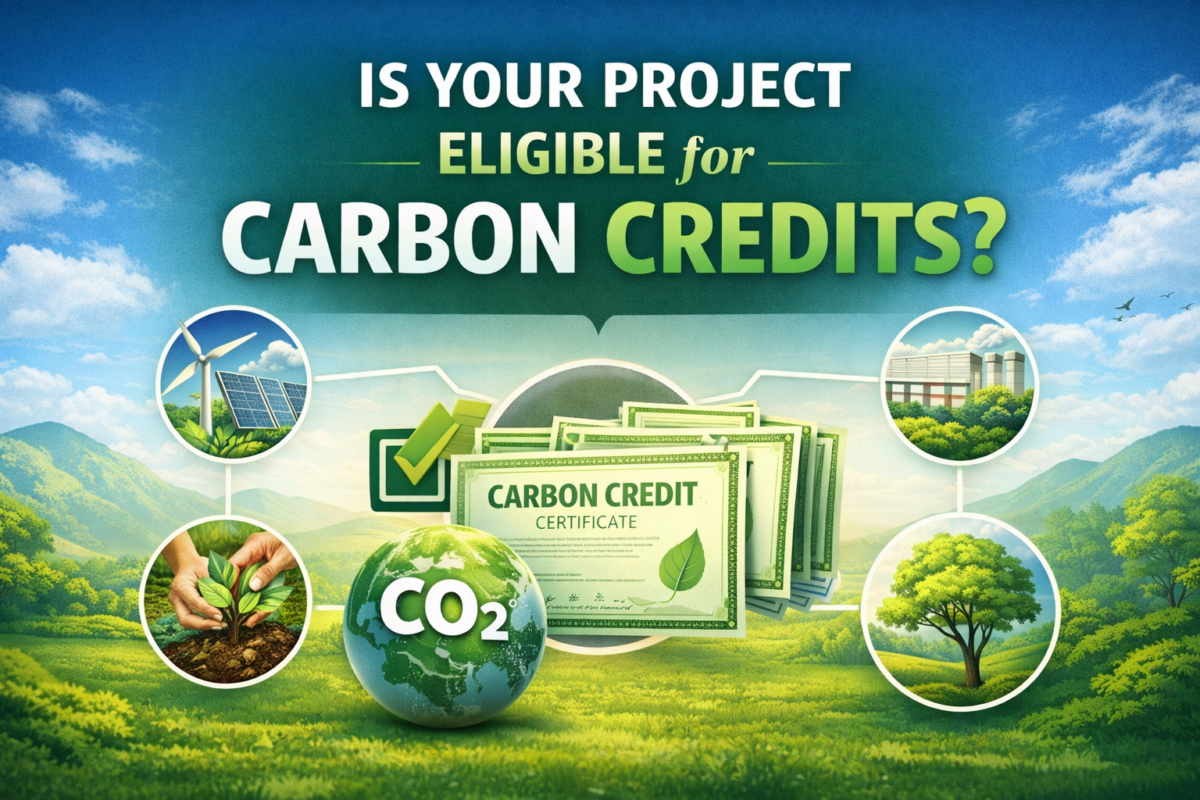
Is Your Project Eligible for Carbon Credits?
Is Your Project Eligible for Carbon Credits?
Carbon credits have become one of the most potent financial instruments for sustainable development as climate action becomes essential to corporate responsibility and economic prosperity. Opportunities for companies to profit from environmental responsibility are growing in India as a result of the country’s efforts to create a structured carbon trading ecosystem, which is being facilitated by initiatives like the Bureau of Energy Efficiency and regulations from the Ministry of Environment, Forests, and Climate Change.
However, the crucial query still stands:
Are carbon credits available for your project?
Whether you are a startup implementing climate technology, a manufacturing company increasing energy efficiency, an agribusiness encouraging regenerative practices, or a producer of renewable energy, knowing your eligibility for carbon credits can open up new revenue streams and international market access.

The Fundamentals of Understanding Carbon Credits
One metric ton of carbon dioxide equivalent (CO2e) removed from the atmosphere is represented by a carbon credit. Businesses looking to offset their emissions can buy or sell these credits.
Two main markets exist:
- Governments regulate the compliance market, where businesses are required to achieve emission targets.
- In order to achieve ESG or sustainability objectives, companies can choose to offset their emissions through the Voluntary Carbon Market (VCM).
Through programs like the Carbon Credit Trading Scheme (CCTS), India is creating a structured carbon trading system in accordance with international climate obligations under the United Nations Framework Convention on Climate Change.
The Significance of Carbon Credits for Indian Companies
India is one of the biggest producers of greenhouse gases and has one of the fastest-growing economies. The nation has pledged to meet challenging climate goals, such as:
- By 2070, achieving net-zero emissions
- Lowering GDP’s emissions intensity
- Increasing the capability for renewable energy
Carbon credits for businesses provide:
- Extra sources of income
- Higher ESG scores
- Competitive edge in international marketplaces
- Preparedness for compliance with upcoming rules
- Improved reputation of the brand
What Qualifies as a Carbon Credit Project?
Not all green projects are immediately eligible. Eligibility for carbon credits is based on stringent requirements set by national and international carbon standards.
- Extension
The project must demonstrate that without carbon finance, emissions reductions would not have taken place. Your project might not qualify if it would proceed regardless of regulatory requirements or great financial viability.
- Quantifiable Decreases in Emissions
Greenhouse gas reductions must be quantified in your project using approved procedures.
- Verifiability
Emission reductions must be confirmed by impartial third-party auditors.
- Durability
Carbon storage for initiatives like afforestation needs to be long-term and closely watched to avoid reversal.
- Steer clear of double counting
No country or entity may claim more than one reduction.
Crucial Requirements for Carbon Credit Certification
Projects must be registered under accepted carbon criteria in order to produce tradeable credits.
Several popular international standards are as follows:
- (Verified Carbon Standard, or VCS) Verra
- The Gold Standard
- The Climate Action Reserve
Under the Carbon Credit Trading Scheme, India’s developing domestic frameworks will produce nationally issued credits that are in line with global best practices.
Typical Causes of Project Eligibility Failures
During validation, a lot of initiatives fail. Typical pitfalls consist of:
- Not enough evidence of additionality
- Inadequate baseline computations
- Inadequate documentation
- Inaccurate measurement of emissions
- Conflicts of regulations
To prevent these problems, careful preparation and professional advice are crucial.
Eligibility for Carbon Credits in India’s Developing Carbon Market
India is moving toward a more extensive domestic carbon trading ecosystem in place of project-based CDM systems.
The CCTS, or Carbon Credit Trading Scheme, will:
- Create a carbon market for compliance.
- Permit credit trading for energy-intensive sectors.
- Boost reporting and monitoring requirements
- Connect to global carbon markets
This change will make huge industrial polluters and cutting-edge climate technologies eligible in addition to conventional renewable projects.
India’s Prospects for Carbon Credits
The carbon market in India has the potential to grow into one of the biggest in the world. Project developers have a historic opportunity as corporate climate commitments increase and regulatory clarity improves.
Important patterns influencing eligibility:
- More stringent requirements for verification
- Increased demand for superior credit
- Connectivity to global carbon markets
- Blockchain tracking and digital monitoring
The market will be dominated by projects that exhibit additionality, transparency, and quantifiable impact.
Conclusion: Is Your Project Eligible for Carbon Credits?
Large renewable energy developers are no longer the only ones eligible for carbon credits. These days, there is eligibility possibility for waste management systems, agricultural advancements, industrial upgrades, and cutting-edge climatic technology.
Your project may be eligible for carbon credits in India’s growing carbon market if it produces quantifiable, extra, and verifiable emission reductions.
Strong paperwork, professional advice, and early assessment are essential for a successful registration and long-term carbon revenue.
Businesses that take action now will have a strategic edge in the low-carbon economy as India fortifies its carbon trading system.
Urban Sustainability in Action: The Inspiring Success Story of Carbon Credit Projects
Urban Sustainability in Action: The Inspiring Success Story of Carbon Credit Projects