
 Aksh
Aksh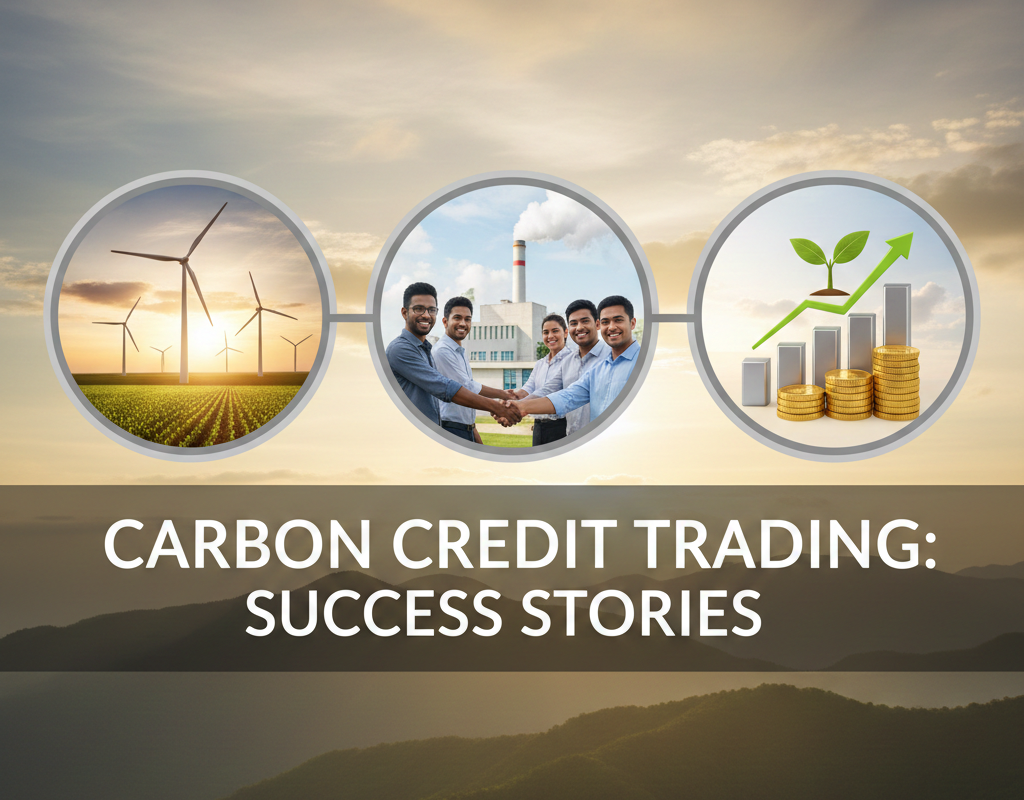
Carbon Credit Trading Success Stories
Carbon Credit Trading Success Stories
While creating economic value from decarbonization, carbon credit trading success stories are changing how governments, businesses, communities, and investors respond to climate change. Globally, carbon markets and carbon credit initiatives have resulted in quantifiable decreases in greenhouse gas emissions, aided in the development of local communities, and opened up new business models that balance profitability and climate action. The proof of the impact on the environment and economy is expanding quickly, from voluntary carbon credit programs to regulatory markets like the EU Emissions Trading System. This comprehensive analysis outlines compelling case studies, examines the factors that led to their success, and shows how India’s carbon credit ecosystem is becoming more and more crucial to the success of global carbon trading.

Carbon Credit Trading Success: What Is It?
Projects, markets, or efforts that have produced noteworthy results—such as confirmed emission reductions, community uplift, investor returns, policy innovations, and scalable models for climate finance—are referred to as carbon credit trading success. Success is determined by long-term sustainability, value creation, and a meaningful emissions impact, whether in voluntary or compliance markets.
By lowering or eliminating a certain quantity of carbon dioxide or other greenhouse gases, carbon credit trading initiatives produce traded carbon credits. Companies and nations looking to satisfy emissions targets or make net-zero claims can purchase these credits in carbon markets.
Success Stories in the Global Carbon Market
- The EU Emissions Trading System (EU ETS): A Pioneering Example
The EU Emissions Trading System (EU ETS), which is commonly regarded as the first and largest carbon trading market in the world, is a prime example of a successful carbon credit trading scheme. Power plants, manufacturers, and other industrial facilities must have enough credits to cover their emissions under the EU ETS, which has been in effect since 2005. Companies that lower their emissions below the cap are able to sell extra allowances. The EU ETS has significantly reduced emissions in the heavy industries and power sectors over the course of over 20 years.
- California Cap-and-Trade: Supporting Eco-Friendly Innovation
California’s Cap-and-Trade Program is another well-known example of a successful carbon credit trading scheme. California’s scheme, which was created to limit emissions from important industries including transportation fuel and energy generation, enables businesses to exchange allowances and make investments in low-carbon alternatives. Allowance auction proceeds have been used to finance community climate resilience efforts, zero emission car projects, and renewable energy projects.
- Verified Carbon Project Success: Actual Benefits, Actual Reductions
Voluntary carbon credit initiatives offer impact stories that integrate social and environmental results, going beyond compliance markets. International conservation initiatives, such as Guatemala’s community-led forest protection program, have produced high-integrity carbon credits while reducing deforestation, protecting biodiversity, and expanding access to healthcare and education in isolated areas.
Success Stories of Carbon Credit Trading in India
With achievements in industry, agriculture, and renewable energy, India is quickly becoming a major player in the creation and trading of carbon credits.
- Industrial Decarbonization: The Green Initiative of JSW Steel
One of the top steel manufacturers in India unveiled a ground-breaking green steel project in 2025 with the goal of lowering carbon intensity by using low-carbon technologies and getting energy from renewable sources. The company is expected to drastically reduce emissions by switching to electric arc furnaces and hydrogen-based technology for a portion of its manufacturing. These initiatives have made it possible to produce valuable carbon credits that draw in overseas investors looking for superior decarbonization units.
- Carbon Projects in Agriculture and Rural Areas
A pilot project engaging thousands of mango growers in biomass management and tree planting was started by India’s National Bank for Agriculture and Rural Development (NABARD). This initiative serves as an example of how natural climate solutions in rural areas can generate carbon credits and give farmers new sources of revenue. These models are strengthened by international financing relationships, demonstrating that carbon credit initiatives can thrive outside of the conventional energy
- Carbon Credits for Wind and Renewable Energy
Wind farms and other renewable energy projects have historically produced substantial amounts of carbon credits in India. Installing wind turbines in a number of Indian states has led to a high yearly credit issuance rate, generating income for upkeep and future growth. These credits have been traded in foreign markets, benefiting both local and international consumers and fostering economic growth.
Important Success Elements Affecting Carbon Credit Results
The success of some carbon credit trading programs is explained by a few recurrent themes in all of these tales:
- Strong MRV and Verification:
Market confidence is increased and credits are guaranteed to reflect actual emissions reductions when accurate measurement is backed by contemporary digital tools, satellite monitoring, and open registries.
- Collaborative Partnerships:
Project durability and impact are increased when governments, local communities, NGOs, investors, and technical partners are involved.
- Co-Benefits:
Projects that provide social and environmental co-benefits, like better jobs, health, biodiversity, and ecosystem restoration, draw more support from the general public and higher value customers.
- Policy and Market Support:
Stable demand signals and predictable investment conditions are offered by regulatory frameworks like national carbon markets and cap-and-trade schemes.
Prospects for the Future: Growing Achievement in Carbon Credit Trading
The future of carbon credit trading is bright, but it hinges on ongoing enhancements to integrity, standards, and market structure. In addition to increasing the number of projects that can take part, emerging digital solutions promise to address issues like double-counting and opaque pricing. These projects include smallholder agriculture, circular economy models, and blue carbon ecosystems like mangroves and coastal wetlands.
Scaling success stories for Indian markets will need combining cutting-edge MRV technology, worldwide connections under international agreements, and local policy backing. India is positioned to become a significant supply hub as well as a thought leader in inclusive and high-integrity carbon markets as its communities and industry get more involved in carbon credit trading.
In conclusion: Carbon Credit Trading Success Stories
From voluntary forest conservation and renewable energy projects that result in actual emissions reductions and financial gains to compliance markets like the EU ETS and California’s cap-and-trade, carbon credit trading has shown to be successful worldwide. Diverse industries can thrive in carbon markets, as demonstrated by India’s innovative industrial decarbonization, hydropower schemes, renewable energy credits, and rural carbon projects.
These achievements highlight the revolutionary potential of carbon credit trading when it is planned with honesty, thorough verification, and community involvement. Carbon credit trading will continue to be a crucial weapon in the battle against climate change as markets develop and technology advances, generating genuine effect, spurring innovation, and opening doors to sustainable prosperity for communities everywhere.