
 Aksh
Aksh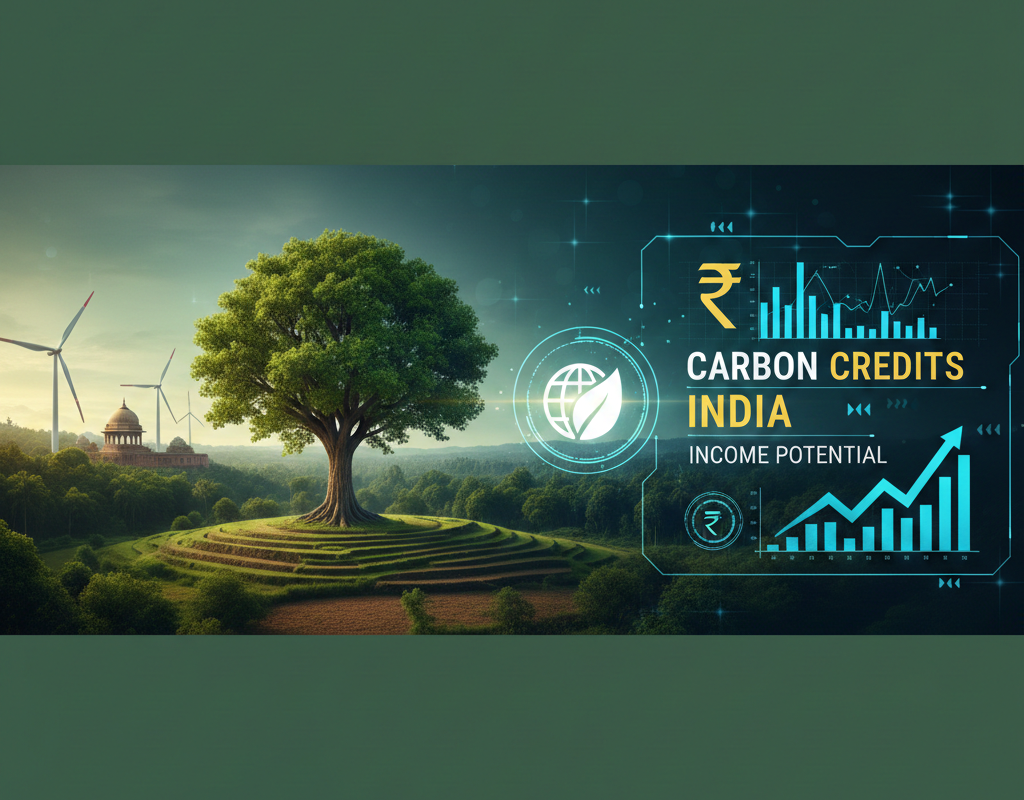
Carbon Credits Income Potential in India
Carbon Credits Income Potential in India
India is about to embrace a revolutionary era where economic opportunity and environmental responsibility coexist. Carbon credits are becoming a potent financial tool as global efforts to mitigate climate change increase. Carbon credit income is no longer a far-fetched idea for companies, farmers, entrepreneurs, and even individuals in India; it is now a feasible source of income.
India is quickly developing a structured carbon market thanks to the government’s 2023 launch of the Carbon Credit Trading Scheme and its increased commitment under the Paris Agreement. Numerous industries, including forestry, waste management, renewable energy, agriculture, and industrial efficiency, now have more opportunities to generate revenue as a result of this advancement.

Comprehending Carbon Credits and Their Potential Revenue
The removal or reduction of one metric ton of carbon dioxide (or other comparable greenhouse gases) from the atmosphere is represented by a carbon credit. These credits can be produced by eco-friendly endeavors like:
- Wind and solar energy initiatives
- Manufacturing that uses less energy
- Afforestation and replanting
- Sustainable agricultural methods
- Waste-to-energy and methane capture systems
These credits are bought by businesses who want to mitigate their carbon footprint or surpass emission restrictions. Emissions reduction becomes a monetary asset in this carbon trading environment.
This implies that climate action might immediately result in revenue for Indian stakeholders.
The Growing Carbon Market Environment in India
India is one of the markets for renewable energy with the greatest rate of growth, but it is also the world’s third-largest emitter of greenhouse emissions. A structured framework for regulated carbon trading in the nation has been established with the launch of the Carbon Credit Trading Scheme (CCTS).
The Ministry of Power’s Bureau of Energy Efficiency (BEE) has been designated as the nodal organization in charge of managing the compliance market. In the meantime, India’s voluntary carbon market is still thriving, enabling projects to produce credits that can be sold to purchasers throughout the world.
For carbon credit projects, this dual system—voluntary and compliance—creates several revenue streams.
Prospects for Business in Carbon Credits
Not only farmers can benefit from carbon credits. Companies from many sectors can gain.
- Companies that Provide Renewable Energy
Significant emission reductions are produced by solar, wind, hydro, and biomass projects. In addition to generating electricity, these projects have the potential to profit from carbon credits.
- Units for Manufacturing and Industry
Under India’s newly regulated market, businesses who invest in waste heat recovery, cleaner technologies, or energy efficiency can earn compliance credits.
- Bioenergy and Waste Management Companies
High-value carbon credits can be produced by methane capture from landfills or livestock activities.
- Climate Technology Startups
Carbon accounting, MRV (Measurement, Reporting, Verification), blockchain-based carbon trading, and sustainability consultancy are among the services that climate-focused firms can offer.
Beyond project execution, carbon credit business prospects in India are growing into technology, consultancy, and marketplace platforms.
Carbon Credits for Small Businesses and MSMEs
The foundation of the Indian economy is made up of micro, small, and medium-sized businesses, or MSMEs. Because of their antiquated technology, many MSMEs use energy inefficiently.
MSMEs can upgrade to renewable energy systems or energy-efficient equipment to:
- Cut back on operating expenses
- Boost sustainability scores
- Create carbon credits
- Obtain green financing
Participation in carbon credit might increase Indian MSMEs’ competitiveness as green compliance becomes crucial for export markets.
Revenue from Forestry and Reforestation Initiatives
By 2030, India has pledged to increase its forest and tree cover to provide an extra carbon sink of 2.5–3 billion tons of CO2 equivalent.
Long-term carbon credits are produced via replanting and reforestation initiatives. Forestry-based offsets are becoming more and more popular among corporations and institutions.
Programs for community-based forest management enable rural areas to:
- Preserve deteriorated terrain
- Boost biodiversity
- Make money from carbon
As a result, both rural income generating and environmental restoration benefit.
Price Trends for Carbon Credits and Their Prospects
Prices for carbon credits vary based on:
- Project type
- Standard of verification
- Co-benefits (effect on biodiversity and society)
- Demand in the market
Premium credits with significant co-benefits related to sustainability are frequently more expensive.
Experts estimate that as demand from multinational firms grows, carbon credit prices in Asia may rise sharply. Domestic trading volumes are anticipated to rise in tandem with India’s expanding sustainability infrastructure.
In conclusion: Carbon Credits Income Potential in India
The way that India tackles sustainability is being redefined by carbon credits. Carbon reduction is now a structured business opportunity and is no longer only a matter of environmental activism.
In India, there is a genuine, scalable, and growing income potential from carbon credits for both major industrial plants and small farms.
The Indian carbon credit market is poised to become a vital component of the nation’s green economy as a result of the convergence of corporate demand, government support, and the urgency of the global climate.
The most advantageous people are those who comprehend and take action early in this developing field.