
 Aksh
Aksh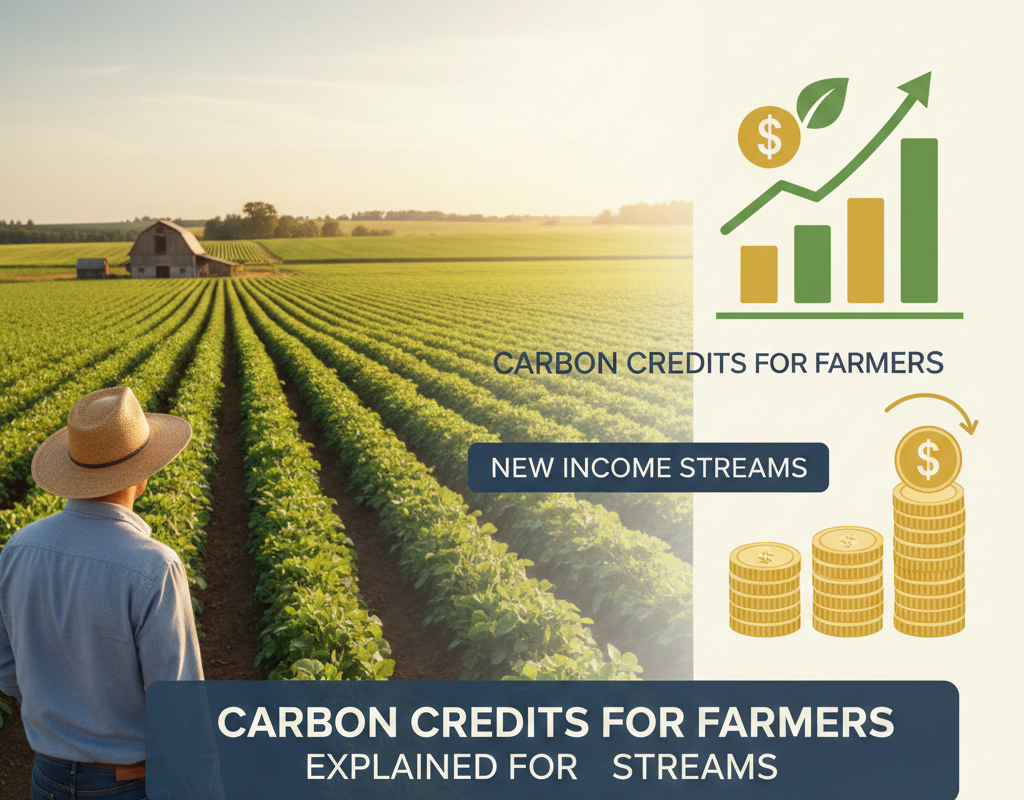
Carbon Credits Income Explained for Farmers
Carbon Credits Income Explained for Farmers
Farmers now have a new opportunity as concerns about climate change grow worldwide: earning money through carbon credits. A prospective supplementary source of income for Indian farmers who must contend with erratic weather patterns, growing input expenses, and volatile market prices is carbon credit income.
This thorough handbook describes carbon credits, how farmers can produce them, how much money they can anticipate, and the exact steps involved in joining carbon markets.

Carbon Credits: What Are They?
One metric ton of carbon dioxide (CO₂) or an equivalent greenhouse gas that has been avoided, decreased, or eliminated from the atmosphere is represented by a carbon credit. These credits are bought by governments and businesses to fulfill their climate pledges and offset their carbon emissions.
By implementing sustainable farming methods, farmers can produce carbon credits that:
- Boost the amount of carbon stored in the soil
- Cut back on greenhouse gas emissions
- Encourage regenerative agriculture
- Boost biodiversity
Farms become “carbon sinks” as a result of these techniques, absorbing more carbon than they emit.
The Significance of Carbon Credits for Indian Farmers
Climate effect and climate solutions are significantly influenced by agriculture. With better land management, Indian agriculture has enormous potential to store carbon in soils.
Carbon credits provide:
- Extra money made outside of crop sales
- Rewarding sustainable practices financially
- Increased output and soil health
- Decreased reliance on chemical sources
- Long-term resilience of farms
Farmers are becoming more and more important players in climate solutions as India moves toward sustainability goals and organized carbon markets.
How Carbon Credits Are Generated by Farmers?
By adopting strategies that either lower emissions or improve carbon sequestration, farmers can obtain carbon credits. Science measures and validates the quantity of carbon stored or emissions decreased.
The following are typical methods used in carbon farming:
- Farming with No-Till or Reduced Tillage
Reducing soil disturbance enhances soil structure and aids in the retention of soil carbon.
- The use of cover crops
Carbon storage and organic matter are increased when cover crops are planted in between primary crops.
- Rotation of Crops
Diverse crop systems increase carbon capture and soil health.
- Forestry
Carbon sequestration is greatly increased when trees are integrated with crops or livestock.
- Growing Food Organically
Nitrous oxide emissions are reduced when synthetic fertilizers are used less.
Carbon Credits’ Advantages for Farmers
- Extra Consistent Revenue
Income from carbon credits is generated independently of commodity prices and crop yields.
- Enhanced Fertility of Soils
Soil productivity is enhanced by higher quantities of organic carbon.
- Lower Input Expenses
Costs are decreased by using less fertilizer and chemicals.
- Resilience to Climate Change
Healthy soils are more drought-resistant and retain water better.
- Sustainability Over Time
Generational agricultural sustainability is supported by carbon farming.
Technology’s Place in Measuring Carbon Credits
Carbon farming is changing due to technology.
- Satellite Surveillance
Land use and crop patterns are monitored via remote sensing.
- Analytics for Soil Sampling
Soil organic carbon is measured using sophisticated laboratory procedures.
- Electronic Farm Records
Farmers can document practices with the aid of mobile apps.
- Carbon Markets and Blockchain
Guarantees credit traceability and transparency.
How Farmers Can Begin Receiving Carbon Credits?
Take the following actions if you’re thinking about carbon farming:
- Determine the eligibility of your property.
- Recognize the necessary practice modifications
- Join forces with a reputable carbon program.
- Make a commitment to sustainable long-term behaviors.
- Ensure that your agricultural records are accurate.
- Regularly check the health of the soil.
As carbon markets develop, there may be long-term benefits to early involvement.
Long-Term Prospects for India’s Carbon Credit Revenue
The demand for verified carbon credits is rising as a result of global climate targets. One of the world’s biggest undeveloped carbon sinks is agriculture.
As carbon markets grow:
- It is anticipated that demand for agricultural loans would increase.
- Technologies for measurement will advance.
- There will be more market transparency.
- Farmer involvement will increase.
Within the next ten years, carbon credit income may become a significant source of income for Indian agriculture.
Commonly Asked Questions
- If farmers don’t alter their crops, can they still receive carbon credits?
Yes, by altering procedures like minimizing tillage or making the best use of fertilizer.
- Are carbon credits a surefire way to make money?
Market demand and effective verification are prerequisites for revenue.
- Are big landholdings necessary for farmers?
Not always. Group projects are open to small farmers.
- How much time does it take to get paid?
usually following yearly cycles of verification.
Concluding Remarks: Carbon Credits Income Explained for Farmers
Beyond merely addressing climate change, carbon credits provide farmers with a new revenue model. Farmers may enhance soil health, boost output, and generate extra revenue by implementing sustainable farming methods.
Carbon farming is a viable business opportunity as well as an environmental solution for Indian farmers navigating climate concerns and economic instability.
Farmers that embrace the system early and have a thorough understanding of it stand to gain the most as awareness rises and carbon markets develop. Carbon credit revenue is a potent addition that encourages sustainability; it is not a substitute for farming.
Climate-smart agricultural techniques are the way of the future, and in the years to come, carbon credits might emerge as one of the biggest sources of income for farmers.
Carbon Credits Income Guide for Beginners: How to Earn from Carbon Markets in India
Carbon Credits Income Guide for Beginners: How to Earn from Carbon Markets in India