
 Aksh
Aksh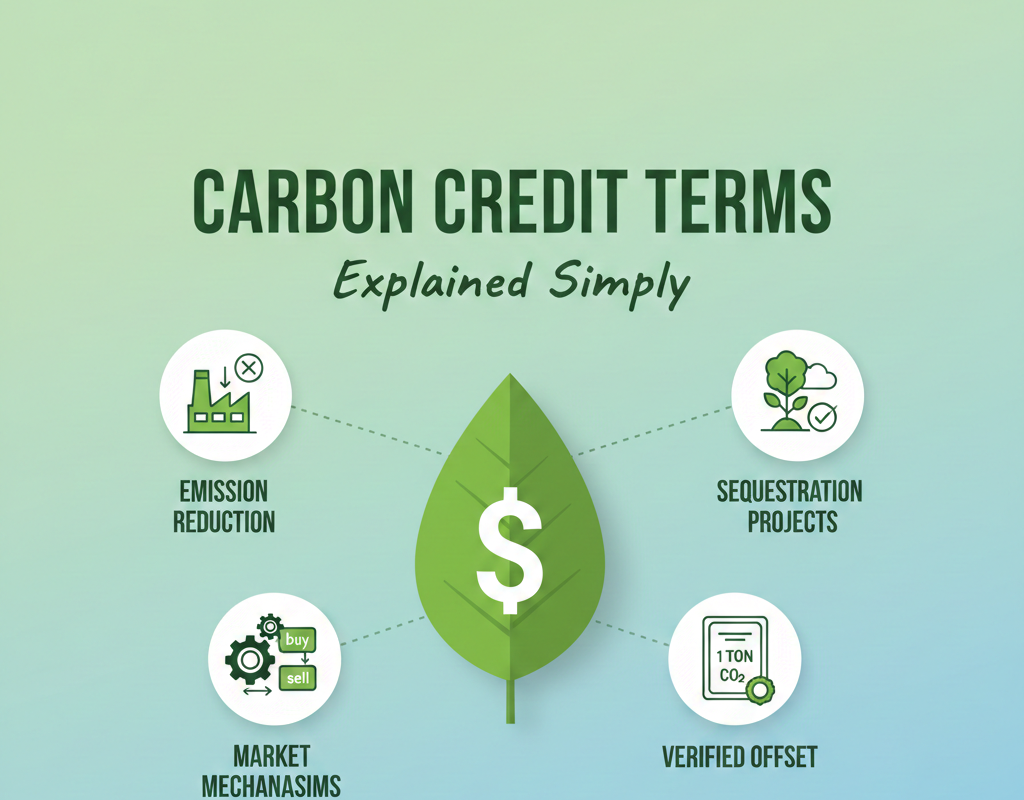
Carbon Credit Terms Explained Simply
Carbon Credit Terms Explained Simply
One of the most talked-about issues in the world today is climate change. To cut greenhouse gas emissions and halt global warming, governments, corporations, and individuals are all looking for workable solutions. The carbon credit system is one of the most crucial instruments in this endeavor. However, the jargon used in relation to carbon credits can frequently seem complex and unclear.
Anybody, whether a business owner, sustainability expert, investor, or concerned citizen, can grasp how carbon markets function and how they support climate action by using this guide’s straightforward explanations of carbon credit terminologies.

A Carbon Credit: What Is It?
One metric ton of carbon dioxide (CO₂) or its equivalent is reduced or removed from the atmosphere to create a carbon credit.
To put it simply:
- A project receives one carbon credit for reducing one ton of CO₂.
- These credits can be purchased by businesses or individuals to make up for their own emissions.
A financial incentive to reduce pollution is created by carbon credits. Businesses can make investments in actual environmental projects that lower emissions rather than just talking about sustainability.
Greenhouse Gas Emissions: What Are They?
The gases that trap heat in the Earth’s atmosphere are known as greenhouse gases (GHGs). Carbon dioxide (CO₂) is the most prevalent greenhouse gas, while other gases include nitrous oxide (N₂O) and methane (CH₄).
CO₂ is released by industries when they burn fossil fuels like coal, oil, or gas. Climate change is exacerbated by these emissions. By placing a cost on pollution, carbon markets aim to lower these emissions.
A Carbon Footprint: What Is It?
A person, business, product, or nation’s overall greenhouse gas emissions are measured by their carbon footprint.
For instance:
- The carbon footprint of a plant include emissions from manufacturing, transportation, and energy consumption.
- Travel, electricity use, and food consumption all contribute to an individual’s carbon footprint.
- Reducing or mitigating emissions begins with understanding your carbon footprint.
A Carbon Offset Project: What Is It?
An effort to cut, prevent, or eliminate greenhouse gas emissions is known as a carbon offset project.
Typical project types consist of:
- Renewable power (hydro, wind, and solar)
- Reforestation and replanting
- Enhancements in energy efficiency
- Capture of methane from landfills
- Solutions for clean cooking
- Reduction of industrial emissions
Based on the quantity of emissions these initiatives cut, they are validated and given carbon credits.
What is the market for voluntary carbon?
Companies and individuals can choose to acquire carbon credits to offset their emissions through the voluntary carbon market (VCM).
This is not the same as systems that are mandated by the government. Within the voluntary market:
- It is not required to participate.
- Businesses purchase credits to fulfill sustainability objectives.
- It backs ESG pledges and corporate social responsibility (CSR).
The market for voluntary carbon is expanding quickly as more companies pledge to achieve net zero emissions.
Describe Net Zero.
When greenhouse gas emissions and removals from the atmosphere are balanced, net zero is achieved.
For instance:
- An organization releases 100,000 tons of CO₂.
- Internally, it lowers 70,000 tons.
- The remaining 30,000 tons are offset by it.
The business reaches net zero when total emissions and total removals are equal.
Climate Finance: What Is It?
Funding allocated to climate change-related projects is referred to as climate money.
One of the main sources of climate finance is the carbon market because:
- Projects to reduce emissions are funded by businesses.
- Investment is made in developing areas.
- Development that is sustainable picks up speed.
The financial gap required for international climate action is filled in part by climate finance.
The Significance of Carbon Credits in India
India’s economy is among the fastest-growing in the world. Reducing emissions is essential given the growing industrialization and energy demand.
India’s carbon markets:
- Promote renewable energy initiatives.
- Encourage rural development.
- Bring in global climate funding.
- Assist companies in fulfilling international ESG criteria.
India has great potential in areas like solar energy, wind power, and afforestation as customers from around the world want for verified carbon credits.
Concluding remarks: Carbon Credit Terms Explained Simply
It doesn’t have to be difficult to understand carbon credit concepts. The fundamental goal of the carbon credit system is to provide financial incentives for climate action and to give value to emission reductions.
Businesses and individuals may take an active role in creating a low-carbon future by being familiar with essential terminology like carbon offset, voluntary carbon market, compliance market, net zero, carbon footprint, and climate finance.
Carbon markets are economic systems that promote sustainable growth, encourage renewable energy, and aid in the achievement of global climate goals. They are not merely environmental tools.
Carbon credits will continue to influence sustainability and climate responsibility in India and around the world as awareness and involvement rise.
Carbon Footprint Tools Explained Simply: A Complete Guide for Businesses and Individuals
Carbon Footprint Tools Explained Simply: A Complete Guide for Businesses and Individuals