
 Aksh
Aksh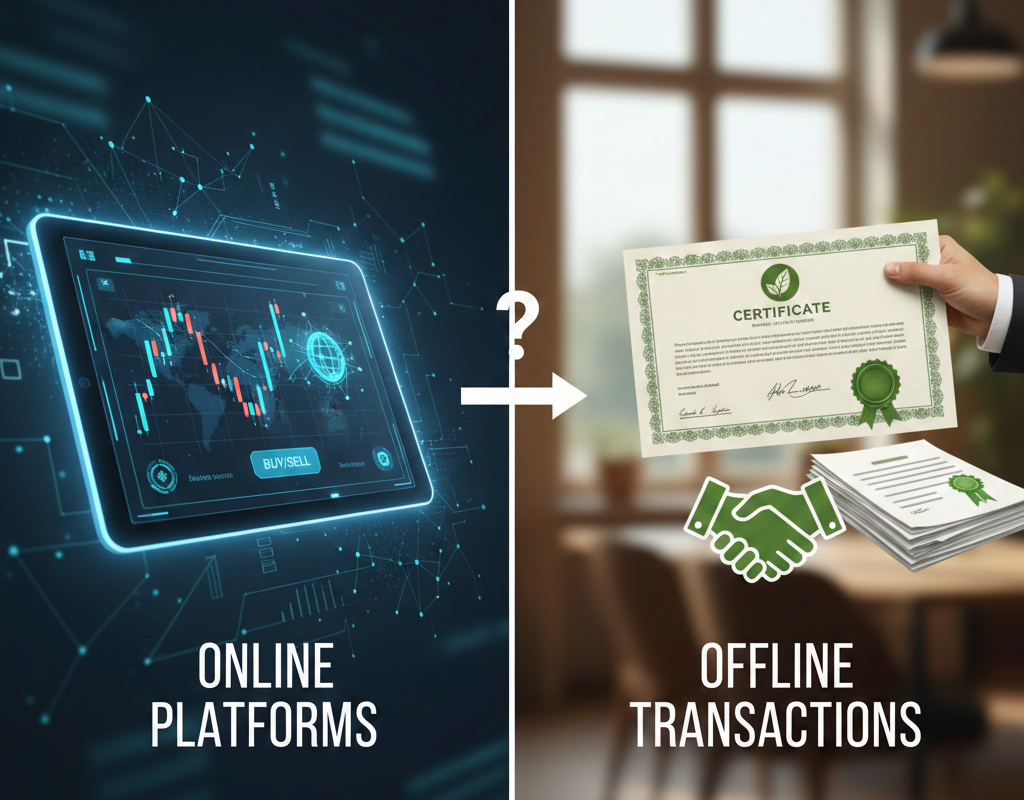
Carbon Credit Trading Online vs Offline
Carbon Credit Trading Online vs Offline
The carbon market in India is about to enter a revolutionary phase. Businesses from a variety of industries are actively engaging in carbon credit trading as a result of increased climate pledges, more stringent sustainability standards, and the implementation of organized carbon trading regimes. A crucial dilemma that arises as demand increases is whether businesses should exchange carbon credits online or through more conventional offline means.
How companies in India purchase, sell, and handle carbon credits has been greatly impacted by the development of online versus offline carbon credit trading schemes. Each approach has unique benefits and drawbacks, ranging from speed and transparency to regulatory compliance and pricing effectiveness.
For industries, sustainability consultants, investors, and project developers hoping to optimize profits while fulfilling environmental commitments, it is essential to comprehend these distinctions.

Comprehending India’s Carbon Credit Trading
One metric ton of carbon dioxide or other comparable greenhouse gases can be reduced or removed with the use of carbon credits, which are tradable certifications. Businesses that cut emissions below the allowed levels can sell extra credits, while those who go over the restrictions have to buy credits to make up for their emissions.
The voluntary carbon market and the compliance carbon market are the two main divisions of the Indian carbon credit market. Government frameworks that require some industries to fulfill emission requirements govern the compliance industry. Companies can offset emissions as part of their environmental and ESG commitments through the voluntary market.
The traditional broker-driven offline system is being challenged by digital platforms that are modernizing the carbon credit market in India as participation rises.
Online Carbon Credit Trading: What Is It?
Purchasing and selling carbon credits using online platforms or carbon trading marketplaces is known as “online carbon credit trading.” These platforms facilitate direct interactions between buyers and sellers, automated documentation, verified project listings, and real-time pricing.
Under the model of the digital carbon marketplace, businesses can:
- View confirmed inventories of carbon credits.
- Monitor changes in price
- Complete transactions in real time.
- Obtain digital certification and supporting materials.
- Track the success of your portfolio.
The online model is becoming more and more popular among Indian startups, MSMEs, and ESG-focused businesses since it offers efficiency, data transparency, and streamlined procedures.
Important Distinctions Between Online and Offline Carbon Credit Trading
The comparison of offline and online carbon credit trading reveals key structural distinctions influencing India’s sustainability environment.
- Price transparency
Online carbon trading platforms offer historical data, standardized credit information, and current market pricing. Businesses are able to make data-driven investment decisions because to this transparency.
- Transaction Speed
Settlements can occur more quickly, frequently in a matter of days, thanks to digital carbon markets. Delays are greatly decreased by digital documentation and automated compliance verification.
- Availability
India’s carbon market is becoming more accessible to all thanks to online carbon credit trading. Small and medium-sized businesses don’t need to have large broker networks to take part.
The Development of India’s Digital Carbon Marketplaces
The transition to online carbon credit trading has been expedited by India’s swift digital revolution. Government-supported carbon trading schemes, ESG consciousness, and fintech innovation are driving companies toward open online platforms.
Market credibility is further increased by the implementation of official carbon swaps and digital registries. Online platforms are becoming essential to India’s carbon credit market due to the growing involvement of the waste management, forestry, renewable energy, and industrial sectors.
The way Indian businesses sell carbon credits is being redefined by technological integrations like blockchain verification, AI-based carbon accounting, and automated ESG reporting.
Why Companies Prefer Trading Carbon Credits Online?
The increasing popularity of online carbon trading systems can be explained by a number of factors:
- More authority over transactions
- Current market intelligence
- Safe digital records
- Decreased chances of fraud
- Quicker performance
- Scalability for expanding businesses
Digital platforms offer comprehensive project impact measurements to ESG-driven businesses, guaranteeing alignment with sustainability objectives.
Why Some Businesses Continue to Use Offline Trading?
Offline carbon credit trading is still important in several situations, even with the rise of digital technology:
- Customized contracts in large quantities
- Long-term, strategic alliances
- Complicated transactions related to compliance
- Sector-specific guidance assistance
Large carbon footprint industries frequently need the individualized advice that typical brokers offer.
Hazards of Carbon Trading, Both Online and Offline
There are dangers associated with both models.
- Risks associated with online trading include exposure to market volatility, platform dependability problems, and cybersecurity concerns.
- Pricing opacity, reliance on middlemen, delayed transactions, and restricted market access are some of the problems associated with offline trading.
- Regardless of the trading method, due diligence, credit authenticity verification, and compliance with Indian regulatory frameworks are crucial.
In conclusion: Carbon Credit Trading Online vs Offline
India’s carbon credit market is changing quickly due to rising ESG obligations, regulatory changes, and digital innovation. The contrast between offline and online carbon credit trading demonstrates a move toward accessibility, efficiency, and transparency.
Online carbon marketplaces are propelling the democratization and modernization of the Indian carbon credit ecosystem, even as offline trading still supports large-scale negotiated contracts.
Long-term sustainability success will depend on choosing the appropriate carbon trading plan as climate accountability becomes a top business issue.
In India’s growing carbon market, companies, investors, and project developers will be most successful if they use transparent digital platforms while staying in compliance with regulations.
The shift is structural rather than just technological, changing the way India trades carbon credits and hastening the country’s transition to a low-carbon economy.
Top Carbon Credit Marketplaces in India 2026 | Leading Platforms for Carbon Trading & Sustainability
Top Carbon Credit Marketplaces in India 2026 | Leading Platforms for Carbon Trading & Sustainability