
 Aksh
Aksh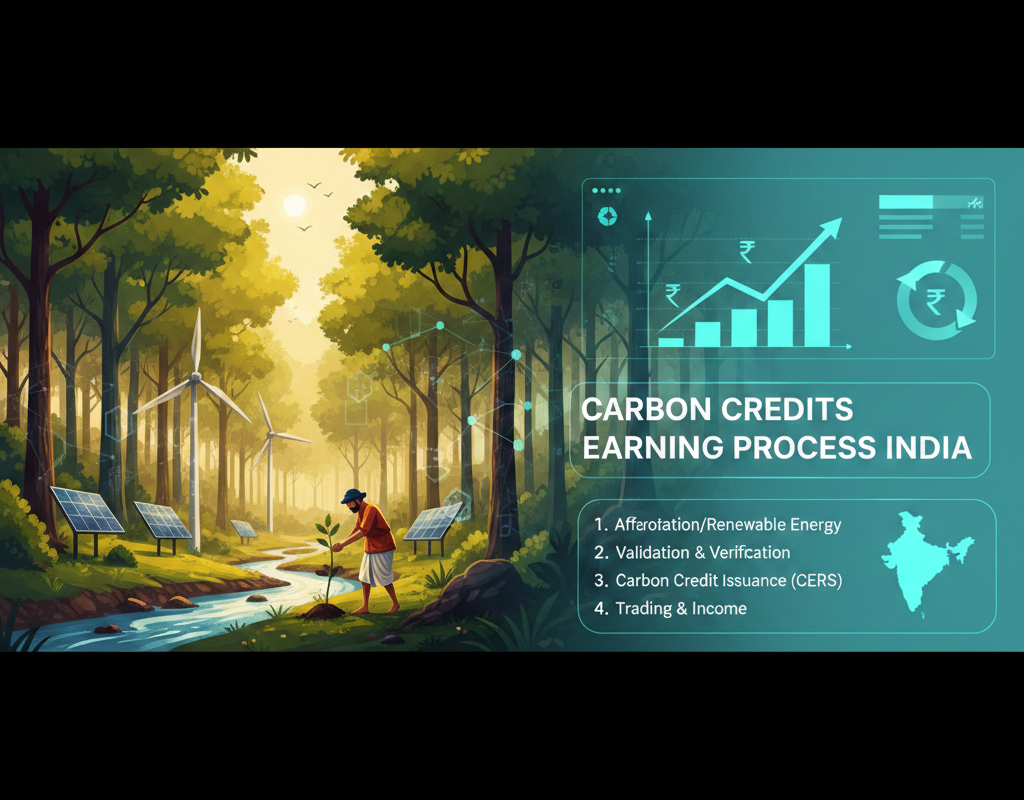
Carbon Credits Earning Process in India
Carbon Credits Earning Process in India
India is quickly becoming a global leader in the development of the carbon market and climate action. India’s carbon credit earning process has become a major opportunity for industries, renewable energy developers, MSMEs, infrastructure companies, farmers, and sustainability-driven organizations thanks to aggressive commitments made under international climate agreements and robust domestic regulatory reforms.
Businesses no longer view carbon reduction as merely complying with regulations as mitigating the effects of climate change becomes a primary goal. It has developed into a chance to make money. Organizations can support national and international sustainability goals by using carbon credits to monetize certified decreases in greenhouse gas emissions.

Comprehending India’s Carbon Credits
One metric ton of carbon dioxide (CO₂) or an equivalent greenhouse gas that is avoided, decreased, or eliminated from the atmosphere is represented by a carbon credit. Businesses can obtain market carbon credits for successfully bringing their emissions below predetermined baselines.
There are two main ways that the carbon market in India functions:
- Market for Compliance (Indian Carbon Market, or ICM)
- Market for Voluntary Carbon (VCM)
Through the Carbon Credit Trading Scheme (CCTS), which is supervised by the Ministry of Power’s Bureau of Energy Efficiency (BEE), the Indian government is formally establishing the compliance framework.
The Significance of Carbon Credits for Indian Companies
India has one of the fastest-growing markets for renewable energy, while being the world’s third-largest emitter of greenhouse emissions. Carbon trading changes have been greatly hastened by the government’s goal of achieving Net Zero by 2070.
- Carbon credits have several benefits.
- An additional source of income
- Improvement of ESG Compliance
- Enhanced recognition of the brand
- Access to investors with a worldwide focus on sustainability
- Lower long-term dangers related to regulations
- An edge over competitors in export markets
Carbon monetization is being actively investigated by a number of industries, including waste management, steel, cement, textiles, electricity generation, chemicals, and real estate.
India’s Voluntary Carbon Market
Businesses can offset emissions above and beyond what is required by law thanks to the voluntary market.
Credits are frequently generated by Indian project developers for:
- Global companies
- ESG-conscious investors
- Manufacturers of carbon-neutral products
Premium pricing are charged for high-quality voluntary credits that benefit the community and nature.
India’s Potential for Carbon Credit Revenue
The following factors affect carbon credit revenue:
- Project scope
- Type of technology
- Demand for credit
- Trends in international prices
Depending on their capacity, renewable energy installations can produce thousands to millions of credits every year.
For rural towns, forestry and agriculture initiatives can generate steady, long-term revenue streams.
India’s Sectors That Gain the Most from Carbon Credits
- Developers of Renewable Energy
The solar and wind industries in India have enormous potential for credit creation.
- MSMEs
MSMEs can save money and receive credits by upgrading their energy efficiency.
- Property Developers
Credits are available for low-carbon construction methods and green buildings.
- Sector of Agriculture
Regenerative agriculture and carbon farming are becoming more popular.
- Companies that Manage Waste
Projects involving waste-to-energy and methane capture have a significant impact.
Important Requirements for Compliance
In order for carbon credits to be issued successfully, organizations need to:
- Keep your documentation open and transparent.
- Make sure the emission measurement is precise.
- Employ certified validators
- Adhere to the recommended procedures
- Send in reports on time.
Penalties or rejection may follow noncompliance.
Issues with India’s Carbon Credit Earning Process
Despite the enormous opportunity, there are several obstacles to overcome.
- Intricate regulatory structure
- Challenges in choosing a methodology
- High initial expenditures for documentation
- Verification costs
- Volatility of market prices
It is frequently advised to seek professional advising assistance.
How Companies Can Begin?
Businesses wishing to get into the carbon market ought to:
- Assess the carbon footprint.
- Determine areas for decrease.
- Hire carbon experts
- Create project documentation that complies.
- Register within an appropriate framework
- Track and confirm emission reductions
- Strategically monetize credits
Long-term revenue streams and competitive advantages are provided by early adoption.
In conclusion: Carbon Credits Earning Process in India
In India, the process of obtaining carbon credits is now a strategic business opportunity in line with national climate goals rather than a specialized environmental project. India’s carbon market is expected to grow quickly because to the country’s strong government support, developing regulatory frameworks, and rising global demand.
Early adoption of structured carbon management solutions by businesses, industries, farmers, and project developers can boost ESG credibility, increase climate resilience, and unlock sustainable revenue.
Carbon credits will be essential to converting environmental duty into economic opportunities as India moves closer to its Net Zero goal.
Carbon Credit Trading in India: A Complete Beginner’s Guide to India’s Emerging Carbon Market
Carbon Credit Trading in India: A Complete Beginner’s Guide to India’s Emerging Carbon Market