
 Aksh
Aksh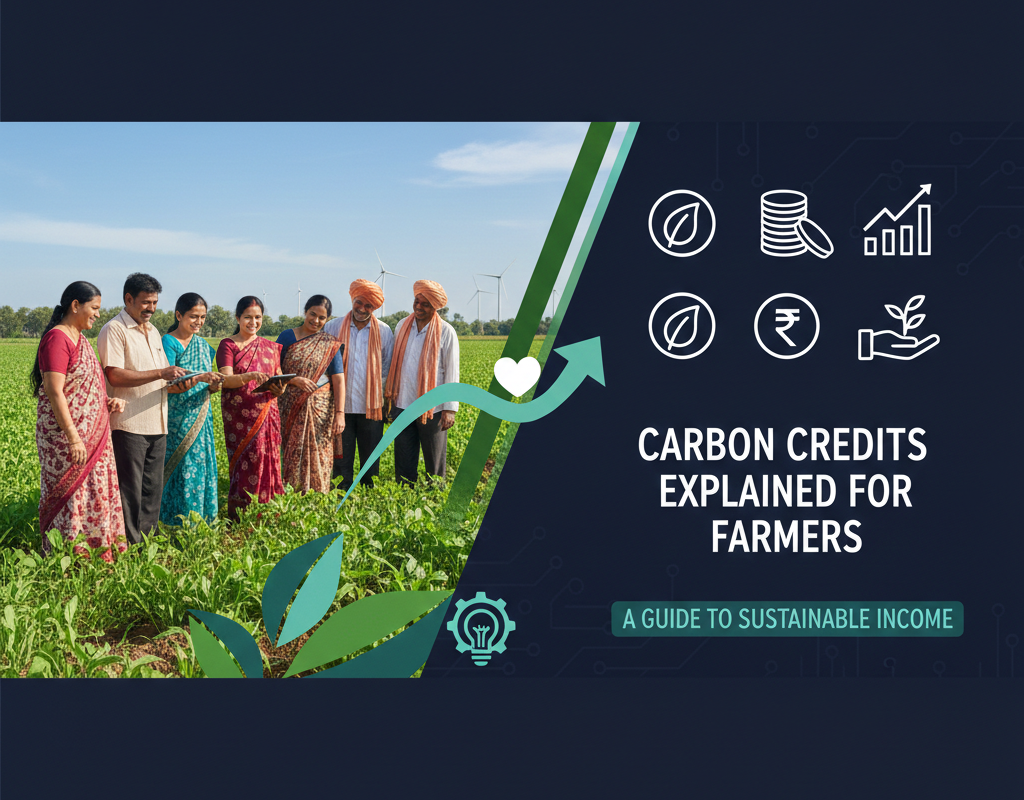
Step-by-Step Guide to Carbon Credits for Farmers
Step-by-Step Guide to Carbon Credits for Farmers
Farmers in India are dealing with rising heat, erratic rainfall, degraded soil, and growing production costs as climate change transforms agriculture. Simultaneously, a novel prospect is arising that enables farmers to generate extra revenue in addition to safeguarding their land: carbon credits.
Farmers that embrace climate-friendly and sustainable farming methods are increasingly using carbon credits as a potent financial instrument. Carbon credits, which were formerly thought to be a concept exclusive to huge enterprises and industries, are now providing opportunities for small and medium-sized farmers throughout India.

How to Understand Carbon Credits in Plain English
The removal or decrease of one metric tonne of carbon dioxide or its equivalent from the atmosphere is represented by a carbon credit. Carbon reductions from actions that stop greenhouse gas emissions or absorb carbon into vegetation, trees, or soil can be quantified and turned into carbon credits.
Businesses, groups, or institutions that wish to offset their emissions and achieve sustainability objectives buy these credits.
This implies the following for farmers:
- Sustainable agricultural methods can lower emissions or store carbon in the soil.
- These decreases are measurable and verifiable.
- Carbon credits can be issued for verified reductions.
- Climate-friendly agriculture generates revenue for farmers.
The Significance of Carbon Credits to Indian Farmers
The use of fertilizer, livestock, rice cultivation, and changes in land use are the main ways that India’s agriculture industry contributes to greenhouse gas emissions. However, there is a great deal of potential for natural carbon storage in Indian farming.
For farmers, carbon credits are important since they
- Create additional sources of revenue without expanding the land used for crops.
- Encourage the use of regenerative and traditional farming methods.
- Boost water retention and soil health
- Decrease reliance on chemical inputs
- Boost agricultural resistance to climate change
- Orient farmers to upcoming markets and agricultural policies.
India has one of the biggest prospects for the production of agricultural carbon credits in the world, thanks to its millions of smallholder farmers.
Carbon Credit-Generating Farming Methods
- No-Till and Reduced Tillage Farming
Conventional plowing releases carbon that has been stored in the soil. In addition to improving soil structure and reducing fuel use, reduced or zero tillage locks carbon underground.
- The use of cover crops
In addition to increasing organic matter and preventing soil erosion, using cover crops like legumes or grasses in between major crops also helps absorb carbon from the atmosphere.
- Rotation of Crops
Diverse crop rotation increases carbon sequestration, decreases pests, and boosts soil biodiversity.
- Natural and Organic Agriculture
Utilizing bio-inputs, compost, farmyard manure, and green manure raises soil carbon and lowers emissions from chemical fertilizers.
- Forestry
Integrating trees with crops or livestock captures carbon above and below ground while providing additional income from fruits, timber, or fodder.
Soil Health and Carbon Credits
Soil enhancement is one of the main benefits of carbon farming.
Rich in carbon soil:
- Retains moisture when it’s dry.
- Increases the availability of nutrients
- Encourages the growth of beneficial microbes
- Lessens erosion
- Gradually raises agricultural yields
In addition to receiving income from credits, farmers who use carbon-friendly methods frequently experience long-term increases in productivity.
How Carbon Credits Help Farmers Make Money
Carbon credits are typically not sold directly to businesses by farmers. Rather, they manage technical and financial elements through organized programs.
The usual earning procedure consists of:
- Signing up for a carbon program
- Initial evaluation of soil and emissions
- Using climate-smart strategies
- Regular observation and gathering of data
- Verification by third parties
- Issuing and selling credit
- Sharing of profits with farmers
Typically, payments are made once a year or following verification rounds.
Technology’s Place in Carbon Credit Farming
In carbon farming, digital technologies are essential:
- Land use and crop cover are tracked by satellite monitoring.
- Carbon levels are measured by soil sampling.
- Farm operations are recorded using mobile apps.
- Emissions are estimated by data analytics.
- Costs are reduced by remote verification.
Small farmers who were previously shut out because of high transaction costs can now be included thanks to technology.
Difficulties in Growing Carbon Credits
Carbon credits have drawbacks despite their potential:
- Complexity of Measurement
It takes time, skill, and consistency to measure soil carbon accurately.
- Long-Term Dedication
To guarantee permanence, the majority of programs demand involvement for several years.
- Awareness Deficit
Carbon markets and certification procedures are still new to many farmers.
- Volatility of Prices
Prices for carbon credits might change based on demand worldwide.
- Transparency and Trust
Fair income sharing and unambiguous contracts are crucial.
Scaling carbon farming requires addressing these issues through technology, aggregation, and education.
Conclusion: Step-by-Step Guide to Carbon Credits for Farmers
The relationship between agriculture and the economy and environment is changing as a result of carbon credits. They provide Indian farmers a significant chance to convert sustainable farming methods into real cash gains.
Carbon credits have the ability to transform rural livelihoods, advance climate-smart agriculture, and establish Indian farmers as important players in global climate solutions as awareness rises and systems advance.
Building better communities, healthier soils, and a more sustainable future for Indian agriculture are the goals of the carbon farming movement, which goes beyond simply obtaining credits.
Carbon Credit System Explained Simply: A Complete Guide for India and the World
Carbon Credit System Explained Simply: A Complete Guide for India and the World