
 Aksh
Aksh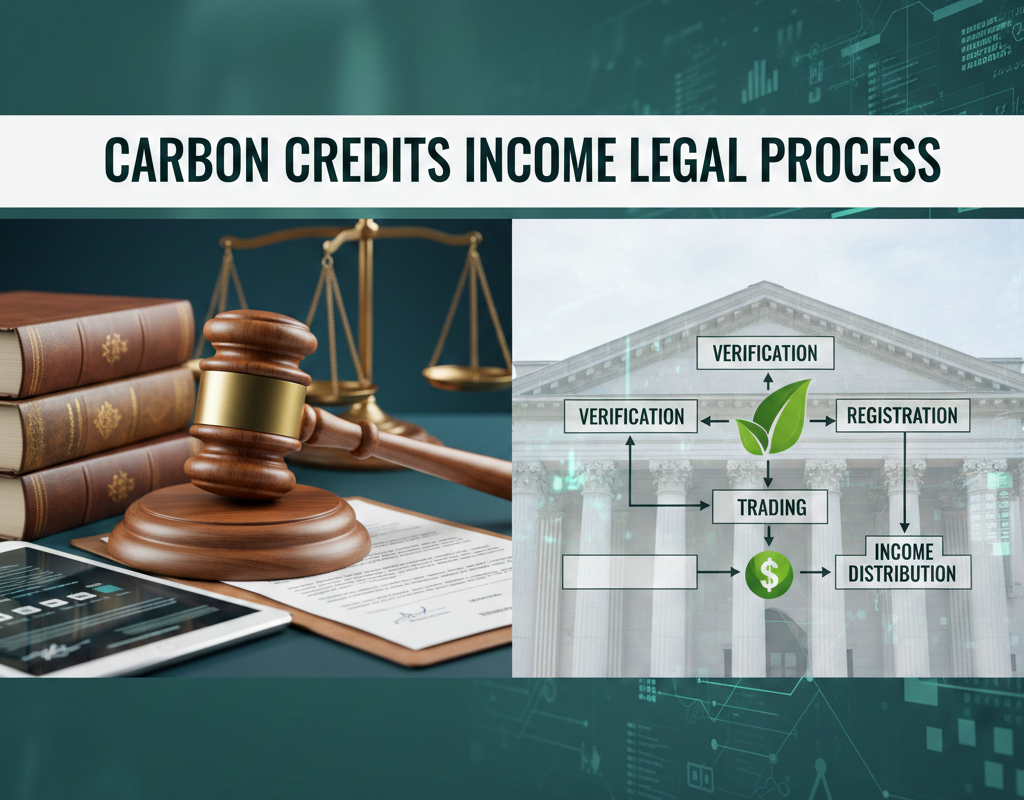
Carbon Credits Income Legal Process in India
Carbon Credits Income Legal Process in India
India’s climate pledges under the Paris Agreement and the UN Framework Convention on Climate Change are propelling the country’s fast transition to a low-carbon economy. Carbon credits have become a potent financial tool as companies, agriculture, infrastructure, and the renewable energy industry have made sustainability a strategic focus.
Carbon credits are more than just environmental compliance for companies, landowners, developers of renewable energy, and sustainability-driven industries; they are a valid and expanding source of revenue. However, following a structured legal and regulatory framework is necessary to generate income from carbon credits.

Comprehending Carbon Credits and Potential Revenue
One metric ton of carbon dioxide (CO₂) or its equivalent greenhouse gas that has been avoided, decreased, or eliminated is represented by a carbon credit. Companies looking to offset their emissions can purchase these credits.
Carbon credit revenue is produced when:
- Greenhouse gas emissions are captured or reduced by a project.
- Verified and certified are the emission savings.
- An authorized registry is responsible for issuing certified credits.
- Credits are offered for sale in compliance or voluntary markets.
Due to growing domestic carbon trading frameworks, demand from international investors, and rising corporate ESG commitments, the carbon credit market in India is growing.
The Carbon Credit Regulatory Environment in India
In line with its climate objectives, India has started the process of creating a domestic carbon trading system. The government’s strategy creates national norms for carbon market regulation while incorporating global frameworks.
Oversight of climate policy is primarily the responsibility of the Ministry of Environment, Forests, and Climate Change. India’s Nationally Determined Contributions (NDCs), which were filed under the framework of the UN Framework Convention on Climate Change, serve as the foundation for its climate pledges.
In preparation for the implementation of Article 6 of the Paris Agreement, which regulates global carbon market cooperation, India is also coordinating carbon trading systems.
Legal Records Needed to Receive Carbon Credit Income
Creating revenue from carbon credits involves thorough documentation:
- Evidence of land ownership
- Certificates of environmental clearance
- Approvals from the pollution control board
- Information on energy output (for renewable projects)
- Keeping an eye on logs
- Reports on audits
- Details of tax registration
Maintaining accurate records is necessary to pass regulatory inspection.
Legal Hazards and Difficulties with Compliance
Carbon credits present prospects for high income, but there are drawbacks as well.
- Rejection of methodology
- Delays in validation
- Modifications to regulations
- Volatility of prices
- Problems with double counting
- Penalties for fraud and deception
It is crucial to strictly conform to national and international compliance standards.
New Prospects in the Carbon Market in India
India’s growing carbon market is bolstered by:
- Growth in renewable energy
- Corporate pledges to be sustainable
- ESG compliance pushed by exports
- Global flows of climate finance
Carbon credits are anticipated to become a widely used financial tool when formal domestic trading platforms develop.
New players in the carbon economy are also appearing in the fields of agriculture, MSMEs, and rural landownership.
Professional Carbon Credit Consultants’ Function
The legal process for carbon credits is intricate and involves a lot of paperwork. Expert advice aids in:
- Analysis of eligibility
- Preparing documentation
- Coordination of the registry
- Managing audits
- Method of credit monetization
Professional consultants optimize income potential while lowering compliance concerns.
Prospects for the Future: Carbon Credits as an Ecological Revenue Source
Carbon credits are evolving from specialized environmental instruments to widely used financial instruments.
India is positioned as a significant player in the carbon market according to its climate roadmap, which complies with the Paris Agreement and the United Nations Framework Convention on Climate Change.
Important trends influencing the future:
- Carbon registers that are digital
- Blockchain-driven monitoring
- More stringent domestic laws
- Combining ESG reporting with integration
- Foreign investment in Indian carbon initiatives has increased.
The revenue from carbon credits is anticipated to increase dramatically during the next ten years.
In conclusion: Carbon Credits Income Legal Process in India
Structured project creation, validation, registration, monitoring, verification, and trading are all part of the legal procedure for making money from carbon credits in India. The framework has significant financial and environmental benefits, but it also has strict compliance requirements.
Carbon credit initiatives that are properly registered and validated can open up sustainable cash streams for businesses, renewable energy providers, agricultural landowners, and industrial organizations.
The potential to profit from emission reductions will keep growing as India fortifies its climate pledges and carbon trading systems. The main factors influencing the viability of long-term carbon credit revenue will be early acceptance, robust recordkeeping, and regulatory compliance.