
 Aksh
Aksh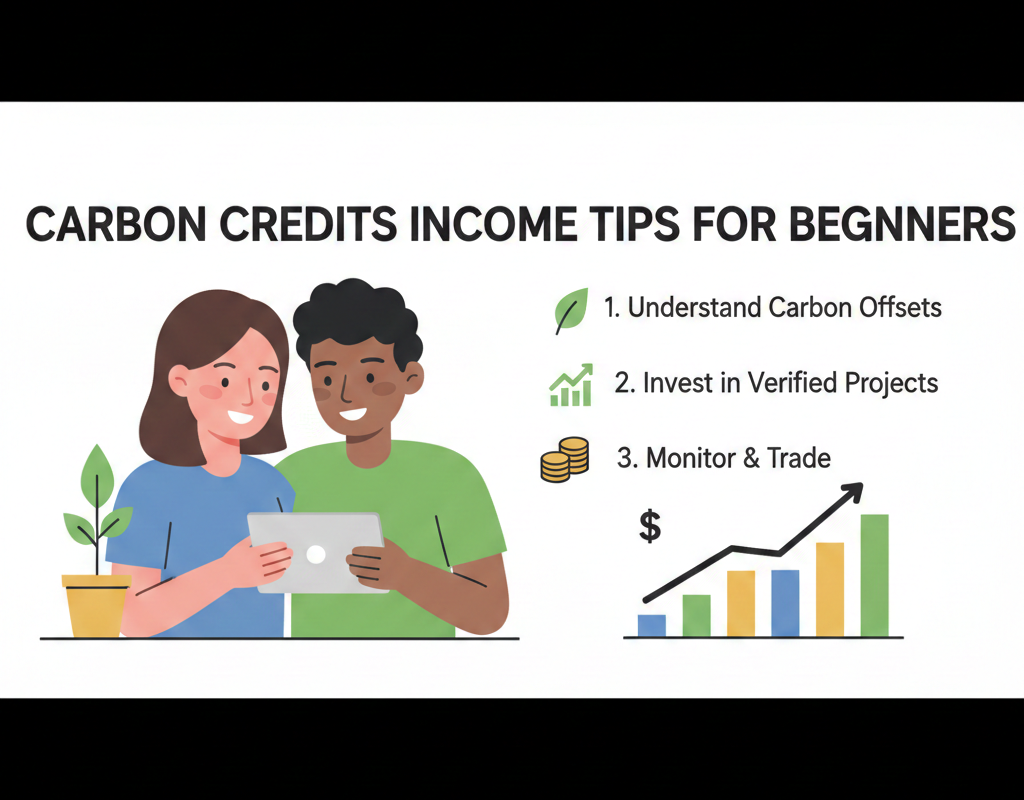
Carbon Credits Income Tips for Beginners
Carbon Credits Income Tips for Beginners
Carbon credits have become one of the sustainability industry’s most promising revenue streams as climate change continues to alter international policy and corporate strategy. Beginners in India may open up new financial opportunities and help protect the environment by learning how carbon credits operate and how to make money from them.
Carbon markets are growing quickly as a result of governments’ and businesses’ growing climate commitments. Individuals, farmers, entrepreneurs, and businesses can now join this expanding ecosystem as businesses look for carbon offsets to reach net-zero goals.

Carbon Credits: What Are They?
The reduction, avoidance, or removal of one metric ton of carbon dioxide (CO₂) or its equivalent greenhouse gas from the atmosphere is represented as a carbon credit.
Measureable emission reductions are produced when a project lowers emissions, for as by putting in solar panels, planting trees, increasing energy efficiency, or absorbing methane. After verification, these reductions are turned into carbon credits that can be traded on carbon markets.
In order to fulfill their environmental obligations and offset their emissions, businesses buy these credits.
Why India Is Seeing a Significant Increase in Revenue from Carbon Credits?
One of the markets with the quickest rates of growth for climate solutions and renewable energy is India. The need for verified carbon credits is continuously growing as a result of business ESG (Environmental, Social, Governance) objectives and national climate obligations.
The main causes of India’s rising carbon credit revenue are:
- Increasing the capability for renewable energy
- Robust agricultural foundation appropriate for carbon farming
- Support from the government for sustainability projects
- Growing demand for premium voluntary carbon credits worldwide
- Growing corporate pledges to achieve net-zero
For farmers, landowners, startups, MSMEs, and developers of renewable energy, this presents a significant potential.
Who Is Eligible to Receive Carbon Credit Income?
Carbon credits are not just for big businesses. Participants can be novices from a variety of fields:
- Farmers
- Developers of renewable energy projects
- Waste management firms
- Production facilities
- NGOs that develop real estate
- Owners of forestry projects
- Community-based programs for sustainability
You might be eligible if your action lowers emissions or takes carbon out of the environment.
How to Create Carbon Credits in India: A Comprehensive Guide?
- Determine which projects are eligible.
- Perform a feasibility study.
- Create a project design document.
- Sign up for a carbon standard
- Undergo third-party auditor validation
- Execute the project
- Keep an eye on emission reductions
- Validation and issuance
- In the carbon market, sell credits.
Compliance and paperwork are necessary at every level.
Carbon Farming: A Potential Source of Income for India’s Rural Communities
The following techniques are used in carbon farming to improve soil carbon storage:
- Decreased tillage
- Using cover crops
- Rotating crops
- Fertilization with organic materials
These techniques produce quantifiable carbon sequestration and enhance soil health.
To scale the creation of credit, farmers can pool their land under cooperatives.
Risks Novices Should Take Into Account
Although it is not risk-free, carbon credit income is promising.
- The volatility of the market
Prices vary according to changes in regulations and worldwide demand.
- Uncertainty in Regulation
Regulations pertaining to carbon change. It’s critical to stay current.
- Delays in Verification
Credit issuance may be delayed by improper documentation.
- Initial Expenses
An initial investment is needed for registration and verification.
India’s Prospects for Carbon Credits
India’s carbon markets appear to have a bright future because
- Compliance with corporate ESG
- Global climate pledges
- Voluntary carbon market expansion
- Increasing consciousness on sustainability
- Possible frameworks for domestic carbon trading
Early adopters stand to gain a great deal as climate finance expands globally.
How to Increase Your Income from Carbon Credits?
To increase income:
- Select project categories with a high impact.
- Combine minor efforts to create more extensive portfolios.
- Create robust monitoring mechanisms.
- Put an emphasis on openness
- Target high-end consumers looking for superior offsets.
- Observe any modifications to the policy.
Credibility over time draws in repeat business.
Concluding remarks: Carbon Credits Income Tips for Beginners
Carbon credits are a component of a global movement toward sustainable development, not just a way to earn money.
Understanding the system, picking the appropriate project, upholding transparency, and concentrating on long-term environmental impact are the opportunities for novices in India.
Income from carbon credits can be a potent supplement to investments in renewable energy, agricultural transformation, and sustainable business expansion with careful planning.
The carbon economy is growing. Early entry, in-depth education, and a dedication to excellence will put one in a strong position for long-term success.