
 Aksh
Aksh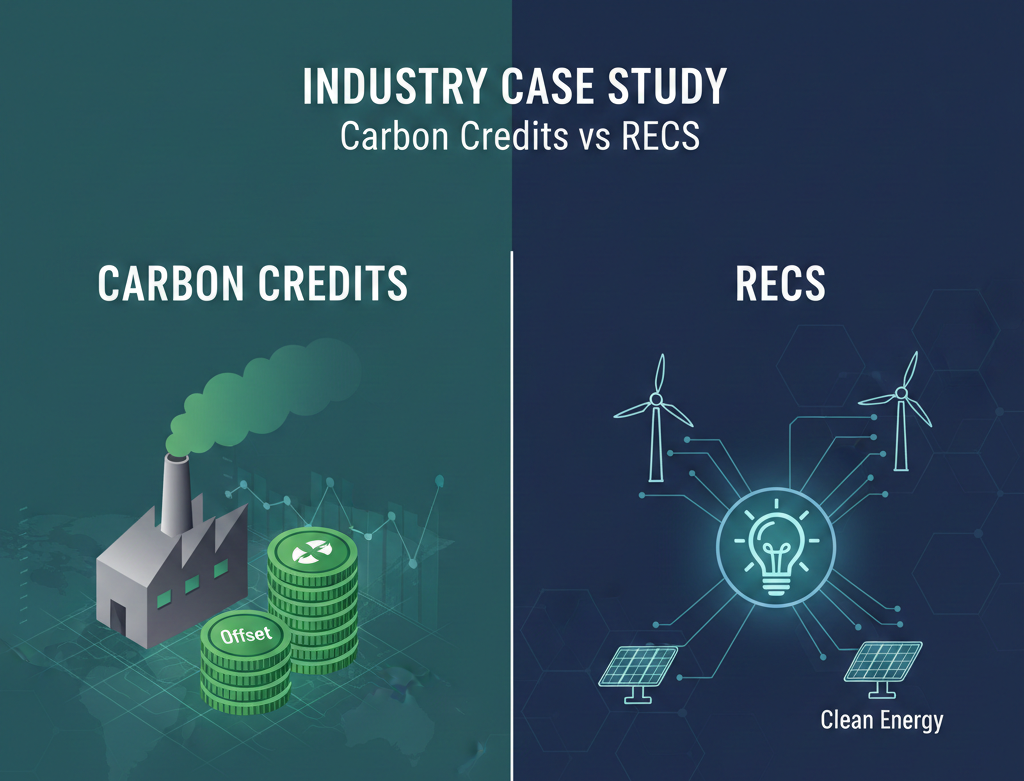
Carbon Credits vs RECs: Industry Case Study
Carbon Credits vs RECs: Industry Case Study
Indian firms are navigating intricate processes to cut emissions, comply with legal obligations, and align with ESG commitments as climate action becomes a defining issue in corporate competitiveness. Carbon credits and Renewable Energy Certificates (RECs) are two of the most talked-about tools. Although they both support environmental goals, their structure, goals, and financial ramifications are very different.
Through the perspective of an Indian manufacturing company making the shift to net zero emissions, this comprehensive business case study examines carbon credits vs. RECs. This paper offers practical insights for companies assessing these tools by examining market frameworks, financial results, regulatory approaches, and long-term sustainability impact.

Comprehending Carbon Credits
One metric ton of carbon dioxide (CO2) or its equivalent is reduced or removed from the atmosphere in the form of carbon credits. Verified climate projects like methane capture, afforestation, renewable energy installations, and energy efficiency upgrades produce these credits.
- The Operation of Carbon Credits
A project’s verifiable decrease in emissions below a predetermined baseline turns into a tradeable credit. These credits are bought by businesses to offset their own emissions. There are two main ways that the market functions:
- Governments regulate compliance markets.
Voluntary Markets: Businesses who have committed to ESG and net zero offset emissions voluntarily.
Emerging frameworks for carbon trading and regulatory measures under the Energy Conservation Act modifications have shaped India’s changing carbon market ecology.
Understanding Certificates of Renewable Energy (RECs)
Market-based documents known as Renewable Energy Certificates serve as evidence that one megawatt-hour (MWh) of electricity was produced using renewable energy sources and delivered to the grid.
The main purpose of RECs is to fulfill regulatory bodies’ Renewable Purchase Obligations (RPOs). A business can show compliance by purchasing RECs when it is unable to directly acquire renewable energy.
How RECs Operate
- Electricity is generated via renewable energy generators.
- The grid receives the electricity.
- A REC is created by separating the environmental attribute.
- Businesses buy RECs to meet renewable energy goals.
RECs do not immediately reflect averted emissions like carbon credits do. Rather, they certify the production of green energy.
Financial Comparison: Analysis of Long-Term Costs
Over a period of five years:
- Strategy for Carbon Credits
- Greater initial outlay
- Possibility of value growth
Investor perception of the ESG premium
- The REC Strategy
- Reduced expenses for compliance
- Minimal influence on branding
- Limited coverage of emissions
RECs exhibit short-term compliance efficiency, while carbon credits exhibit a greater long-term reputational return on investment when assessed using a net present value model.
Implications for ESG and Sustainability Reporting
The distinction between carbon offsetting and renewable energy acquisition is becoming more and more important in global reporting standards. Businesses must openly reveal:
- Total emissions
- Use of renewable energy
- Purchases of offsets
The quality, additionality, permanence, and verification criteria of offsets are increasingly closely examined by investors.
The Case Study’s Strategic Suggestion
Regarding the manufacturing business:
- To fulfill your required Renewable Purchase Obligations, use RECs.
- Over the medium term, make an investment in on-site solar.
- For residual emissions, use premium carbon credits.
- Reduce dependency on offsets over time by improving efficiency.
Credibility, cost, and compliance are all balanced in this hybrid strategy.
Long-Term Prospects for the Industry
Industries will probably move from voluntary offsets to regulated carbon trading as carbon price systems develop. RECs have the potential to develop into integrated energy attribute certificates that are compliant with international standards.
Transparency in both markets will be improved by blockchain-based tracking, digital MRV (Measurement, Reporting, and Verification) systems, and more stringent disclosure requirements.
In conclusion: Carbon Credits vs RECs: Industry Case Study
The argument between RECs and carbon credits is not about picking one over the other. Rather, it is about matching instruments to investor expectations, regulatory requirements, and corporate sustainability goals.
It is crucial for Indian companies navigating decarbonization to comprehend the strategic distinctions between these strategies. The case study shows that carbon credits allow for a wider climate effect and net zero positioning, whilst renewable energy certificates (RECs) guarantee compliance with renewable energy standards.
Businesses will be in a better position to control risks, draw in investment, and take the lead in the developing low-carbon economy if they proactively incorporate both tools into an organized sustainability plan.
Industries that implement smart carbon market strategies now will shape the competitive environment of tomorrow as India moves closer to fulfilling its climate pledges.