
 Aksh
Aksh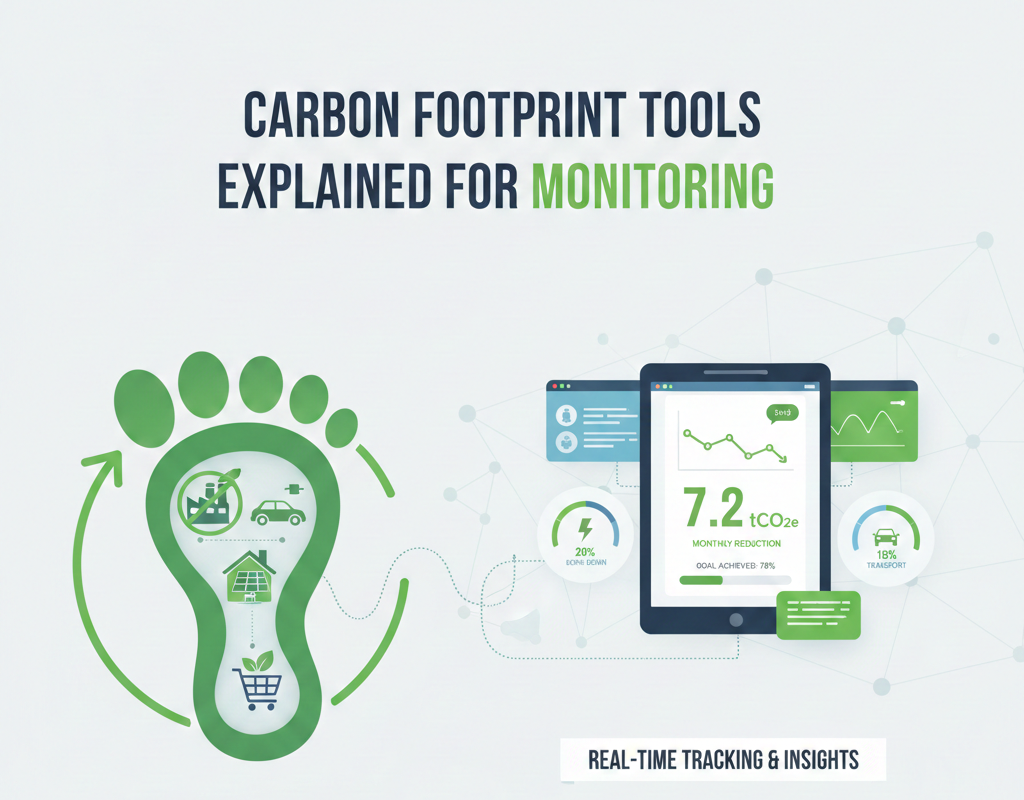
Carbon Footprint Tools Explained for Monitoring
Carbon Footprint Tools Explained for Monitoring
Organizations in India and around the world are facing mounting pressure to monitor, control, and lower their greenhouse gas emissions in the current climate-conscious economy. Carbon footprint technologies have become crucial tools for tracking environmental impact, increasing transparency, and successfully engaging in carbon credit markets as sustainability becomes a key component of company strategy. Knowing how these technologies operate is now strategic for companies looking to maintain their competitiveness, compliance, and accountability.
The practice of calculating the total greenhouse gas (GHG) emissions produced, both directly and indirectly, by a company, good, service, or activity is known as carbon footprint monitoring. The standard unit of measurement for these emissions is carbon dioxide equivalent (CO2e).

Comprehending Carbon Footprint Tracking
The total amount of greenhouse gases released as a result of company operations is known as the “carbon footprint.” The widely accepted framework created by the Greenhouse Gas Protocol divides these emissions into three main categories:
- Scope 1: Direct emissions from controlled or owned sources, including industrial operations, business cars, and fuel burning.
- Scope 2: Indirect emissions from steam, heating, cooling, or electricity purchases.
- Scope 3: Any additional indirect emissions that arise throughout the value chain, such as trash disposal, staff travel, logistics, supplier operations, and product consumption.
In order to assist organizations in creating practical climate strategies, carbon footprint tools are made to measure and analyze emissions across different scopes.
The Importance of Carbon Footprint Tools for Indian Companies
Climate action has accelerated across sectors as a result of India’s commitment to the Paris Agreement and its national goal of achieving net-zero emissions by 2070. Carbon accounting is now more crucial than ever due to regulatory changes, voluntary sustainability reporting requirements, and growing investor scrutiny.
The following benefits are offered by carbon footprint monitoring tools:
- Regulatory Compliance: Adhere to future carbon market laws and environmental compliance standards.
- Participation in Carbon Credits: Precisely measure emission reductions for the creation and exchange of carbon credits.
- Finding energy inefficiencies and cutting operating costs are two aspects of cost optimization.
- Boost reporting credibility and ESG transparency to increase investor confidence.
- Competitive advantage: Comply with regulations pertaining to the sustainability of global supply chains.
Integration with India’s Carbon Credit Strategy
Carbon footprint tools will be essential to the certification of carbon credits as India’s carbon market ecosystem grows.
In order to produce carbon credits, companies need to:
- Calculate the baseline emissions.
- Put reduction projects into action.
- Calculate confirmed reductions in emissions.
- Transparently record and report.
Software for carbon accounting offers the data foundation required for:
- Keeping an eye on initiatives to reduce emissions
- Exhibiting additionality
- Facilitating third-party verification
- Keeping up audit preparedness
Participation in carbon markets becomes risky and unreliable in the absence of precise carbon footprint monitoring.
Principal Advantages of Carbon Management Platform Implementation
- Better Decision-Making
Management is able to prioritize high-impact emission reduction projects because to data-driven insights.
- Improved ESG Reporting
Investor trust is increased by transparent reporting as global sustainability frameworks gain traction.
- Efficiency in Operations
Inefficiencies that lower expenses and emissions are frequently found through energy monitoring.
- Mitigation of Risk
Disclosures about climate risk are becoming required in a number of jurisdictions. Regulatory exposure is decreased through proactive monitoring.
- Reputation of the Brand
Consumers are favoring environmentally conscious brands more and more. Credibility is increased when carbon measures are made public.
Choosing the Appropriate Carbon Footprint Instrument
Indian companies should take into account the following when assessing carbon footprint tools:
- Scalability for expansion in the future
- Adherence to global norms
- Financial and ERP system integration
- Features of data security
- Capabilities for real-time monitoring
- Support for audit and verification
- Reporting formats that can be altered
- Assistance with tracking carbon credits
Selecting the appropriate platform guarantees regulatory compliance and long-term viability.
Carbon Footprint Tracking for Indian MSMEs
Despite making a substantial economic contribution to India, micro, small, and medium-sized enterprises (MSMEs) frequently lack the resources necessary for sophisticated sustainability systems.
MSMEs may do the following thanks to simplified carbon footprint calculators and reasonably priced cloud-based carbon accounting software:
- Monitor your energy usage.
- Find areas for efficiency
- Obtain green financing
- Engage in carbon markets that are voluntary.
Small business adoption is anticipated to rise as a result of government incentives and green finance efforts.
In conclusion: Carbon Footprint Tools Explained for Monitoring
Tools for measuring, managing, and lowering greenhouse gas emissions are now essential for any firm. Accurate carbon monitoring is the cornerstone of environmental compliance, carbon credit participation, and ESG excellence in India’s quickly changing sustainability landscape.
These technologies, which range from supply chain tracking tools and sustainability management platforms to carbon accounting software and emission monitoring systems, enable companies to shift to low-carbon operations. Indian businesses may meet international climate regulations, access carbon credit opportunities, increase operational effectiveness, and create long-term resilience by implementing cutting-edge carbon management technologies.
Investing in efficient carbon footprint monitoring is becoming more than just an environmental choice; it is a strategic business necessity as climate responsibility becomes a fundamental part of corporate governance.