
 Aksh
Aksh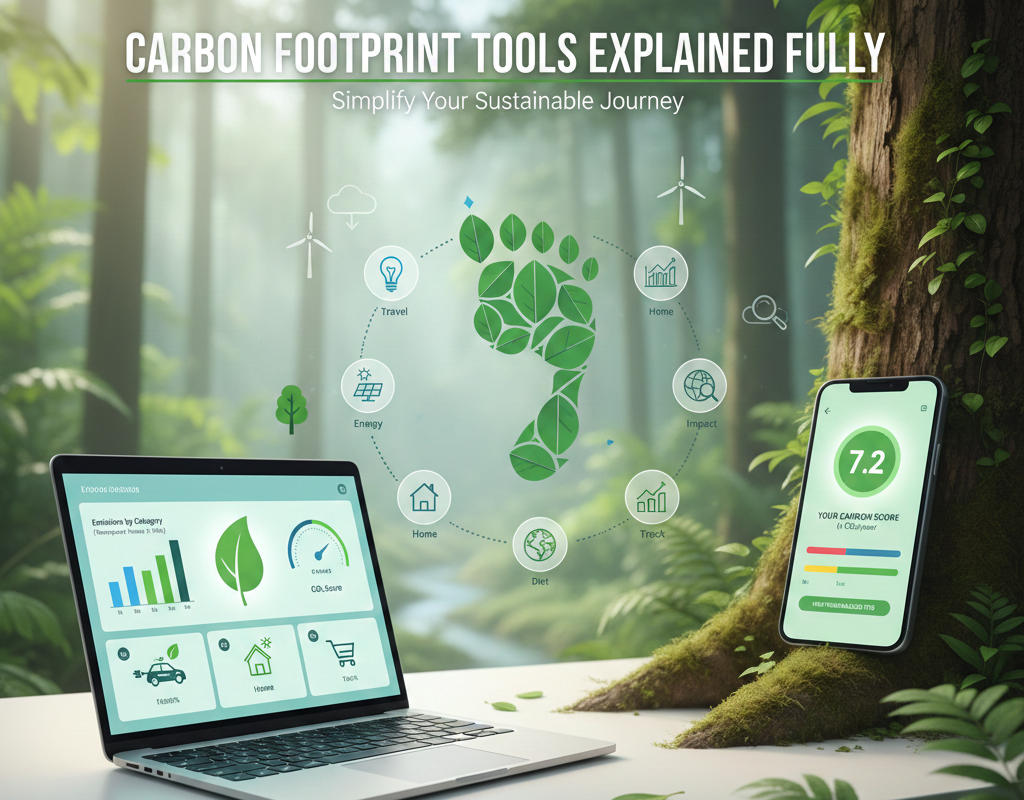
Carbon Footprint Tools Explained Fully
Carbon Footprint Tools Explained Fully
The issue of climate change is not a remote one anymore. In India, companies, governments, and people are constantly looking for methods to assess, control, and lessen their environmental impact. One key idea is at the center of many sustainability initiatives: the carbon footprint. Accurate data, dependable systems, and organized reporting are necessary for comprehending and controlling carbon emissions. Here’s where carbon footprint tools can make a big difference.
Carbon footprint tools are analytical or digital solutions used to determine greenhouse gas (GHG) emissions from businesses, activities, goods, or people. These tools assist organizations in tracking reductions, quantifying emissions, adhering to global climate obligations, and complying with legislation.

Comprehending Carbon Footprint: The Basis
An entity’s total greenhouse gas emissions, whether directly or indirectly, are measured by its carbon footprint. Carbon dioxide equivalent (CO₂e), a standardized measure that takes into account several greenhouse gases such as carbon dioxide (CO₂), methane (CH₄), and nitrous oxide (N₂O), is commonly used to express these emissions.
According to the Greenhouse Gas Protocol, carbon footprints fall into three main categories:
- Scope 1: Direct emissions from sources that are owned or under control (such as company vehicles or fuel combustion).
- Scope 2: Indirect emissions from steam, heating, cooling, or electricity purchases.
- Scope 3: Every additional indirect emission in the value chain, such as waste disposal, travel, and the supply chain.
These scopes serve as the foundation for carbon footprint tools, which assist organizations in methodically organizing their emission inventories.
Carbon Footprint Tools: What Are They?
Carbon footprint tools include enterprise systems, calculators, and software platforms that:
- Gather information about activities (energy use, travel, production, logistics).
- Use emission factors to determine CO2e.
- Create thorough reports.
- Encourage adherence to sustainability guidelines
- Connect to carbon credit systems
- Monitor your progress toward achieving net-zero.
You can use these tools by:
- Big businesses
- Small and medium-sized businesses (SMEs)
- Governmental organizations
- Manufacturing sectors
- Institutions of higher learning
- People
Carbon footprint tools are becoming more and more necessary for businesses as India advances climate legislation under the framework of the Paris Agreement and develops its own carbon market.
The Significance of Carbon Footprint Tools in India
India’s economy is among the fastest-growing due to its burgeoning industry, infrastructural, and energy needs. Although it promotes development, growth also raises carbon emissions.
Tools for measuring carbon footprints are crucial because:
- Regulatory Compliance: Sustainability disclosures and ESG reporting requirements must be met by Indian businesses.
- Investor Expectations: A growing number of investors are assessing their exposure to climate risk.
- Global Supply Chain Requirements: Transparency in emissions is demanded by foreign purchasers.
- Carbon Market Participation: In order to produce or acquire carbon credits, businesses must measure their reductions.
- Savings: Energy and operating expenses are decreased when inefficiencies are found.
The requirement for organized carbon accounting systems is reinforced by India’s pledge to achieve net-zero emissions by 2070.
Crucial Elements of Powerful Carbon Footprint Instruments
Businesses should consider the following when choosing a carbon footprint tool:
- Adherence to international norms
- Emission factors unique to India
- Data integration that is automated
- Capacity for Scope 3 computation
- Reports that are ready for an audit
- Access via the cloud
- Compatibility with carbon credits
- Dashboards in real time
- Modeling scenarios
- Interface that is easy to use
Scalability is also essential, particularly for expanding companies.
The Advantages of Carbon Footprinting Tools
- Increased Openness
Transparency in reporting fosters confidence among investors, customers, and authorities.
- Better Ability to Make Decisions
Initiatives for reduction are prioritized with the aid of data-driven insights.
- Economic Savings
Operational costs are decreased through resource optimization and energy efficiency.
- A competitive edge
Brand reputation is enhanced by sustainability positioning.
- Managing Risk
Exposure to climate risk becomes quantifiable and controllable.
Measurement Challenges for the Carbon Footprint
Despite the benefits, businesses nevertheless have to deal with issues like:
- Problems with data accuracy
- Complicated Scope 3 computations
- Variations in emission factors
- Insufficient transparency from suppliers
- Uncertainties in regulations
Sophisticated carbon management systems use workflows and automation to help overcome these obstacles.
In conclusion: Carbon Footprint Tools Explained Fully
In today’s climate-conscious industry, carbon footprint tools are strategic needs rather than optional. Structured carbon accounting systems offer clarity, transparency, and quantifiable effect to Indian firms navigating ESG compliance, carbon markets, and sustainability promises.
These technologies, which range from basic carbon calculators to enterprise-level carbon management systems, enable businesses to measure emissions, lessen their influence on the environment, and take advantage of carbon credit opportunities.
Carbon footprint tools will serve as the foundation for emission transparency, climate accountability, and sustainable economic growth as India moves closer to its long-term climate targets. Companies will be in a better position to spearhead the low-carbon economy of the future if they implement strong carbon management systems now.
Carbon Footprint Tools for NGOs: Complete 2026 Guide to Measuring, Managing, and Reducing Emissions
Carbon Footprint Tools for NGOs: Complete 2026 Guide to Measuring, Managing, and Reducing Emissions