
 Aksh
Aksh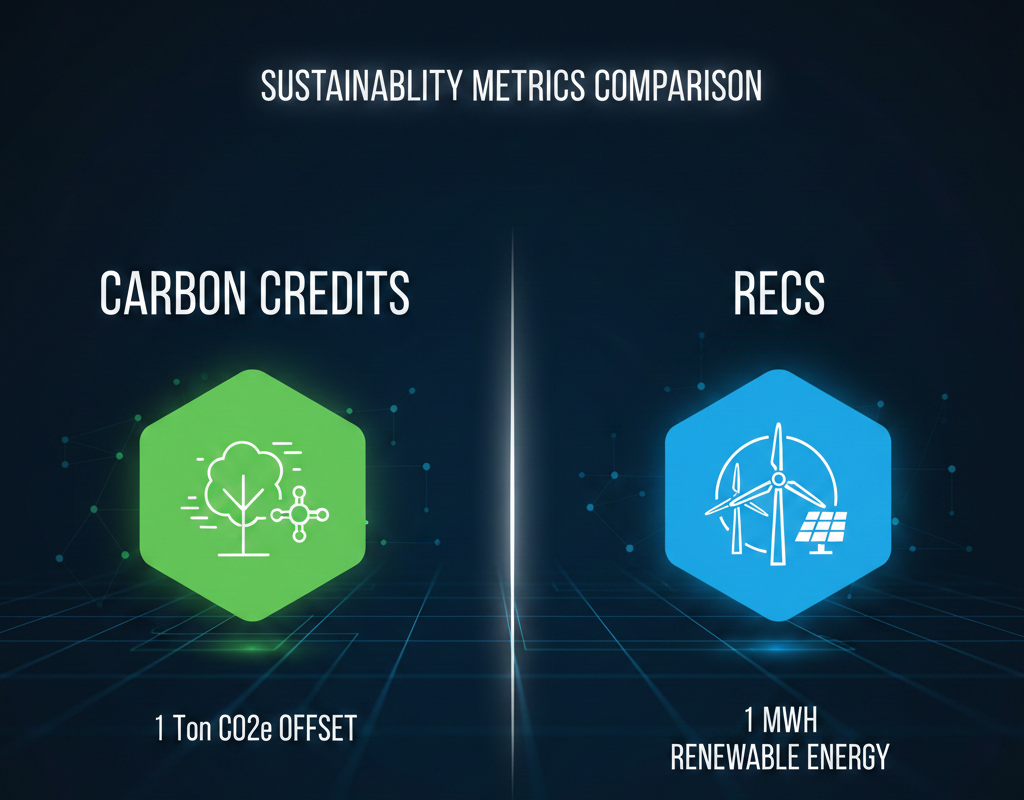
Comprehensive Carbon Credits vs RECs Comparison
Comprehensive Carbon Credits vs RECs Comparison
India is moving at a never-before-seen rate toward a low-carbon economy. Environmental tools like carbon credits and Renewable Energy Certificates (RECs) are becoming more well-known as a result of aggressive climate pledges, corporate sustainability requirements, and growing investor scrutiny under ESG frameworks. But there is frequently still misunderstanding about their structure, goal, financial worth, and compliance needs.
Companies, project developers, sustainability consultants, and investors working in India’s changing environmental markets must comprehend the difference between carbon credits and RECs. In order to make clear how both tools work, when they are applicable, and how firms may strategically use them, this thorough guide provides a detailed explanation of each tool along with a comparison table.

Carbon Credits: What Are They?
One metric tonne of carbon dioxide equivalent (CO2e) removed from the atmosphere is represented by carbon credits, which are tradable certificates. Projects that lower greenhouse gas emissions, like methane collection systems, afforestation initiatives, renewable energy installations, energy efficiency upgrades, and industrial emission reductions, are the source of these credits.
After being verified by recognized organizations, a project receives carbon credits when it can be shown to reduce emissions below a baseline scenario. Businesses looking to reduce their carbon footprint can then purchase these credits.
There are two main markets for carbon credits:
- Compliance Market: Subject to international or national regulations.
- Organizations seeking to achieve net-zero or internal ESG goals use the voluntary market.
With new carbon market mechanisms and frameworks being developed under the Ministry of Environment, Forests, and Climate Change, India’s regulatory environment is still changing.
Renewable Energy Certificates (RECs): What Are They?
Market-based documents known as Renewable Energy Certificates (RECs) serve as evidence that one megawatt-hour (MWh) of electricity was produced using renewable resources like biomass, wind, sun, or hydropower.
RECs do not immediately reflect reductions in emissions, in contrast to carbon credits. Rather, they attest to the electricity’s renewable source. The main purpose of RECs in India is to fulfill Renewable Purchase Obligations (RPOs) that are required of captive power producers, open-access customers, and distribution firms.
The amount of renewable electricity generated and fed into the system is represented by each REC. The environmental attribute is separated and traded separately through markets once the electricity is used.
Applications for Compliance
- Compliance with Carbon Credits
International compliance systems and voluntary environmental commitments are the main uses for carbon credits. It is anticipated that compliance-based carbon trading will grow considerably as India fortifies its carbon market systems.
High emissions intensity industries may potentially be subject to formal obligations that require them to offset or reduce emissions.
- RECs Compliant
Renewable Purchase Obligations (RPO) directly involve RECs. To meet required quotas, entities who are unable to directly acquire renewable electricity can buy RECs.
RECs are a compliance requirement for obliged entities since noncompliance with RPO targets may result in penalties.
Economic Factors
- Pricing of Carbon Credits
Prices for carbon credits vary according to:
- Project type (prices for forestry credits are frequently high)
- Standard of verification
- Vintage year
- Demand in the market
- Co-benefits (social impact, biodiversity)
Between voluntary and compliant markets, prices vary greatly.
- REC Costing
The following factors affect REC prices:
- RPO objectives
- Capacity to generate renewable energy
- Modifications to regulations
- The liquidity of the market
When compared to voluntary carbon markets, REC markets often show greater regulation price stability.
Impact of ESG and Corporate Sustainability
Measurable sustainability measures are becoming more and more necessary for Environmental, Social, and Governance (ESG) reporting.
Carbon credits have a direct effect on net-zero declarations and carbon footprint reporting. RECs support claims for renewable electricity under Scope 2.
Clarity is essential for transparent reporting since investors and rating agencies distinguish between purchasing green energy and reducing emissions.
Risk Elements
- Credits for Carbon
- Verification of additionality
- Concerns about permanence, particularly in forestry
- Volatility of the market
- Uncertainty in regulations
- RECs
- Modifications to policy
- Risks of over-supply
- Restricted capacity to trade internationally
Businesses may create balanced sustainability strategies by having a thorough understanding of these risks.
Use Cases for Strategy
- When to Utilize Carbon Credits
- To compensate for any remaining emissions
- In order to fulfill net-zero pledges
- For worldwide adherence to ESG
- Regarding global reporting guidelines
- When to Make Use of RECs
- To fulfill requirements for renewable purchases
- To illustrate the use of renewable electricity
- In order to comply with green energy regulations
- To encourage the expansion of the renewable energy industry
Prospects for India’s Future
Environmental markets are undergoing structural change as a result of India’s pledge to achieve net-zero emissions by 2070. It is anticipated that carbon pricing schemes will develop, opening up new markets for sectors, financiers, and businesses with an emphasis on sustainability.
Credibility and liquidity in the carbon credit and REC markets are anticipated to be enhanced by the incorporation of digital registries, open trading platforms, and global alignment.
The demand for validated carbon instruments will increase due to the push for green hydrogen, large-scale renewable installations, and industrial decarbonization.
In conclusion: Comprehensive Carbon Credits vs RECs Comparison
The cornerstones of India’s sustainability architecture are carbon credits and renewable energy certificates. Their methods, uses for compliance, and market dynamics vary greatly, despite the fact that they both aim to advance climate action.
Understanding these distinctions is strategic for companies working in India’s changing regulatory environment, not just academic. Businesses that use RECs for renewable compliance and carbon credits for emissions reduction put themselves at the forefront of responsible growth.
Organizations that proactively incorporate these tools into their sustainability frameworks will benefit from regulatory resilience, investor trust, and long-term competitive advantage as India fortifies its environmental market infrastructure.