
 Aksh
Aksh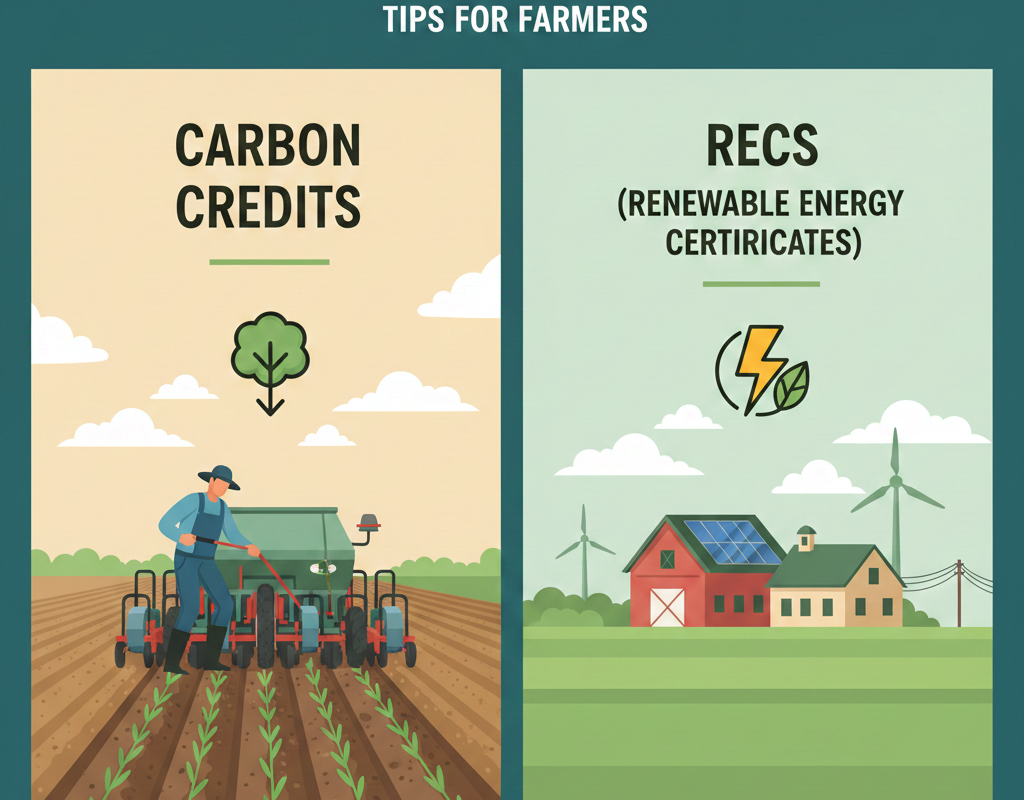
Comprehensive Guide for Farmers: How to Maximize Income?
Comprehensive Guide for Farmers: How to Maximize Income?
Farmers are finding new revenue streams in environmental markets as global markets move toward sustainability and climate accountability. Renewable energy certificates (RECs) and carbon credits are two of the most promising possibilities. Both offer financial incentives and promote climate goals, but they function differently and are appropriate for different kinds of agricultural activity.
Knowing the difference between carbon credits and renewable energy certificates (RECs) is crucial for farmers who want to increase their revenue streams, enhance soil health, or make investments in renewable energy. This thorough manual describes each system’s operation, associated risks and advantages, and practical advice to assist farmers optimize profits while promoting environmental sustainability.

Comprehending Farmers’ Carbon Credits
Verified decreases or eliminations of greenhouse gas emissions are represented by carbon credits. One metric ton of reduced or sequestered carbon dioxide equivalent (CO2e) is normally equivalent to one carbon credit. By implementing techniques that decrease methane emissions, store carbon in the soil, or cut total agricultural emissions, farmers can produce carbon credits.
The following are typical agricultural practices that produce carbon credits:
- No-till or conservation tillage farming
- Using cover crops
- Agroforestry
- Methane extraction from animal dung
- Better control of fertilizer
- Use of biochar
- Regenerative grazing methods
Farmers can sell carbon credits in voluntary or compliant carbon markets after implementing these techniques and proving quantifiable emission reductions.
Understanding Certificates of Renewable Energy (RECs)
One megawatt-hour (MWh) of power produced by renewable sources, such as solar, wind, biomass, or small hydro, is demonstrated by a Renewable Energy Certificate.
In addition to selling power, farmers who build renewable energy systems on their property, including solar panels, biogas plants, or wind turbines, can receive RECs.
A separate revenue stream can be generated by selling each REC independently of the electricity itself.
- How Farmers Make Money Using RECs
- When a farm produces electricity using renewable resources:
- The electricity can be sold to the grid or utilized on-site.
- RECs are created from that electricity’s renewable quality.
- These RECs are sold to organizations that have renewable energy commitments.
Advice for Farmers Thinking About Carbon Credits
- Determine the Carbon Potential of Your Farm
Assessing your land type, cropping system, animal operations, and existing practices should be your first step. Strong prospects for carbon projects are farms with deteriorated soils because they frequently have better potential for sequestering carbon.
To determine baseline carbon levels, test the soil. It is impossible to assess credit generation precisely without a baseline.
- Select Regenerative Methods That Have Measurable Effects
Stronger carbon results are produced by specific practices:
- Soil disturbance is decreased by no-till systems.
- Organic matter is improved by cover crops.
- Agroforestry incorporates carbon-absorbing trees.
- Soil carbon storage is enhanced by rotational grazing.
To reduce disruption, choose methods that complement your current farming operations.
- Recognize the Need for Additionality
“Additionality” is necessary for carbon markets. This implies that your current practices need to be expanded upon. It might not be considered a new emission reduction action if you have been using no-till for years.
- Keep thorough farm records
Precise documentation is essential. Maintain documentation of:
- Dates for planting
- Rotation of crops
- Use of fertilizer
- Methods of tillage
- Numbers of livestock
- Management of manure
Payment cycles are accelerated and verification is made easier with digital recordkeeping.
Advice for Farmers Thinking About RECs
- Assess the Potential for Renewable Energy
Evaluate the amount of sunlight, wind speed, and biomass availability. sun installations can be quite beneficial for farms with wide space and high levels of sun radiation.
- Recognize the Need for Capital Investment
Installing renewable energy requires upfront funding:
- Solar arrays
- Inverters
- Systems for mounting
- Digesters for biogas
Nonetheless, a variety of funding sources and subsidies could lessen the initial financial strain.
- Take Into Account Onsite Energy Savings
Utility costs are decreased when electricity is generated on-site. Beyond energy savings, REC income generates additional cash.
- Enroll with the Correct Authorities
Grid rules and renewable certification requirements must be met in order for RECs to be issued. Make sure systems fulfill eligibility requirements and are appropriately metered.
- Keep an eye on market prices
Targets and supply levels for renewable energy have an impact on REC markets. Keep an eye on trends to determine the best moment to sell.
Hazards and Difficulties Farmers Need to Be Aware of
- The volatility of the market
Prices for RECs and carbon credits vary according on corporate and regulatory demand.
- Complexity of Verification
Carbon projects can take a lot of time because they need thorough audits and scientific measurement.
- Long-Term Dedication
Carbon storage needs to be kept up for a number of years. Credit cancelation may result from reversing behaviors.
- Upkeep of Technology
Systems using renewable energy need upkeep and technological know-how.
A Strategic Method for Farmers
- Perform financial and environmental feasibility studies.
- Speak with carbon project developers or sustainability specialists.
- Examine income forecasts under various conditions.
- Diversify sources of income related to the environment.
- Long-term farm planning should incorporate sustainability.
Concluding: Comprehensive Guide for Farmers: How to Maximize Income?
For agricultural enterprises, carbon credits and RECs offer revolutionary possibilities. Farmers may contribute to climate solutions and create new revenue streams by comprehending the differences, assessing agricultural potential, and implementing systematic planning.
Making educated decisions is crucial. Start wisely, evaluate your resources, and comprehend commitments.
Sustainability is now a practical agricultural economic strategy as well as an environmental duty.
Farmers that take action now increase their land’s long-term productivity and profitability while putting themselves at the forefront of the green economy.