
 Aksh
Aksh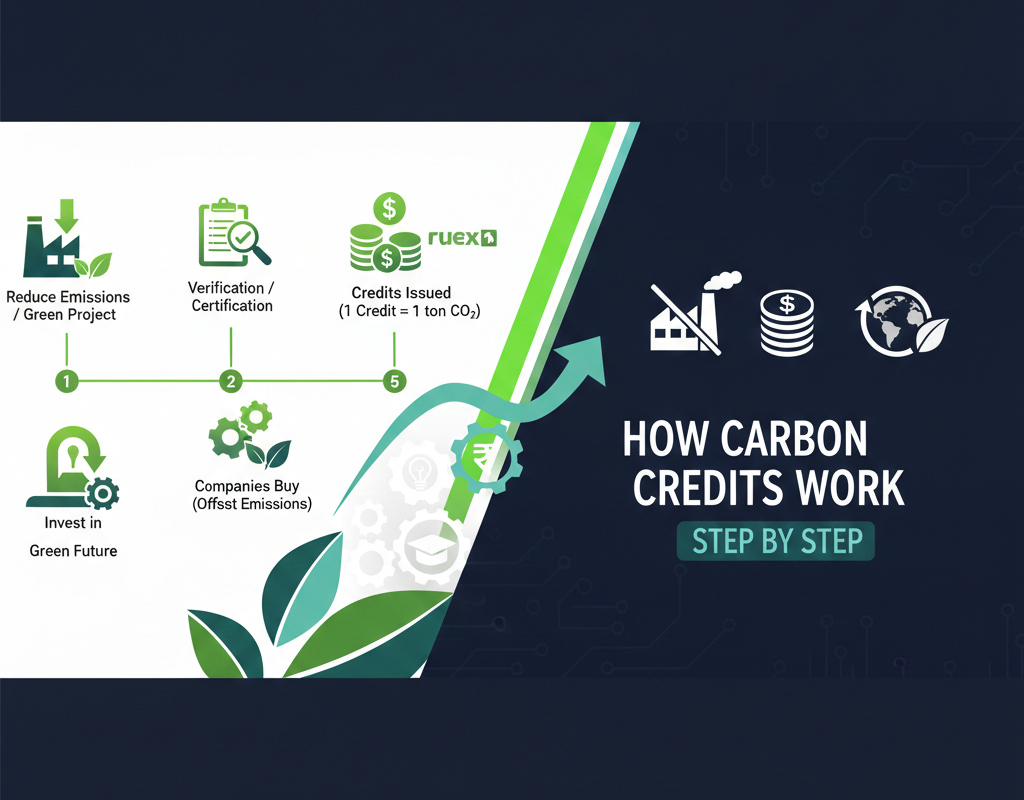
How Carbon Credits Work Step by Step?
How Carbon Credits Work Step by Step?
One of the most significant issues confronting the globe today is climate change. Extreme weather, pollution, melting glaciers, and rising temperatures are all indicators that human activity is having an impact on the environment. There is pressure on governments, corporations, and industries to lower greenhouse gas emissions. The carbon credit system is one of the best instruments designed to combat climate change.
By placing a cost on carbon emissions, carbon credits aid in pollution control. They push businesses to promote environmentally friendly initiatives and cut emissions. Everyone may easily understand this article’s step-by-step explanation of how carbon credits operate in plain English.
Carbon Credits: What Are They?
A certificate or permission that permits the bearer to emit a specific quantity of carbon dioxide or other greenhouse gases is known as a carbon credit. One metric ton of carbon dioxide emissions is typically equivalent to one carbon credit.
A business can receive carbon credits if it lowers emissions below the permitted level. Other businesses that over their emission restrictions can then purchase these credits. As a result, there is an economic incentive to cut pollution.
The Significance of Carbon Credits
The reason carbon credits are significant is that they
- Cut back on greenhouse gas emissions
- Promote clean energy initiatives
- Encourage sustainable growth
- Assist businesses in achieving climate goals
- Establish a worldwide market for reducing emissions
Carbon credits offer an adaptable and useful alternative to enterprises being forced to close.
Carbon Market Types
Understanding the two primary forms of carbon markets is crucial before delving into the detailed procedure.
- Market for Compliance Carbon
Governments or international agreements regulate this market. Businesses must adhere to legally mandated emission standards. They will be penalized or forced to purchase carbon credits if they beyond the limitations.
- Market for Voluntary Carbon
To offset their emissions, businesses and people in this market voluntarily purchase carbon credits. This market is used by many companies to reach carbon neutrality or environmental targets.
Step 1: Calculating Carbon Emissions
Emissions measurement is the initial step in the carbon credit process.
Businesses determine the amount of greenhouse gases they emit into the atmosphere. This comprises emissions from:
- Use of fuel
- Use of electricity
- Production procedures
- Moving around
- Management of waste
Since carbon credits are based on confirmed emission data, precise measurement is crucial.
Step 2: Establishing an Emission Baseline
The amount of emissions that would happen in the absence of any reduction project is known as the baseline.
For instance:
- A coal-powered factory has a high baseline.
- There is also a baseline for a forest region that faces destruction.
Emission savings from carbon reduction projects are calculated by comparing them to this baseline.
Step 3: Creating a Project for Carbon Credit
Approved projects that cut, eliminate, or prevent emissions produce carbon credits.
Typical carbon credit initiatives consist of:
- Renewable energy initiatives such as wind and solar
- Tree planting and forest preservation
- Enhancements in energy efficiency
- Capture of methane from landfills
- Methods of sustainable agriculture
Every project needs to demonstrate in detail how it lowers emissions in comparison to the baseline.
Step 4: Registering for the Project
A project needs to be registered under a recognized carbon standard after it has been designed.
Enrollment guarantees:
- The project is authentic.
- The decreases in emissions are quantifiable.
- The project adheres to established methodologies.
A project cannot produce carbon credits if it is not registered.
Step 5: Project Implementation
Following registration, the initiative is put into action.
For instance:
- There are solar panels installed.
- Trees are planted and kept safe.
- Old equipment is replaced by more efficient machinery.
From this point on, the initiative begins to reduce emissions.
Issues in the Market for Carbon Credits
The carbon credit system has drawbacks despite its advantages.
- Issues with Quality
Not every credit reflects actual decreases in emissions.
- Greenwashing
In order to look environmentally green without actually lowering emissions, some businesses abuse carbon credits.
- Volatility of Prices
The cost of carbon credits might vary significantly.
The Climate Goals of India and Carbon Credits
India is concentrating on energy efficiency, afforestation, and renewable energy. These initiatives are aided by carbon credits, which draw capital and promote environmentally friendly behavior.
Carbon credits have the potential to significantly contribute to India’s low-carbon transition with the right administration.
Carbon Taxes versus Carbon Credits
Although they function differently, carbon credits and carbon taxes both seek to lower emissions.
Carbon taxes punish emissions, but carbon credits reward decrease. The optimum option, according to many experts, is a combination of both.
Concluding: How Carbon Credits Work Step by Step?
An effective way to combat climate change and promote economic expansion is through carbon credits. They promote innovation, sustainability, and environmental preservation by placing a value on emission reduction.
Businesses, legislators, and individuals can make better decisions if they have a thorough understanding of how carbon credits operate. Carbon credits have the potential to significantly contribute to the creation of a cleaner and greener future for the earth if they are used properly.
How UAE Businesses Can Profit from Carbon Credit Trading in 2025
How UAE Businesses Can Profit from Carbon Credit Trading in 2025