
 Aksh
Aksh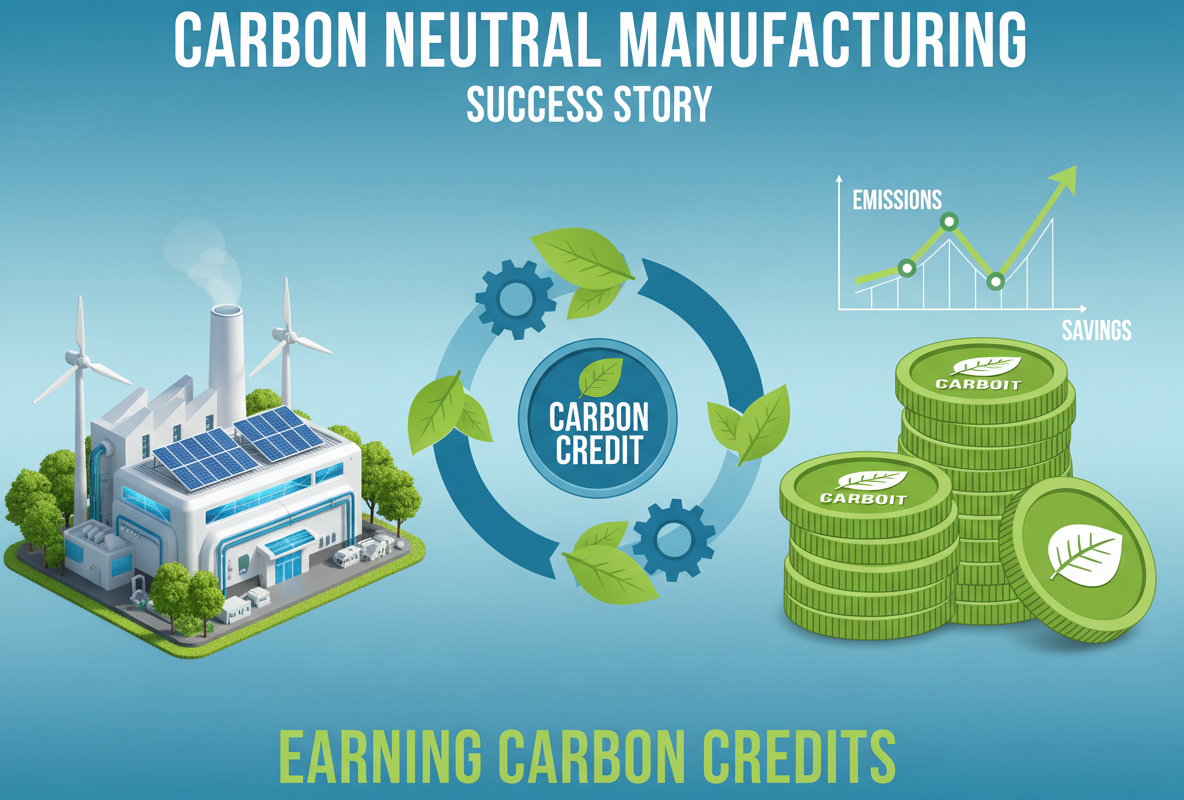
How Indian Manufacturers Achieved Carbon Neutrality?
How Indian Manufacturers Achieved Carbon Neutrality?
India has been a leader in implementing carbon neutral manufacturing processes in response to the country’s fast industrial boom and growing worries about climate change. The strong advantages of carbon credits are driving this change in addition to environmental concern and governmental pressure. Indian industry has entered a new era where sustainability and profits go hand in hand, thanks to carbon credit programs that are changing corporate strategies and enabling quantifiable emissions reduction.
The remarkable success of carbon-neutral manufacturing in India is examined in this article. By highlighting important tactics, results, difficulties, and lessons gained that others can follow, it illuminates how carbon credits have assisted industries in achieving environmental excellence.

India’s Growing Carbon-Neutral Manufacturing
- Industrial Development against Environmental Consciousness
India’s manufacturing industry has been a vital source of economic expansion for many years. Indian manufacturers have made substantial contributions to the country’s GDP and employment, producing anything from chemicals and textiles to cars and large machinery. But this advancement came at a great environmental cost: resource depletion, greenhouse gas (GHG) emissions, and high energy usage.
The Indian government, business community, and civic society saw the need for sustainable growth as global warming quickened. Manufacturing companies started incorporating environmental, social, and governance (ESG) considerations into their main business plan. The objective? to be competitive in a market that is becoming more environmentally sensitive while coordinating manufacturing methods with global climate goals.
- Definition of Carbon Neutrality
To achieve carbon neutrality, greenhouse gas emissions must be balanced with an equivalent reduction or offset. Reducing direct and indirect emissions through cleaner energy, operational efficiency, and carbon credit compensation are all necessary for manufacturers to reach carbon neutrality.
One metric ton of carbon dioxide equivalent (CO2e) or other greenhouse gas reduction is represented by carbon credits, which are tradable certifications. They serve as a market mechanism to encourage the reduction of emissions and assist businesses in offsetting emissions that cannot be avoided by funding reduction initiatives elsewhere.
How Indian Manufacturing Was Affected by Carbon Credits
- Creating Baselines for Measurable Emissions
Evaluating current emissions is the first step towards carbon neutral manufacturing. To perform thorough greenhouse gas inventory, Indian industries worked with environmental experts, auditors, and technology companies. These investigations clarified energy consumption, sources of emissions, and opportunities for reduction.
- Putting Energy Efficiency Measures Into Practice
The low-hanging fruit was energy efficiency. To cut energy use, manufacturers modernized equipment, implemented sophisticated energy management systems, and improved production scheduling. These adjustments reduce operating costs and pollutants considerably.
- Making the Switch to Renewable Energy
One of the main causes of industrial emissions is the production of energy. Many Indian manufacturers switched to renewable energy in order to become carbon neutral. Power purchase agreements (PPAs) with wind and solar farms, solar installations on industrial rooftops, and the integration of biomass energy for heat generating were all examples of this.
Beyond Reducing Emissions, Carbon Neutral Manufacturing Offers Advantages
- Competitive Advantage and Market Differentiation
Carbon neutral production improves market positioning and brand loyalty in a time when consumers value sustainable products. Businesses that exhibit environmental responsibility draw in eco-aware customers and international partners.
- Opportunities for Funding and Investment
Investment decisions are sometimes influenced by sustainability measures. Green bonds, ESG-focused funds that promote climate action, and funding tied to sustainability are all available to carbon neutral manufacturers.
- Regulatory Preparedness
Early implementation of carbon neutral techniques puts firms ahead of compliance trends, as future rules are guided by international agreements such as the Paris Agreement and changing climate policies. This lowers regulatory risk and gets businesses ready for new carbon pricing schemes.
Obstacles and Their Solutions for Manufacturers
- Gathering Information and Reporting Emissions
Although it can be challenging to get, accurate emissions data is crucial. To improve the measurement, reporting, and verification of their emissions, manufacturers made investments in digital tools, Internet of Things sensors, and specialized training.
- High initial outlay of funds
Energy retrofits and renewable energy installations might have high upfront expenditures. Businesses lessened this through collaborations that lowered initial costs, government incentives, and phased deployment.
- Carbon Credit Market Complexity
Expertise was needed to comprehend carbon credit criteria, price, and verification procedures. To create well-informed carbon credit purchase plans, manufacturers attended industry events and hired outside advisors.
Prospects for Carbon Neutral Manufacturing in the Future
- Including the Principles of the Circular Economy
Circular economy practices, such as designing waste out of systems, recycling materials, and extending product life cycles, are increasingly associated with carbon neutral production. These ideas further lessen the impact on the environment and improve resource efficiency.
- Capturing and Utilizing Carbon
For industries with difficult-to-reduce emissions, emerging carbon capture, utilization, and storage (CCUS) technologies show promise. In order to capture pollutants at the source and produce goods with added value, future production systems may incorporate CCUS technology.
- Transparency Is Made Possible by Digital Transformation
Sustainability reporting, carbon credit traceability, and emissions tracking are all being improved by blockchain, artificial intelligence, and data analytics. Climate accountability is strengthened and stakeholder confidence is bolstered by this transparency.
In conclusion: How Indian Manufacturers Achieved Carbon Neutrality?
In India’s industrial environment, carbon neutral production is now a reality rather than a pipe dream. Indian manufacturers have demonstrated that sustainability and economic growth can coexist through the deliberate adoption of carbon credits, operational innovations, integration of renewable energy, and a strong commitment to environmental care.
From establishing baselines to utilizing carbon markets and creating resilient manufacturing systems for the future, this success story has important lessons for sectors all around the world. The next phase of industrial transformation will continue to be shaped by carbon neutral manufacturing as demand for sustainable output grows worldwide.
The path to carbon neutrality is feasible, significant, and crucial, regardless of whether it is motivated by consumer expectations, climate risk, or evolving regulations.