
 Aksh
Aksh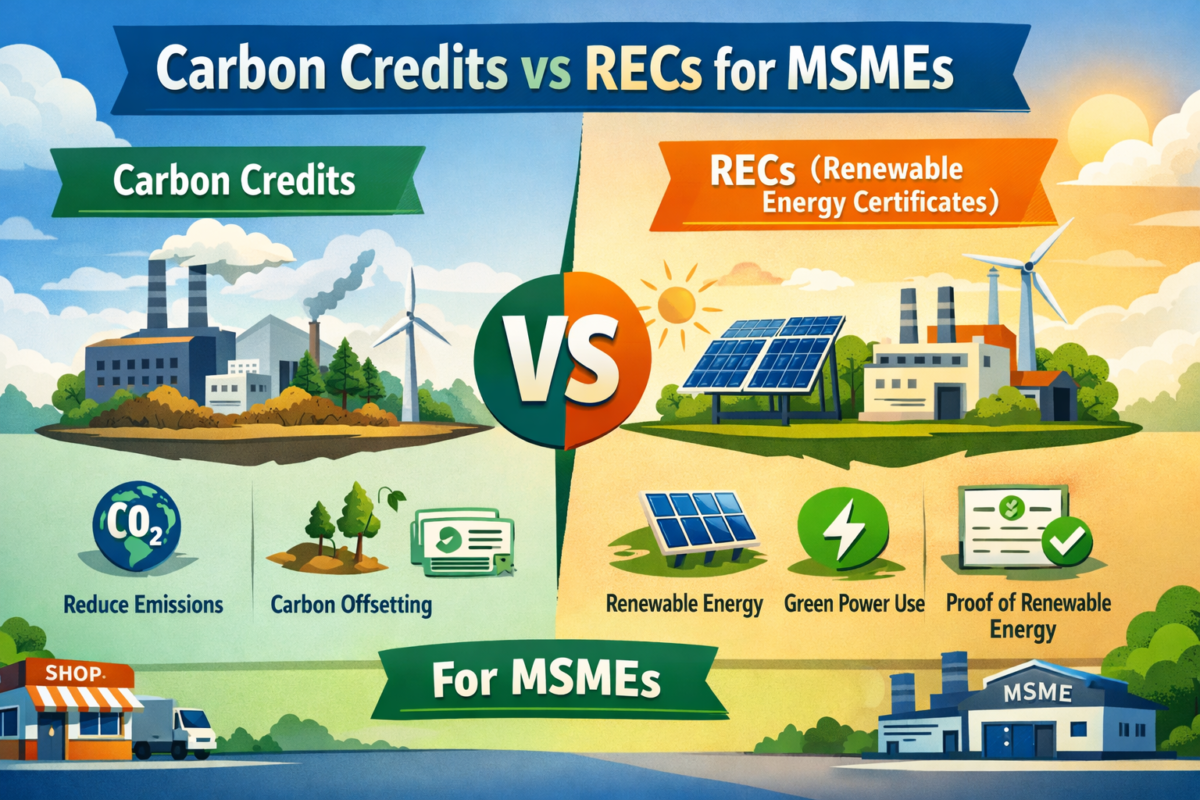
How MSMEs Can Benefit from Carbon Credits and RECs?
How MSMEs Can Benefit from Carbon Credits and RECs?
In the quickly changing global economy of today, big businesses are no longer the only ones who have a need to be environmentally conscious. Micro, Small, and Medium-Sized Businesses (MSMEs) are becoming more aware of the value of sustainability in order to improve their competitive stance, open up new revenue streams, and lessen their impact on the environment. Renewable Energy Certificates (RECs) and Carbon Credits are two important procedures that are attracting the attention of Indian enterprises.
Carbon Credits and RECs serve various purposes, adhere to different criteria, and provide different benefits, particularly for MSMEs operating in India, even if both methods support environmental sustainability and climate action. Any company that wants to grow sustainably must comprehend these distinctions and how MSMEs can use them to their advantage for both legal and financial reasons.

Carbon Credits: What Are They?
The right to release one tonne of carbon dioxide equivalent (CO₂e) into the environment is represented by trade certificates called carbon credits. In essence, each carbon credit allows a company to emit a certain amount of greenhouse gasses. Carbon credits are produced and can be traded in carbon markets when emissions are decreased or eliminated by sustainable practices like methane capture, clean energy initiatives, or forest protection.
Important Carbon Credit Features
- Represent quantifiable greenhouse gas emission reductions or eliminations.
- Expressed in CO₂ equivalent (CO₂e) units.
- Utilized in markets for regulated compliance as well as voluntary carbon markets.
- Governed by global norms like the Gold Standard and Verra’s Verified Carbon Standard (VCS).
- Can be sold or exchanged to make money.
Renewable Energy Certificates (RECs): What Are They?
Market-based documents known as Renewable Energy Certificates (RECs) serve as evidence that one megawatt-hour (MWh) of electricity was produced using a renewable energy source, such as hydro, wind, or solar power. When renewable energy is produced and fed into the grid, a REC is created for every MWh of electricity generated.
Important REC Features
- Showcase the generation of power from renewable sources rather than directly reducing greenhouse gas emissions.
- Facilitate tracking and trading of renewable energy attributes.
- Permit companies to make claims about using green energy without actually using renewable electricity.
- Frequently employed to fulfill corporate sustainability objectives or renewable energy targets.
- Tradeable via REC marketplaces or energy exchanges.
The Significance of Carbon Credits and RECs for MSMEs
One of the world’s most thriving MSME industries, which greatly boost employment and economic output, is found in India. But MSMEs also have certain sustainability issues:
- Restricted availability of technology
- Financial limitations for environmentally friendly solutions
- Expectations from regulations for environmental compliance
- Competing in a market where sustainability is becoming more and more important
Carbon Credits and RECs open up several prospects for MSMEs:
- New Sources of Income
MSMEs can conduct emission reduction projects and earn extra revenue by taking part in carbon credit schemes. Energy efficiency improvements or waste heat recovery, for instance, can result in carbon credits that can be traded on voluntary markets.
- Economical Sustainability
RECs give MSMEs an affordable way to report using renewable energy without having to make significant infrastructure investments. Purchasing RECs can contribute to cost-effectively meeting environmental goals.
- Increased Brand Worth
Sustainability certifications are becoming more and more valued by customers and business partners. MSMEs can improve their brand image and draw in new business by actively reporting on emissions and the use of renewable energy.
- Adherence to and readiness for policies
India is gradually strengthening its environmental laws. MSMEs that implement carbon management strategies early on are better equipped to meet future regulatory obligations.
How Carbon Credits Can Be Generated by MSMEs?
With the correct direction, most MSMEs may successfully complete the strategic process of creating carbon credits:
- Step 1: Find Opportunities for Emission Reduction
Examine areas including fuel usage, trash management, and energy consumption where emissions can be decreased. Typical opportunities consist of:
- Make the switch to energy-efficient devices
- Solar panel installation
- Utilizing biogas from organic waste
- Better controls over processes
- Step 2: Collaborate with Verification and Validation Organizations
To confirm and validate emission reductions, MSMEs must collaborate with recognized third-party organizations. Credibility and commercial acceptance are therefore guaranteed.
- Step 3: Carbon Standard Project Registration
Following validation, projects are registered under established carbon criteria and are continuously monitored in order to produce tradable carbon credits.
How RECs Can Be Used by MSMEs?
Even if direct usage of renewable energy is not practical, MSMEs can nevertheless claim the use of clean energy with the aid of Renewable Energy Certificates. Here’s how:
- Step 1: Assess Needs for Renewable Energy
Establish how much electricity the company wishes to use RECs to offset.
- Step 2: Get RECs.
Through specific marketplaces or energy exchange platforms, MSMEs can purchase RECs. One MWh of renewable energy is equivalent to one REC.
- Step 3: Retire RECs for Reporting on Sustainability
To claim the benefits of renewable energy in sustainability reports or environmental disclosures, RECs can be retired after purchase.
Issues Facing MSMEs and Strategies to Address Them
- Insufficient Resources and Knowledge
Many MSMEs lack the technical know-how or awareness necessary to carry out carbon projects. This gap can be filled by collaborating with platforms that focus on carbon markets or sustainability consultants.
- Verification Expenses
The cost of certification and verification can be high. MSMEs might look at group-based certification approaches or sponsored programs that lower individual costs.
- Complexity of the Market
It can be very difficult to understand REC systems and carbon markets. MSMEs should use professional advice while registering, tracking, and trading projects.
Prospects for the Future: Why RECs and Carbon Credits Will Be More Important?
- Increasing Consumer Interest in Sustainable Products
Credible sustainability practices are becoming more and more preferred by both domestic and foreign purchasers. MSMEs will have a stronger position in supply chains if they are in line with carbon and renewable energy standards.
- New Markets for Carbon
MSMEs can access new buyers and funding sources as the voluntary carbon market grows globally.
- Growth of ESG Investments
ESG performance is becoming a top priority for investors. Better financing and partnerships may be attracted to MSMEs with carbon and renewable energy credentials.
Conclusion: How MSMEs Can Benefit from Carbon Credits and RECs?
Knowing the main distinctions between RECs and Carbon Credits is not merely academic for MSMEs in India; it is strategic. While RECs allow companies to take part in the shift to renewable energy, carbon credits aid in directly offsetting emissions and creating new revenue streams.
With the help of these technologies, MSMEs may increase sustainability, cut expenses, build their brand, and get ready for new regulations. The focus should be on comprehending market dynamics, creating a long-term sustainability roadmap, and coordinating these processes with business objectives.
In addition to helping India reach its climate targets, MSMEs that adopt proactive carbon and renewable energy strategies would gain a competitive edge in a more environmentally friendly economy.
Carbon Credit Glossary for Climate Action | Indian Carbon Credit
Carbon Credit Glossary for Climate Action | Indian Carbon Credit