
 Aksh
Aksh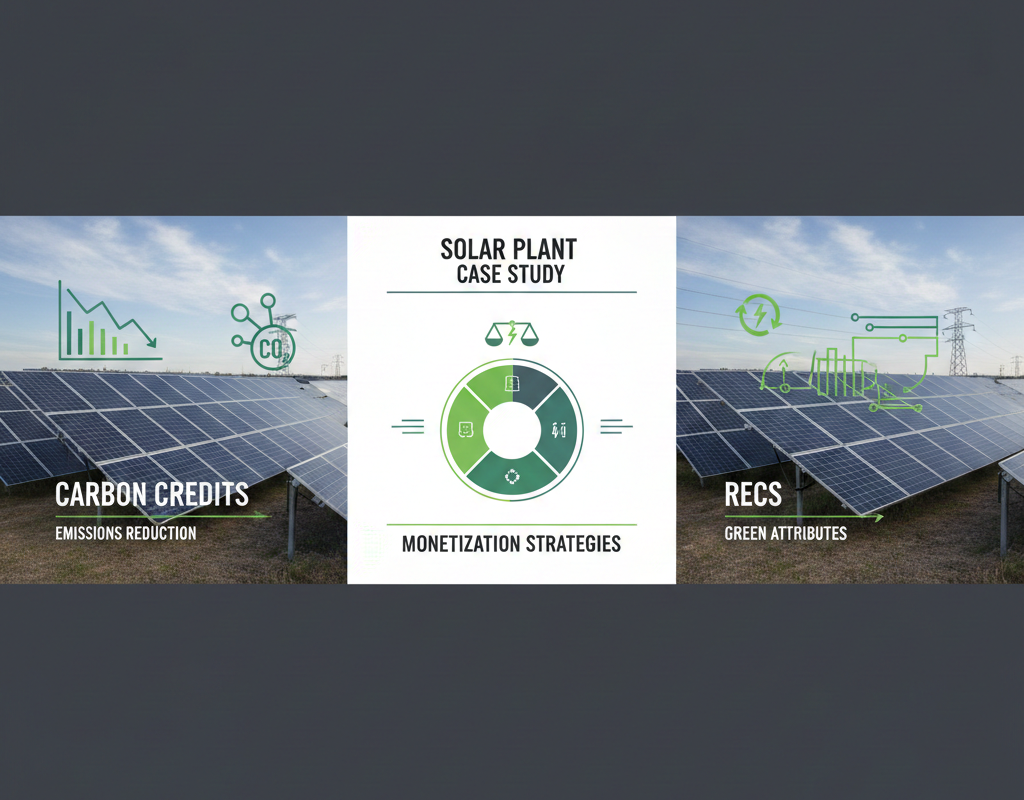
Solar Plant Case Study in India
Solar Plant Case Study in India
The economics of solar power generation have changed as a result of India’s swift shift to renewable energy. Developers of solar projects are increasingly looking into additional revenue streams outside of traditional power sales as the nation moves closer to its aggressive clean energy goals and net-zero pledges. Carbon Credits and Renewable Energy Certificates (RECs) are two of the most important tools in this ecosystem.
This comprehensive case study on solar plants looks at how a grid-connected solar power facility in India might improve its financial viability by using Carbon Credits rather than RECs. Regulatory frameworks, revenue potential, risk concerns, compliance needs, and long-term strategic ramifications for investors and project developers are all covered in the analysis.

The Context of Renewable Energy in India
One of the markets for renewable energy that is expanding the quickest in the globe is India. The nation has developed a regulated market for trading renewable energy and carbon mitigation tools, overseen by the Central Electricity Regulatory Commission (CERC) and led by the Ministry of New and Renewable Energy (MNRE).
The government’s pledge to increase solar capacity is consistent with international climate frameworks, including the Paris Agreement. Both the domestic REC markets and global carbon trading platforms benefit from these promises.
Project developers must choose which environmental attribute tool—Carbon Credits or RECs—best fits their strategic and financial goals in this changing climate.
Overview of the Solar Plant Case Study
Let’s look at a hypothetical 50 MW grid-connected solar power facility in Rajasthan in order to properly compare Carbon Credits and RECs.
- Assumptions for the Project
- 50 MW of installed capacity
- PLF (plant load factor): 22%
- Generation per year: around 96,360 MWh
- Project Duration: 25 years
- The Power Purchase Agreement (PPA) tariff is ₹3.00 per kWh.
The annual earnings from the selling of power is approximately ₹28.9 crore, or 96,360,000 kWh × ₹3.00.
The main query is: How much more money can be made with carbon credits as opposed to renewable energy certificates?
Carbon Credit Revenue
- Calculation of Emission Reduction
India’s average coal-based power emission factor is approximately 0.82 tCO2/MWh.
Annual avoided emissions: 96,360 MWh × 0.82 = 79,015 tCO₂
It is therefore possible to produce about 79,015 carbon credits every year.
- Assumption of Carbon Credit Price
The voluntary market average is between ₹800 and ₹1,500 per credit, though this fluctuates greatly.
- Per credit, conservative estimate: ₹1,000
- Revenue from carbon credits per year: 79,015 × 1,000 = approximately ₹7.9 crore.
Even after deducting 10–20% for transaction, registration, and verification fees, net revenue can still be between ₹6.5 and ₹7 crore per year.
REC revenue
One REC is equivalent to one MWh of renewable electricity under REC systems.
- 96,360 RECs were generated in total each year.
- In the past, REC market prices have fluctuated. ₹1,200 per REC is the assumed average market clearing price.
- REC revenue per year: approximately 96,360 × 1,200 = ₹11.56 crore.
But the following factors have a big impact on REC pricing:
- Price of forbearance and regulatory floor
- Demand for RPO compliance
- The liquidity of the market
- Uncertainty in policy
Market factors may cause actual realization to be lower.
Analysis of Risk
- Regulatory Hazard
Domestic policies have a significant impact on REC markets. Returns are immediately impacted by modifications to RPO regulations or pricing schemes.
Global corporate ESG commitments have a greater impact on carbon credits than changes in domestic policy, particularly in voluntary markets.
- Risk of Market Demand
The purchase of compliance certificates by required entities determines the demand for REC. Demand declines if RPO enforcement deteriorates.
Multinational firms’ pursuit of net-zero goals benefits carbon credits by frequently generating higher long-term demand.
- Stability of Prices
Although there may be volatility in the carbon markets, long-term decarbonization tendencies encourage price increases.
Long-Term Prospects: 2026 and Later
A national framework for a carbon market is now being formalized in India. The economic potential for solar projects may be drastically altered by this development.
The demand for voluntary carbon credits is anticipated to increase as corporate India fortifies ESG compliance and carbon disclosure standards. Stricter RPO targets could increase REC demand at the same time.
Solar developers need to stay flexible, monitoring:
- Trends in carbon pricing
- Reforms to regulations
- Global flows of climate finance
- Mandates for sustainable energy at home
The Viewpoint of Investors
Diversified environmental attribute techniques lower the danger of revenue concentration from the perspective of investors.
Infrastructure and private equity funds are increasingly evaluating:
- Potential for carbon monetization
- Improvements in ESG scores
- Eligibility for green bonds
- Access to international climate finance
Because they are in line with sustainability regulations, projects that can produce carbon credits frequently draw institutional finance from around the world.
In summary: Solar Plant Case Study in India
In this case study, carbon credits offer more long-term strategic value and worldwide diversification than renewable energy certificates (RECs), which may yield larger short-term revenue.
The best course of action for solar developers in India is to align with long-term sustainability objectives, conduct regulatory due diligence, and do thorough financial modeling.
Both Carbon Credits and Renewable Energy Certificates will continue to be essential components of funding for renewable energy as India fortifies its clean energy transition.
Strategic use of these tools in solar projects can greatly increase yields, shorten payback times, and boost investor confidence.