
 Aksh
Aksh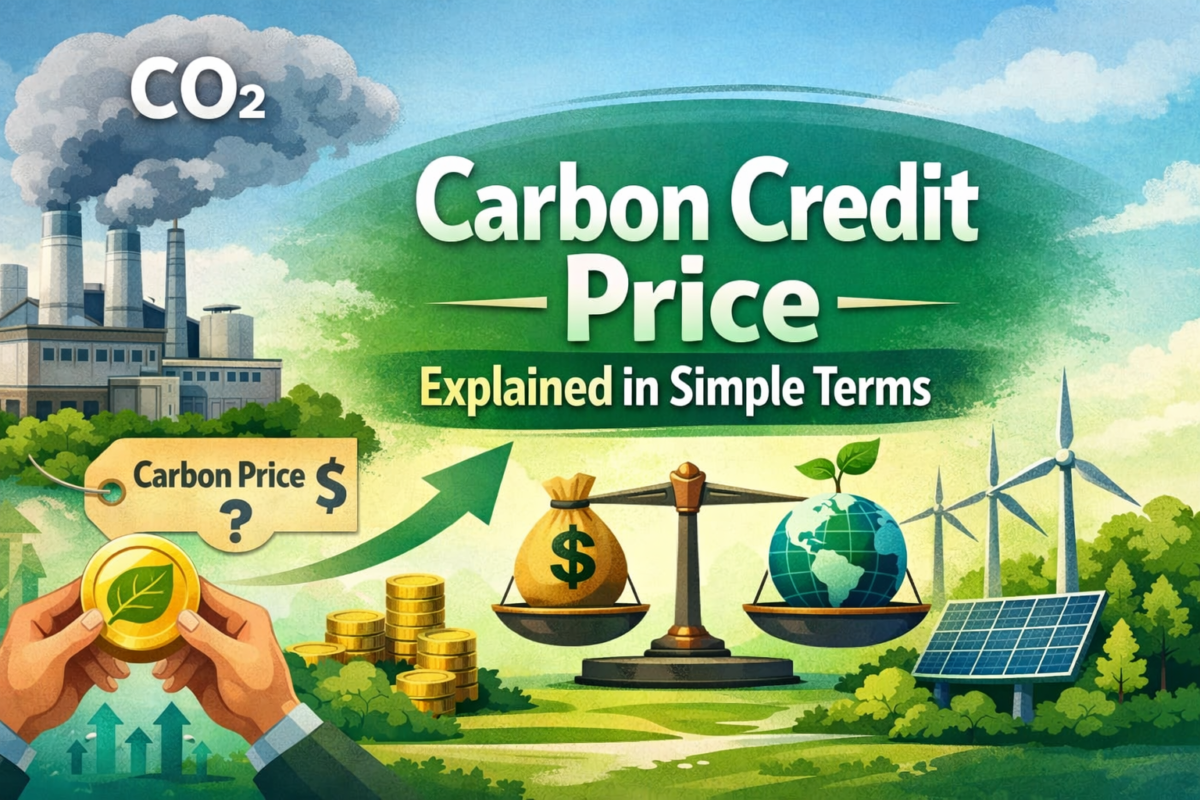
Carbon Credit Price Explained in Simple Terms
Carbon Credit Price Explained in Simple Terms
Climate change is now an economic reality rather than a far-off global issue. Globally, governments, businesses, and investors are attempting to lower greenhouse gas emissions. The carbon credit system is one of the most crucial instruments in this endeavor. But a lot of people still don’t understand the idea, particularly when it comes to the price of carbon credits.
This thorough book explains the price of carbon credits in plain language, looks at how they are valued, analyzes factors that influence carbon pricing, and talks about the changes in the Indian carbon market. This essay will provide you with a clear explanation of how carbon credit pricing operates, regardless of whether you are an investor, business owner, sustainability professional, or just interested in climate financing.

A Carbon Credit: What Is It?
It’s crucial to understand what a carbon credit is before attempting to calculate its price.
The reduction or removal of one metric ton of carbon dioxide (CO₂) or an equivalent greenhouse gas from the atmosphere is represented by a carbon credit. Carbon credits can be produced when a project lowers emissions, such planting trees, putting in solar electricity, or absorbing methane.
Companies or individuals who wish to offset their own carbon emissions can then purchase these credits.
To put it simply:
- One carbon credit is equal to one ton of CO2 offset or eliminated.
- Businesses purchase carbon credits to offset their emissions.
What Does the Price of Carbon Credit Mean?
The cost of purchasing a single carbon credit is referred to as the carbon credit price. The price indicates how much buyers are ready to pay to offset one ton of emissions because each credit is equivalent to one ton of CO₂ reduction.
For instance:
- A business must pay ₹800 to offset one ton of carbon emissions if the price of the carbon credit is ₹800.
- One ton of CO₂ offset costs $10 if the price is $10 worldwide.
Market factors, project type, certification requirements, demand, and regulatory environment all affect the cost.
What Makes Carbon Credits Expensive?
Because they assist firms in meeting regulatory obligations and environmental goals, carbon credits are valuable.
There are three primary reasons why businesses purchase carbon credits:
- In order to adhere to governmental rules
- To fulfill obligations related to Environmental, Social, and Governance (ESG)
- To attain carbon neutrality or net-zero goals
Companies frequently buy credits from initiatives that cut emissions more economically because it can occasionally be costly to lower emissions internally.
This generates supply and demand, and prices exist wherever supply and demand coexist.
What Is the Price of a Carbon Credit?
The cost of carbon credits varies greatly according on the market.
Worldwide:
- The range of voluntary market credits is $3 to $50 per ton.
- Removal credits of superior quality can cost more than $100 per ton.
- Depending on the area, compliance market costs could be significantly higher.
In India, the government is attempting to create a regulated carbon market framework, and carbon credit pricing is still changing. Despite being cheaper than in Europe, prices in voluntary markets are rising steadily in response to rising demand.
India’s Present Carbon Credit Price Situation
Because of its sustainable development initiatives and growth in renewable energy, India is one of the biggest suppliers of carbon credits.
The nation has enormous potential in:
- Solar energy production
- Wind power
- Projects involving biomass
- Energy-saving measures
- Programs for reforestation
Through the Carbon Credit Trading Scheme (CCTS), the Indian government is creating a legal carbon trading system. This might have a big effect on the transparency and stability of carbon credit prices.
The demand for carbon credits is anticipated to increase both locally and globally as India approaches its net-zero goal by 2070.
The Reasons Behind the Global Rise in Carbon Credit Prices
Price trends for carbon credits are showing increased momentum for a number of reasons.
- Commitments to Net-Zero
Around the world, thousands of businesses have pledged to achieve net-zero emissions.
- Pressure from Investors
ESG performance is frequently used by investors to assess businesses. Carbon credits are being purchased by businesses in an effort to raise sustainability indicators.
- Border taxes on carbon
Imports with significant carbon emissions are starting to face penalties under international trade policies. Credit may be necessary for businesses to stay competitive.
- Limited Supply of High-Quality
Prices are rising due to the scarcity of high-quality carbon removal programs.
In conclusion: Carbon Credit Price Explained in Simple Terms
The price of carbon credits doesn’t have to be difficult to understand. Fundamentally, it is the amount of money that is attributed to cutting one ton of carbon emissions. Carbon credits are turning into a crucial financial tool as the global effort to combat climate change picks up speed.
The carbon market offers India tremendous potential for economic expansion, climate finance, sustainable investment, and environmental preservation. The openness and stability of carbon credit prices are anticipated to improve as legislative frameworks develop and corporate climate commitments rise.
The first step to taking part in the developing low-carbon economy is comprehending carbon credit price, regardless of whether you are an investor looking at climate assets, a company looking to offset emissions, or a project developer seeking income.
Carbon Credit Price Explained for Investors: Complete Guide 2026
Carbon Credit Price Explained for Investors: Complete Guide 2026