
 Aksh
Aksh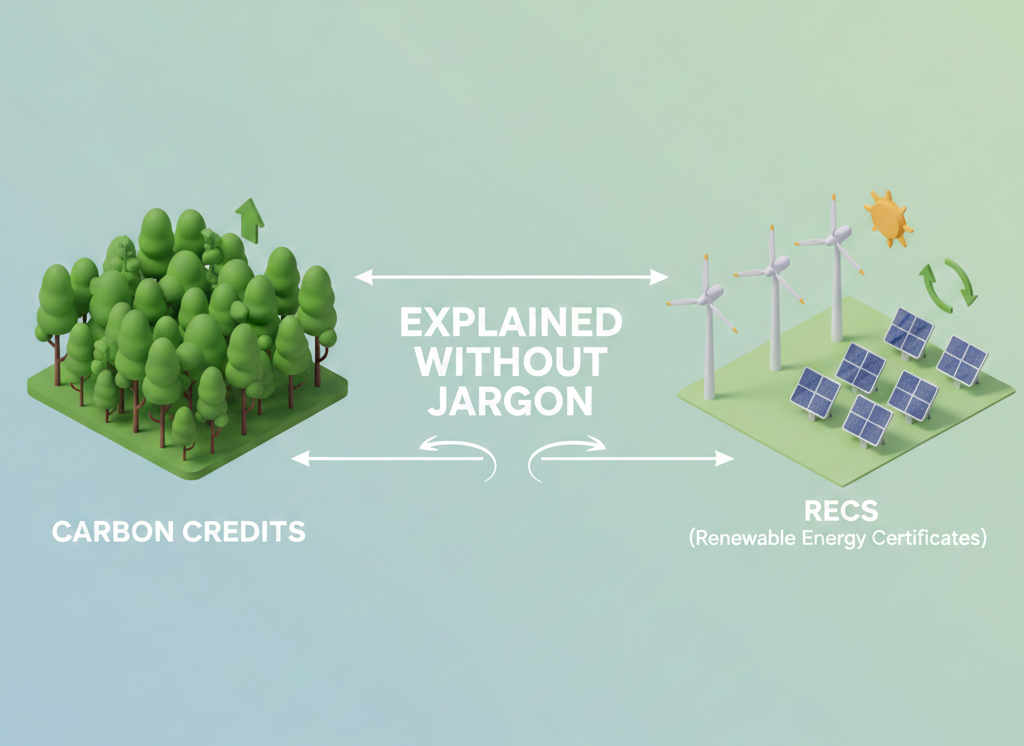
Carbon Credits vs RECs: A Simple, Jargon-Free Guide
Carbon Credits vs RECs: A Simple, Jargon-Free Guide
Terms like renewable energy certificates (RECs) and carbon credits have become widely used in conversations about climate change and sustainable business practices in recent years. However, many people may find it difficult to distinguish between these two ideas. Although they function differently, carbon credits and RECs are both fundamentally instruments that contribute to a cleaner environment by lowering greenhouse gas emissions. In order to help people and organizations make well-informed decisions regarding sustainability, this article will clarify the distinction in straightforward, understandable language.

Carbon Credits: What Are They?
In essence, a carbon credit is a permit that permits an individual, business, or organization to emit a specific quantity of greenhouse gases, such as carbon dioxide (CO₂). Generally speaking, one carbon credit is equivalent to one ton of CO₂ that is avoided, decreased, or extracted from the atmosphere.
The Operation of Carbon Credits
Carbon credits are a component of a cap-and-trade or carbon trading scheme. This is how it operates:
- The overall amount of greenhouse gases that can be released is limited by governments or regulatory agencies.
- A portion of the cap is represented by carbon credits that businesses buy or earn.
- A corporation can sell its remaining credits to other businesses that exceed their limitations if it emits less than its allocated limit.
Renewable Energy Certificates (RECs): What Are They?
Renewable energy certificates (RECs) are a means of encouraging the use of sustainable energy, whereas carbon credits concentrate on lowering carbon emissions. A renewable energy certificate (REC) is evidence that one megawatt-hour (MWh) of power came from a renewable source, like hydro, wind, or solar.
How RECs Operate
RECs function in a marketplace where:
- RECs are awarded to renewable energy producers for each MWh of electricity generated.
- In order to assert that their energy consumption is derived from renewable sources, businesses or individuals buy RECs.
Simply said, purchasing a REC is equivalent to declaring, “Even though my electricity comes from conventional sources, I’m supporting green energy.” More clean energy projects are financed in part by the money generated by RECs returning to renewable energy producers.
Why Companies Make Use of Carbon Credits?
Carbon credits are becoming more and more popular among businesses in India and throughout the world. The primary causes are as follows:
- Offsetting Carbon Footprint: Businesses can offset emissions from processes like production and transportation that aren’t yet completely environmentally friendly.
- Corporate Social Responsibility (CSR): Giving stakeholders and consumers carbon credits shows that you care about the environment.
- Regulation Compliance: Under government programs, certain industries are required to reduce their emissions.
- Appeal to Investors and Customers: Sustainability is increasingly playing a significant role in consumer and investment choices.
For instance, a business in the textile sector might keep emitting during production. It essentially “balances out” these emissions by buying carbon credits, which helps fund initiatives that lower CO₂ elsewhere.
Why Companies Make Use of RECs?
In a similar vein, RECs assist businesses in achieving their renewable energy objectives. Important advantages include:
- Fulfilling Renewable Purchase Obligations (RPOs): A proportion of electricity must come from renewable sources for businesses in certain Indian states.
- Promoting the Development of Renewable Energy: REC purchases provide direct funding for sustainable energy initiatives such as solar or wind farms.
- Cutting Scope 2 Emissions: These are emissions from electricity that has been purchased. Businesses can claim a reduced environmental effect for their electricity consumption by purchasing RECs.
For instance, a big IT company might continue to use coal-powered grid electricity. By purchasing RECs, it can lower its stated carbon footprint by claiming that the energy it uses is essentially renewable.
How RECs and Carbon Credits Are Being Used in India?
India has advanced significantly in the areas of renewable energy certificates and carbon markets:
- Carbon Markets: Companies are able to purchase and sell carbon credits in India’s voluntary carbon markets. Carbon credits are produced by numerous domestic projects, particularly in the fields of renewable energy, waste management, and forestry.
- Renewable Energy Certificates: Large users and energy distribution businesses are subject to RPOs established by the Indian government. RECs encourage investment in solar, wind, and other renewable energy projects while assisting these organizations in fulfilling their responsibilities.
Industry forecasts predict that India’s renewable energy sector will expand quickly, and RECs will be crucial to funding this growth. In a similar vein, carbon credits offer a monetary reward for cutting emissions in the industry, energy, and agricultural sectors.
How People Can Take Part?
Although companies control the majority of the carbon credit and REC markets, anyone can make a contribution:
- Carbon Offsetting: Websites let users determine their carbon footprint and purchase credits to make up for emissions from household energy consumption, travel, and other sources.
- Supporting Renewable Energy: In order to report the amount of renewable energy used in their homes, several utilities allow customers to purchase RECs.
- Sustainable Options: Use solar panels, greener vehicles, or energy-efficient appliances to cut your own emissions.
India’s Prospects for Carbon Credits and RECs
Carbon credits and RECs are becoming more and more significant as a result of India’s pledge to achieve net-zero emissions by 2070 and its emphasis on renewable energy targets. Experts forecast:
- Carbon Trading Expansion: In an effort to lower emissions and draw in foreign investors, more Indian businesses will take part in voluntary carbon markets.
- Growth in RECs: RECs will support the financing and stabilization of the clean power market as renewable energy projects grow.
- Integration with International Markets: As India’s carbon credits become more well-known abroad, local initiatives may be able to capitalize on demand from around the world.
Understanding these resources is the first step toward taking significant environmental action for businesses and individuals that want to change the world.
In conclusion: Carbon Credits vs RECs: A Simple, Jargon-Free Guide
Despite their complex names, carbon credits and renewable energy certificates (RECs) serve the straightforward goal of lessening environmental damage and promoting a cleaner, greener future. While renewable energy certificates (RECs) promote the development and use of renewable energy, carbon credits enable businesses and people to offset greenhouse gas emissions.
Both instruments are crucial for India to achieve its climate targets, support renewable energy, and develop a more environmentally friendly economy. Knowing the difference between carbon credits and RECs is essential whether you’re a person looking to lessen your carbon footprint or a corporation trying to comply with regulations.
Understanding Wind Energy Carbon Credits: Full Glossary for Professionals
Understanding Wind Energy Carbon Credits: Full Glossary for Professionals