
 Aksh
Aksh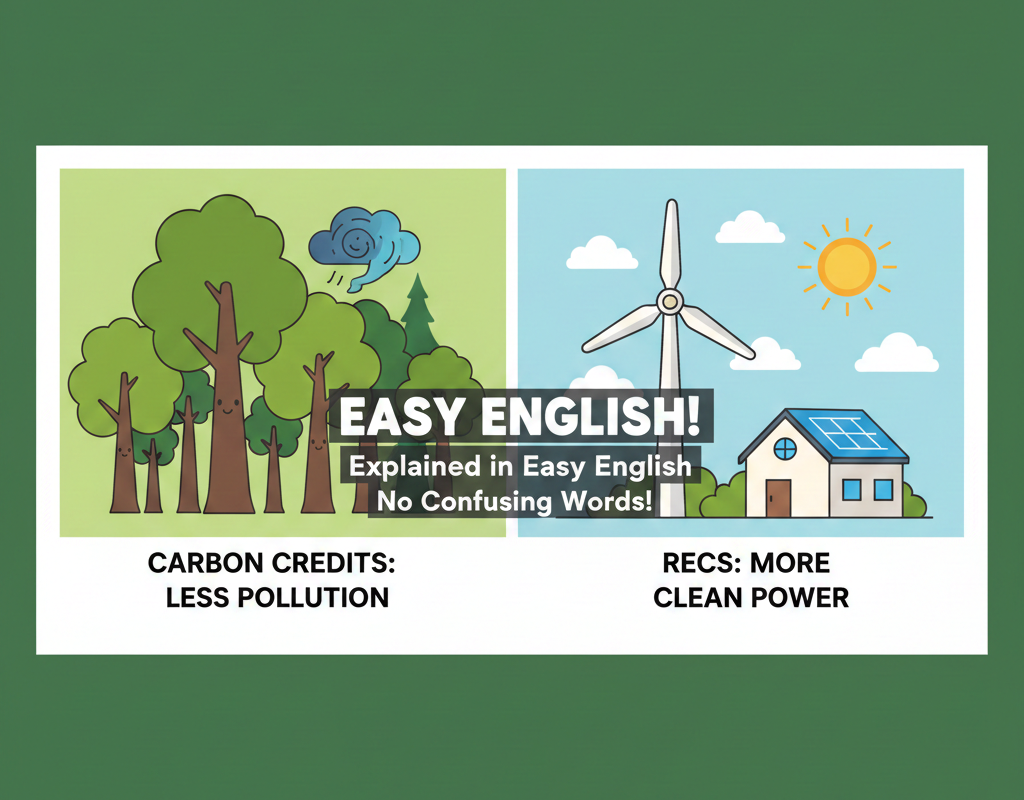
The Ultimate Guide to Carbon Credits vs RECs
The Ultimate Guide to Carbon Credits vs RECs
Climate change and environmental sustainability have grown to be major issues in the modern world. More and more people, governments, and businesses are looking for ways to lessen their carbon footprint and help create a more environmentally friendly world. Carbon Credits and Renewable Energy Certificates (RECs) are two crucial instruments in this endeavor. Despite the fact that they are frequently discussed together, they have distinct functions and methods of operation. In this post, we’ll compare and contrast carbon credits and renewable energy certificates (RECs) in basic, understandable terms and show you how both might help you reach your environmental objectives.

Carbon Credits: What Are They?
One metric ton of carbon dioxide (CO₂) or its equivalent greenhouse gases (GHGs) removed from the atmosphere is represented by a carbon credit, a form of permit. They participate in the worldwide endeavor to tackle climate change.
The amount of greenhouse gases that can be released is restricted by organizations and governments. Businesses that cut emissions more than is necessary can earn Carbon Credits, which they can then sell to businesses that can’t reach their emission goals.
For instance, a firm can receive 100 Carbon Credits if it implements cleaner technology that lowers CO₂ emissions by 100 tons annually. Another business that is going above its emission limitations can then purchase these credits.
Renewable Energy Certificates: What Are They?
Green tags, also known as Renewable Energy Certificates (RECs), are documentation attesting to the fact that power was produced using renewable resources like biomass, sun, wind, or hydropower. RECs, as opposed to carbon credits, are exclusively focused on generating power and advancing renewable energy.
Generally speaking, one REC is equal to one megawatt-hour (MWh) of renewable power generated and sent to the grid. Even if their actual electricity originates from non-renewable sources, businesses and individuals can purchase Renewable Energy Certificates (RECs) to demonstrate that they are using renewable energy.
The Significance of Carbon Credits
Carbon credits are essential for reducing the effects of climate change. Countries and businesses are encouraged to decrease greenhouse gas emissions by international initiatives such as the Paris Agreement. If businesses are unable to immediately decrease all of their emissions, carbon credits offer a flexible alternative for them to make a financial contribution to the cause.
Carbon Credit Project Examples
- Reforestation: By removing CO₂ from the atmosphere, planting trees produces quantifiable carbon offsets.
- Renewable Energy Projects: Projects using biomass, solar, and wind lessen dependency on fossil fuels.
- Energy Efficiency: Emissions can be decreased by upgrading buildings and factories to consume less energy.
- Methane Capture: By capturing methane from farmland or landfills, a powerful greenhouse gas is kept out of the atmosphere.
RECs’ Significance
RECs aid in the shift to a future powered by renewable energy. Even if they don’t use the renewable electricity directly, businesses can nevertheless contribute financially to renewable energy initiatives by buying RECs.
REC Impact Examples
- A business supports 1,000 MWh of renewable energy generation by purchasing 1,000 RECs.
- In addition to selling power, solar farms can also sell RECs, which brings in extra money for environmentally friendly initiatives.
- Aids nations in achieving government renewable energy goals and Renewable Purchase Obligations (RPOs).
Difficulties and misunderstandings
Although RECs and carbon credits are effective instruments, there are certain drawbacks:
- Double Counting: Credibility may be weakened if certain projects claim credits for the same emission reductions. Being properly certified is crucial.
- Greenwashing Risk: Businesses must cut their real emissions and energy use in addition to purchasing RECs or carbon credits.
- Price fluctuations: Demand, project type, and certification requirements can all affect the cost of carbon credits.
- Complexity: It might be difficult to understand the distinction between RECs and Carbon Credits, particularly for small enterprises.
These difficulties can be efficiently handled by selecting certified projects and reliable REC providers.
How RECs and Carbon Credits Are Being Promoted in India?
India is heavily involved in the markets for renewable energy and carbon:
- Carbon Credits: Under the Clean Development Mechanism (CDM), India is one of the biggest providers of Certified Emission Reductions (CERs). Carbon credits are another voluntary way that many Indian businesses mitigate their pollution.
- RECs: To assist businesses in fulfilling their Renewable Purchase Obligations (RPOs), the Indian government set up a Renewable Energy Certificate system. Businesses can embrace renewable energy more easily because RECs are traded on reputable platforms.
- For businesses aiming to lower emissions and advance renewable energy in India, this establishes a favorable environment.
The Future of RECs and Carbon Credits
The demand for carbon credits and RECs is anticipated to increase as a result of increased worldwide awareness of climate change:
- Carbon credits will be essential in assisting nations and businesses in reaching net-zero goals. Emerging are creative initiatives such as carbon capture and storage (CCS).
- RECs: As the use of renewable energy grows, RECs will support green energy providers financially and aid in energy grid balance.
Knowing the distinction between carbon credits and renewable energy certificates (RECs) helps individuals and organizations make well-informed decisions that significantly advance sustainability objectives.
In conclusion: The Ultimate Guide to Carbon Credits vs RECs
In conclusion, while both RECs and carbon credits are necessary for a sustainable future, their functions are distinct:
- Globally, carbon credits lower or balance greenhouse gas emissions.
- RECs support the production of renewable energy and aid in achieving sustainability goals for electricity.
Companies that want to become carbon neutral should think about strategically utilizing both methods. While RECs encourage the use of renewable energy, carbon credits can offset emissions that cannot be avoided. Businesses and individuals can actively contribute to the fight against climate change and the creation of a cleaner, greener world by comprehending and utilizing these methods.
Ultimate Carbon Credit Glossary – Terms & Definitions Explained Fully
Ultimate Carbon Credit Glossary – Terms & Definitions Explained Fully
2 Comments