
 Aksh
Aksh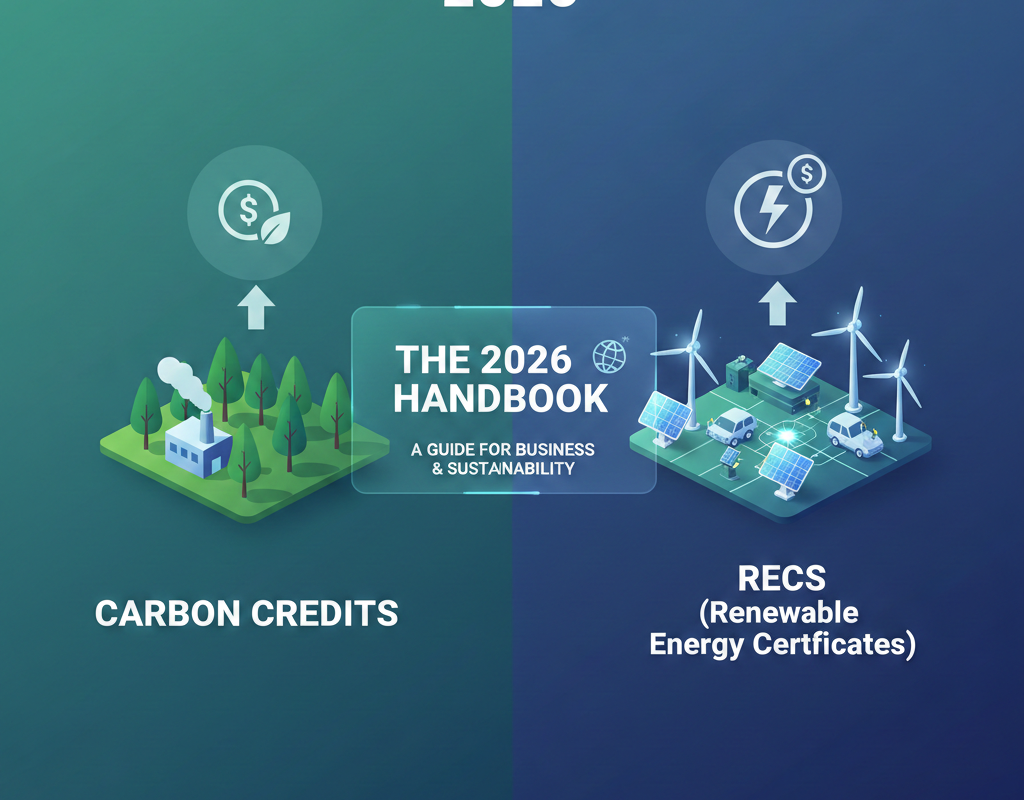
Guide for Carbon Credits vs RECs in 2026
Guide for Carbon Credits vs RECs in 2026
2026 is expected to be a pivotal year for environmental commodities as climate action picks up speed in international markets. Companies in India and elsewhere are increasingly considering Renewable Energy Certificates (RECs) and carbon credits as instruments to fulfill investor demands, legal obligations, and corporate sustainability pledges. The differences between these instruments, their pricing, their regulation, and their compatibility with net-zero policies are still unclear, nevertheless.
The main distinctions between carbon credits and RECs, their changing place in India’s climate ecosystem, voluntary markets, regulatory regimes, dangers, pricing patterns, and how businesses can strategically use them to have quantifiable impact are all covered in this extensive 2026 reference.

Comprehending 2026 Carbon Credits
The reduction, elimination, or avoidance of one metric ton of carbon dioxide equivalent (tCO₂e) from the atmosphere is represented by a carbon credit. These credits are produced by validated climate initiatives like:
- Installations of renewable energy
- Initiatives for afforestation and reforestation
- Methane capture initiatives
- Programs for energy efficiency
- Technologies for removing carbon
Recognizing 2026 Renewable Energy Certificates (RECs)
One megawatt-hour (MWh) of electricity produced from a renewable energy source, such as solar, wind, hydro, or biomass, is verified by a Renewable Energy Certificate (REC).
RECs serve as proof of compliance with renewable energy targets and Renewable Purchase Obligations (RPOs).
Two distinct components are produced during the production and grid supply of renewable energy:
- The actual electricity
- The attribute of the environment (REC)
The REC and the electricity may be sold separately. Even if a business uses conventional grid power, it can still claim renewable energy usage by purchasing the REC.
The Significance of Distinction in 2026
Misuse or ignorance of these tools can put businesses at risk for compliance and reputational issues as ESG reporting and climate disclosures get stricter.
In 2026:
- Investors want to understand the difference between renewable sourcing and emissions offsetting.
- Greenwashing claims are closely examined by regulators.
- Transparent emission accounting is necessary for international carbon border adjustment procedures.
- Market-based and location-based accounting are increasingly distinguished by scope 2 emissions reporting.
Businesses must match their environmental statements exactly with the tool they are using.
Carbon Credit Market Trends for 2026
- Prioritize quality above quantity
High-integrity credits are being prioritized by the market. Strong additionality, permanent safeguards, and independent verification are prerequisites for premium pricing.
- The Rise of Nature-Based Solutions
With the co-benefits of biodiversity, reforestation and ecosystem restoration initiatives in India are garnering international attention.
- The Development of Carbon Removal Technologies
Although they are more expensive, direct air capture and biochar credits are becoming more popular.
- Digitization of Registries
Double-counting issues are lessened by blockchain-based tracking and enhanced transparency tools.
- Application of Article 6
Cross-border credit trading dynamics are being impacted by the increasing operationalization of international cooperation mechanisms under the Paris Agreement.
REC Market Trends in 2026
- Tougher Requirements for Renewable Purchases
India’s regulatory requirements are still driving businesses to purchase more renewable energy.
- Purchase Agreements for Corporate Power (PPAs)
To ensure pricing stability, several big businesses are combining RECs with long-term renewable PPAs.
- The volatility of prices
The supply and demand cycles for renewable energy determine REC pricing.
- A closer examination of additionality
The question of whether REC purchases actually generate new renewable capacity or only reflect current generation is becoming more and more prevalent among buyers.
India’s Compliance Environment in 2026
In order to meet the country’s climate targets, India’s carbon and renewable frameworks are being structurally strengthened. Carbon trading frameworks are increasingly incorporating energy-intensive industries.
In 2026, important factors include:
- Improved standards for monitoring, reporting, and verification (MRV)
- Sector-specific baselines for emissions
- Higher goals for renewable energy purchases
- Conformity to global sustainability reporting guidelines
Companies in the manufacturing, electricity, infrastructure, IT, logistics, and real estate sectors need to assess whether carbon credits, renewable energy certificates, or a mix of the two best suit their ESG and compliance plans.
When Is It Time for a Company to Purchase Carbon Credits?
A business ought to think about carbon credits if
- Scope 1 and Scope 3 emissions that cannot be avoided are intended to be offset.
- It works in industries where carbon pricing mechanisms are still developing.
- It seeks to obtain carbon neutrality or net-zero certifications.
- It aims to partner with global investors.
- In addition to renewable electricity, it seeks to promote climate mitigation.
For companies where direct emission removal is not yet technically or financially feasible, carbon credits are very helpful.
Conclusion: Guide for Carbon Credits vs RECs in 2026
By 2026, it will be mandatory to comprehend the distinction between RECs and carbon credits. It’s a strategic requirement.
- Emissions are decreased or eliminated with carbon credits.
- RECs demonstrate the use of renewable energy.
In climate strategy, both play crucial but different roles.
Companies will be better positioned in the developing low-carbon economy if they combine energy transition with genuine offsetting, supported by open reporting and high-integrity procurement.
The Ultimate Guide to Carbon Credits vs RECs: What They Are and How They Work?
The Ultimate Guide to Carbon Credits vs RECs: What They Are and How They Work?
2 Comments