
 Aksh
Aksh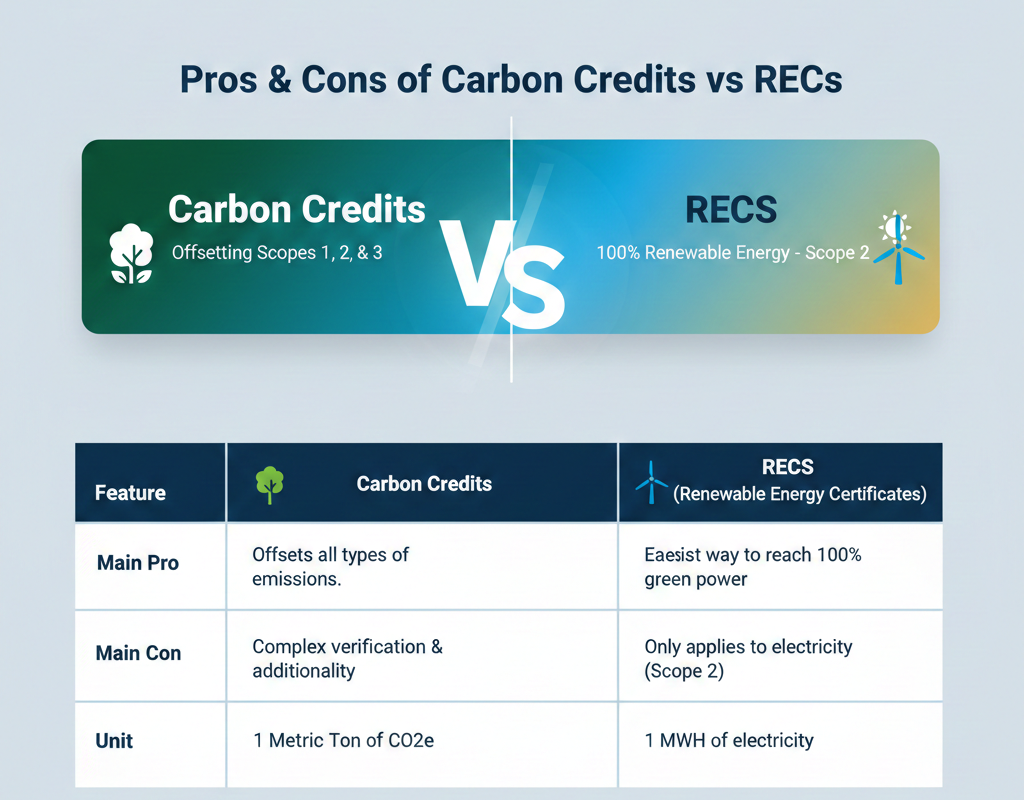
Pros and Cons of Carbon Credits vs RECs
Pros and Cons of Carbon Credits vs RECs
Businesses are facing mounting pressure to implement credible climate strategy as India speeds up its shift to a low-carbon economy. Organizations must show quantifiable effort toward lowering emissions and promoting renewable energy, from legal requirements to investor expectations and ESG reporting systems. In this endeavor, two popular market-based tools are Renewable Energy Certificates (RECs) and Carbon Credits.
Although both tools aid in the fight against climate change, their functions and markets are different. Businesses in India developing a solid net zero strategy must comprehend the benefits and drawbacks of carbon credits against renewable energy certificates.

Comprehending Carbon Credits
One metric ton of carbon dioxide (CO₂) or its equivalent in other greenhouse gases is reduced or removed when carbon credits are issued. These credits are produced by verified projects that either remove carbon from the atmosphere (like afforestation or carbon capture programs) or reduce emissions (like energy efficiency or methane capture projects).
The two main carbon markets are as follows:
- Regulations at the national or international level control the compliance carbon market.
- Voluntary Carbon Market: Businesses voluntarily buy credits to offset emissions and fulfill their net zero or ESG pledges.
A regulated domestic carbon market has been made possible in India by the government’s introduction of the Carbon Credit Trading Scheme (CCTS) under the Energy Conservation Act modifications.
Understanding Certificates of Renewable Energy (RECs)
Market-based tools known as Renewable Energy Certificates (RECs) attest to the fact that electricity was produced using renewable energy sources like biomass, wind, solar, and hydropower. One megawatt-hour (MWh) of renewable electricity generation is usually represented by one REC.
To assist obligated firms in fulfilling Renewable Purchase Obligations (RPOs), RECs were created in India. A minimum percentage of electricity must be purchased from renewable sources by specific power distribution firms, open-access users, and captive power producers under these commitments.
RECs allow for flexible trading by separating the environmental benefit of renewable electricity from the actual power.
Benefits of Carbon Credits
- Encourages ESG and Net Zero Goals
Carbon credits assist Indian companies who have committed to net zero emissions in offsetting any remaining emissions that cannot be removed right now. In frameworks for voluntary ESG reporting, they are often accepted.
- Promotes Creativity
Innovative emission reduction technologies, such as carbon capture and storage (CCS), sustainable agriculture, and the manufacture of biochar, are encouraged by carbon markets.
- Potential for International Trade
Global frameworks allow for the worldwide trading of carbon credits, boosting investment prospects and liquidity. Buyers from throughout the world can be drawn to Indian developers.
Carbon Credit Drawbacks
- The volatility of prices
Prices for carbon credits vary according to market mood, demand, and changes in regulations. Budgeting becomes difficult as a result.
- Risk to Reputation
Using offsets improperly without reducing internal emissions can result in charges of greenwashing.
- Uncertainty in Regulation
The foundation for carbon trading in India is changing. Although it is still being developed, regulatory clarity is getting better.
Benefits of Certificates of Renewable Energy (RECs)
- India’s Clear Regulatory Framework
The Central Electricity Regulatory Commission (CERC) is in charge of India’s well-established REC system. The Renewable Purchase Obligations are directly supported by it.
- Easier Measurement
RECs are simple. Accounting and tracking are made simpler by the fact that one certificate is equivalent to one megawatt-hour of renewable electricity.
- Encourages the Growth of Renewable Energy
Buying RECs helps India reach its clean energy goals by raising demand for the production of renewable energy.
Drawbacks of Certificates of Renewable Energy (RECs)
- Limited Scope
Only emissions related to electricity use are addressed by RECs. They exclude emissions from transportation, industrial processes, and other sources.
- Reduction of Indirect Emissions
A company’s emissions are not immediately decreased by RECs. Rather, they encourage the production of renewable energy elsewhere.
- Risk of Market Oversupply
Oversupply has historically impacted pricing and market efficiency in REC markets.
- Diminished Worldwide Acknowledgment
In India, RECs are mostly compliance-driven tools, and they might not be a perfect replacement for carbon offsets in international ESG reporting.
Indian Market Trends
India is establishing itself as a leader in the global climate movement. Important advancements consist of:
- Increased capability for renewable energy
- Increasing voluntary involvement in the carbon market
- Construction of infrastructure for domestic carbon trading
- Increased ESG disclosures among listed companies
It is anticipated that demand for carbon credits and RECs will increase dramatically as sustainability-linked finance becomes more popular.
Prospects for the Future
Market-based climate tools will be essential as India works toward its 2070 net zero goal. It is anticipated that carbon markets would develop with more stringent regulatory control and verification. Additionally, REC processes might change to conform to global renewable tracking systems.
Transparency in both markets is anticipated to be improved by digital monitoring, blockchain-based registries, and AI-powered carbon accounting technologies.
Businesses will gain a competitive edge, the trust of investors, and long-term resilience if they proactively comprehend and incorporate these mechanisms into their sustainability plan.
Conclusion: Pros and Cons of Carbon Credits vs RECs
In the larger ecosystem of climate action, carbon credits and renewable energy certificates are complimentary rather than rival methods.
The best course of action for Indian companies is determined by their regulatory responsibilities, emission profile, and sustainability goals. Both environmental effect and business credibility can be achieved with a well-rounded strategy that places a high priority on emission reduction, renewable procurement, and premium offsets.
Understanding the benefits and drawbacks of carbon credits versus RECs is now essential for sustainable growth in India as climate accountability becomes a key component of corporate governance.
Carbon Credit Terminology for Corporates: A Complete Guide to Offsetting and Net Zero
Carbon Credit Terminology for Corporates: A Complete Guide to Offsetting and Net Zero
2 Comments