
 Aksh
Aksh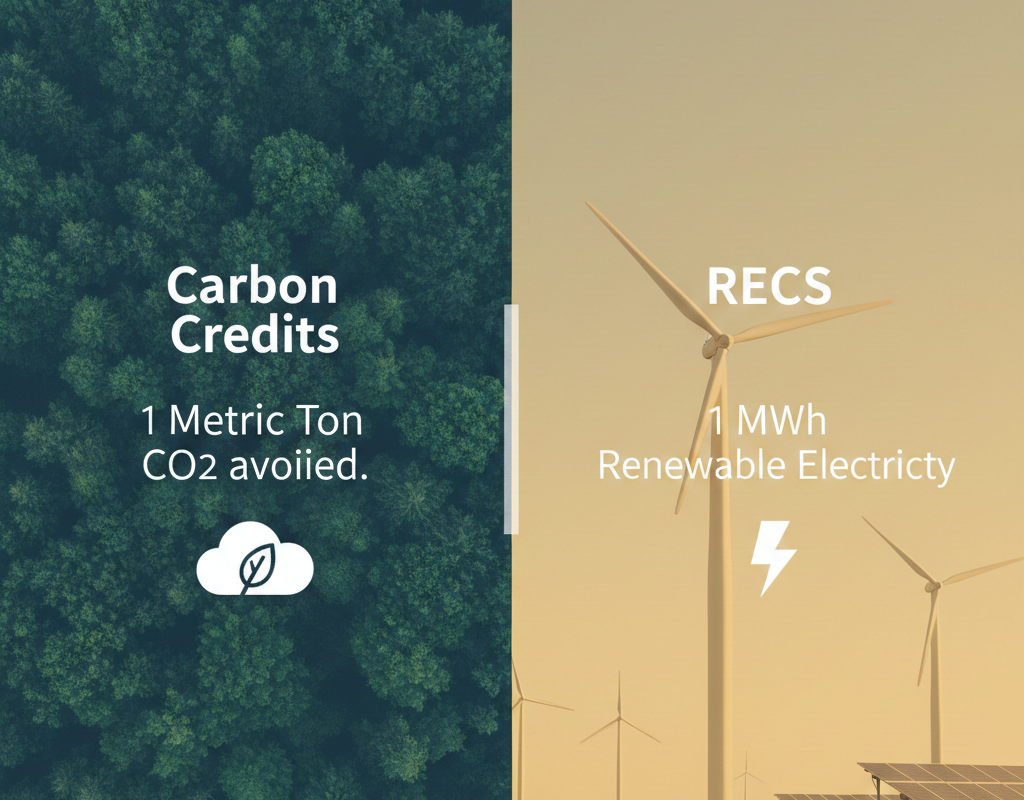
Green Business Strategies in India
Green Business Strategies in India
Environmental markets have become more effective instruments to hasten decarbonization as climate change continues to transform economies around the world. Renewable Energy Certificates (RECs) and carbon credits are two of the most important tools influencing investments in sustainability. These two mechanisms have different functions in climate policy and green business strategies, despite the fact that they are frequently employed interchangeably in discourse.
Understanding the distinctions between RECs and carbon credits is crucial for businesses navigating India’s ever changing sustainability landscape. Organizations may show environmental responsibility, comply with regulations, and reinforce Environmental, Social, and Governance (ESG) pledges with the use of both tools. But there are significant differences in their use, structure, and commercial influence.

Carbon Credits: What Are They?
One metric ton of carbon dioxide equivalent (CO2e) is reduced or removed from the atmosphere in the form of tradable permits known as carbon credits. Projects that lower greenhouse gas emissions produce these credits, including:
- Installations of renewable energy
- Projects involving reforestation and forestry
- Initiatives for energy efficiency
- Methane capture initiatives
- Technologies for reducing industrial emissions
Following the ratification of the United Nations Framework Convention on Climate Change (UNFCCC), which created mechanisms to combat global warming through market-based measures, the idea of carbon credits acquired international traction.
Renewable Energy Certificates (RECs): What Are They?
One megawatt-hour (MWh) of power produced from a renewable energy source and delivered into the grid is demonstrated by Renewable Energy Certificates. RECs allow trading regardless of power usage by separating the environmental characteristics of renewable electricity from the actual electricity.
The Central Electricity Regulatory Commission (CERC) oversees REC regulation in India. They fall within the Renewable Purchase Obligation (RPO) system in India, which requires some organizations to buy a predetermined proportion of their electricity from renewable sources.
Why Green Companies Need to Know the Distinction
The decision between carbon credits and RECs for Indian green enterprises is based on strategic sustainability goals.
- Scenario 1: A Manufacturing Firm
Buying carbon credits aids in offsetting inevitable emissions and achieving carbon neutrality if a manufacturing company produces large amounts of greenhouse gasses.
- Scenario 2: A Data Center
RECs offer a compliance-friendly option for data centers looking to demonstrate their use of renewable energy without formal power purchase agreements.
- Scenario 3: Multinational ESG-Driven
To satisfy investor expectations and international sustainability norms, multinational companies doing business in India may employ both RECs and carbon credits.
India’s Regulatory Environment
In accordance with the Energy Conservation (Amendment) Act, India is actively creating its carbon market structure. The government wants to establish a strong Indian carbon market that promotes industry-wide emission reductions.
Under CERC supervision, the REC system has been in place for years. Price discovery, trading flexibility, and transparency have all improved as a result of reforms.
Among India’s climate pledges are:
- Reaching a non-fossil fuel energy capacity of 500 GW by 2030
- Lowering GDP’s emissions intensity
- By 2070, achieving net-zero
RECs and carbon credits are both essential to reaching these national goals.
Financial Consequences for Companies
- Creating Revenue
By creating carbon credits, or RECs, green project developers can make money off of sustainability projects.
- Optimization of Costs
By strategically acquiring environmental certifications, organizations can lower the expenses associated with compliance.
- Attracting Investors
Businesses with open carbon management plans are given preference by ESG-aware investors.
- Mitigation of Risk
Businesses can protect themselves from future carbon price rules by taking part in environmental markets.
Indian Market Trends
- Expanding Nonprofit Sector
In an effort to satisfy international ESG standards, Indian businesses are becoming more involved in voluntary carbon markets.
- Growth of Renewable Energy
India has one of the fastest-growing renewable energy marketplaces in the world, which has led to a rise in REC trading volumes.
- Systems for Digital MRV
Transparency in carbon accounting is improved by sophisticated monitoring, reporting, and verification (MRV) technology.
- Net-Zero Corporate Commitments
The market for premium carbon credits is rising as a result of big corporations agreeing to science-based goals.
India’s Prospects for Carbon Markets and RECs
It is anticipated that compliance measures will be greatly expanded by India’s new carbon trading market. The demand for verified carbon credits will probably increase as carbon pricing becomes more commonplace.
RECs will play a key role in India’s electrical transition as the adoption of renewable energy rises concurrently.
Technological developments like blockchain-based registries have the potential to improve traceability and transparency even more.
In conclusion: Green Business Strategies in India
Renewable energy certificates and carbon credits are complementing tools in the sustainability ecosystem rather than rivals. While RECs particularly promote the use of renewable electricity, carbon credits target more general greenhouse gas reduction.
Understanding these mechanisms opens doors for Indian green enterprises in terms of long-term resilience, investor involvement, revenue generation, and compliance. Corporate sustainability plans will be significantly influenced by environmental markets as India moves closer to being a low-carbon economy.
Businesses that actively participate in carbon markets and renewable energy frameworks now will be in the greatest position to prosper in the climate-conscious economy of the future.
Carbon Trading and Carbon Offset Glossary Explained for Beginners
Carbon Trading and Carbon Offset Glossary Explained for Beginners
3 Comments