
 Aksh
Aksh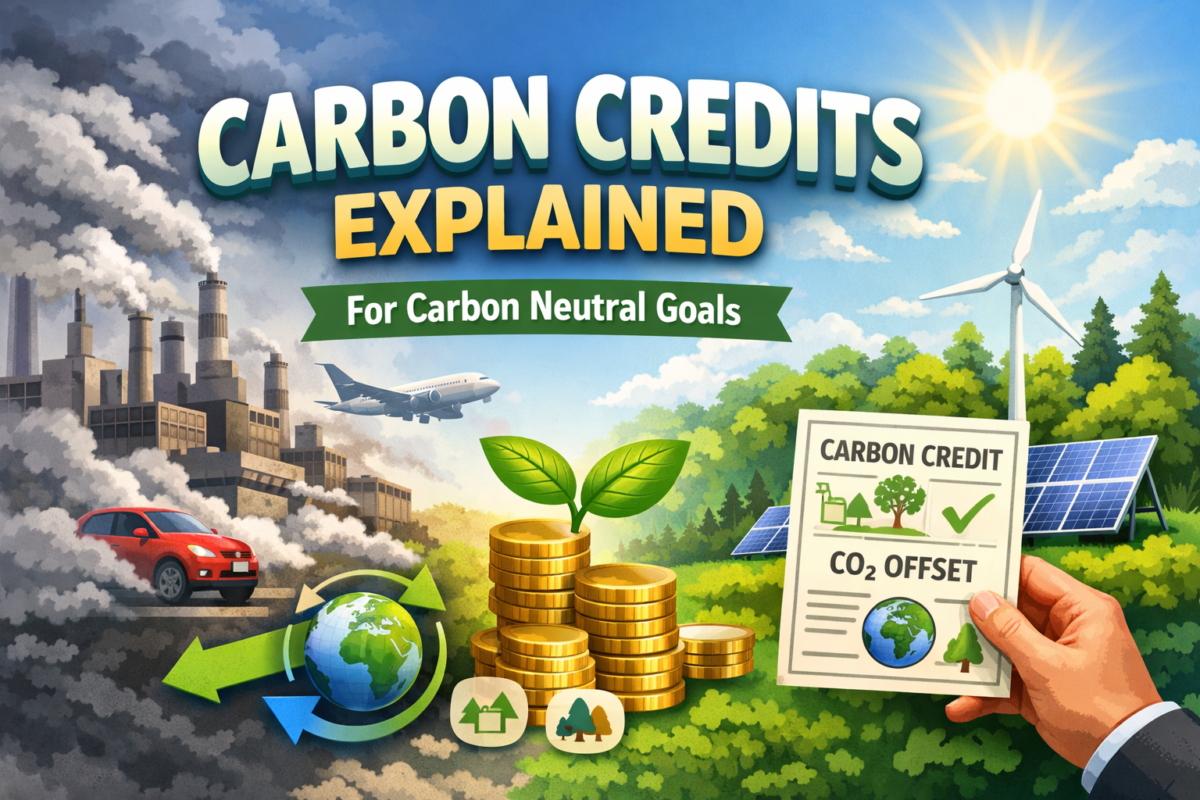
Achieving Carbon Neutral Goals with Carbon Credits
Achieving Carbon Neutral Goals with Carbon Credits
Governments, businesses, and individuals are coming under increasing pressure to cut greenhouse gas emissions and move toward sustainable development as the global climate crisis worsens. Carbon credits are one of the most talked-about and commonly used instruments in this international endeavor. Carbon credits have emerged as a key topic in the discussion of carbon neutrality, from global firms committing to net-zero goals to new nations influencing climate policy.
Carbon credits are more than just an environmental idea; they are a strategic, financial, and regulatory tool that links economic growth and climate action. Carbon credits are both a challenge and a huge potential for nations like India, where sustainability and development must advance simultaneously.

Comprehending Carbon Credits
The reduction, avoidance, or removal of one metric ton of carbon dioxide or its equivalent in other greenhouse gases is represented by a tradable certificate or permit known as a carbon credit. The basic tenet of carbon credits is straightforward: lowering emissions should have a quantifiable value since emissions have a cost.
Carbon credits are produced when a project or organization lowers emissions below a predetermined baseline. These credits can subsequently be offered for sale to organizations who wish to comply with legal obligations or make voluntary climate pledges but are unable to completely eradicate their emissions.
By transforming climate responsibilities into a market-based system, carbon credits enable emission reductions to take place where they are most economically advantageous.
The Science of Carbon Credits
Carbon dioxide, methane, and nitrous oxide are examples of greenhouse gases that trap heat in the Earth’s atmosphere, causing climate instability and global warming. In order to assess various gases according to their potential for global warming, scientists quantify these gases using a standard metric known as carbon dioxide equivalent.
Accurate measurement, reporting, and verification of emission reductions are essential components of carbon credit schemes. Each credit is guaranteed to reflect a genuine, extra, and long-lasting decrease in emissions through independent verification.
Carbon Offsets versus Carbon Credits
Carbon credits and carbon offsets are not exactly the same, despite the fact that they are frequently used interchangeably.
Verified emission reductions that can be traded on voluntary or regulated marketplaces are sometimes referred to as carbon credits. Conversely, carbon offsets typically refer to the usage of carbon credits to make up for emissions that are impossible to completely eradicate.
In order to balance their carbon footprint, businesses actually buy carbon credits and use them as offsets. Achieving carbon neutrality requires both ideas, which are interrelated.
The Creation of Carbon Credits
Projects that cut or eliminate greenhouse gas emissions generate carbon credits. These projects can be divided into a number of general groups.
- Projects Using Renewable Energy
Renewable energy projects use renewable energy sources like solar, wind, hydro, or biomass to replace power generated by fossil fuels. These projects provide carbon credits by replacing emissions that would have come from traditional electricity generation.
- Initiatives for Energy Efficiency
Initiatives for energy efficiency lower the amount of energy used in buildings, transportation, and industrial activities. Efficiency projects are a trustworthy source of carbon credits because lower energy use leads to less emissions.
- Nature-Based Solutions and Forestry
Carbon dioxide is taken up from the atmosphere and stored in trees and soil by reforestation, afforestation, and forest conservation initiatives. These natural solutions also assist livelihoods, water, and biodiversity.
The Carbon Neutrality Concept
Achieving a net-zero balance between emissions generated and emissions eliminated or offset is known as carbon neutrality. When the overall emissions of a company, product, or even a nation match the amount offset by carbon credits or removal efforts, the entity is said to be carbon neutral.
Zero emissions are not the same as carbon neutrality. Rather, it recognizes that certain emissions are currently inevitable and need to be offset with reliable sources.
Carbon Neutral versus Net Zero
Carbon neutrality and net zero are not the same, despite their similarities.
The goal of carbon neutrality is usually to employ offsets to balance emissions over a specified time period, usually a year. Deep emission reductions along the whole value chain are the focus of net zero, with offsets only being utilized for emissions that cannot be completely eliminated.
Although carbon credits are a component of both ideas, net zero often calls for more extensive long-term change.
Why Carbon Credits Are Important to Companies?
Carbon credits are now a strategic instrument used by companies in a variety of industries.
- Reaching Sustainability and ESG Objectives
Investors, regulators, and consumers are increasingly examining governance, social, and environmental performance. Carbon credits assist businesses in aligning with global sustainability norms and demonstrating quantifiable climate action.
- Controlling Transition and Regulatory Risks
Businesses are exposed to operational and financial risks due to carbon pricing and emission limitations as climate policies become more stringent. Flexibility throughout the shift to low-carbon activities is offered by carbon credits.
- Increasing Trust and Brand Value
More than ever, consumers are concerned about the environment. Businesses that take proactive measures to reduce their carbon impact get respect, allegiance, and a competitive edge.
India’s Expanding Contribution to the Carbon Credit System
India’s size, development requirements, and potential for renewable energy make it a unique player in the global carbon market. India, whose economy is among the fastest-growing in the world, needs to strike a balance between economic expansion and climate stewardship.
In support of national climate commitments, carbon credit mechanisms offer a means of funding sustainable projects. India could produce large amounts of high-quality carbon credits through the expansion of renewable energy, increases in energy efficiency, and nature-based solutions.
It is anticipated that India’s developing carbon market structure will facilitate international cooperation while bolstering domestic climate action.
Conclusion: Achieving Carbon Neutral Goals with Carbon Credits
One of the most useful and expandable strategies for combating climate change is the use of carbon credits. They balance economic incentives with environmental responsibilities by giving emission reductions a value.
Carbon credits provide flexibility, accountability, and influence for organizations, governments, and individuals working toward carbon neutrality. They promote sustainable development and hasten the shift to a low-carbon future when applied honestly and openly.
Carbon credits will continue to be a key factor in creating a more resilient, sustainable, and carbon-conscious world as climate action progresses from ambition to implementation.
Carbon Credits Explained: Complete FAQ Guide for India’s Carbon Market
Carbon Credits Explained: Complete FAQ Guide for India’s Carbon Market