
 Aksh
Aksh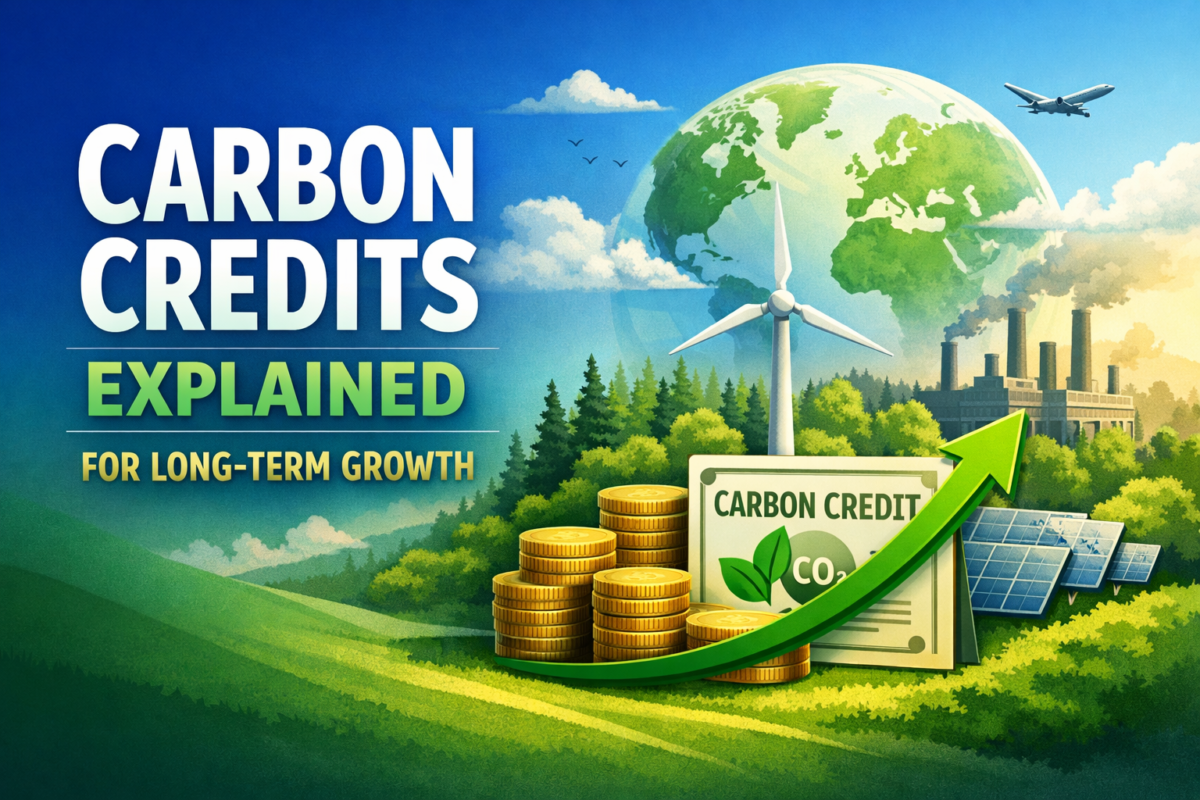
The Role of Carbon Credits in Driving Long-Term
The Role of Carbon Credits in Driving Long-Term
Our time’s most significant economic, environmental, and societal threat is climate change, which is no longer a remote worry. Carbon credits have become one of the most effective market-based instruments to lower greenhouse gas emissions while enabling long-term economic growth as countries, businesses, and investors look for sustainable solutions.
Carbon credits are more than just an environmental tool for India. They offer a calculated chance to draw in green capital, encourage rural growth, hasten the use of renewable energy, and establish the nation as a global leader in climate change.

Comprehending Carbon Credits
The reduction, avoidance, or removal of one metric tonne of carbon dioxide or its equivalent greenhouse gas from the atmosphere is represented by a tradable certificate known as a carbon credit. Verified initiatives that reduce emissions in comparison to a predetermined baseline are the source of these reductions.
Environmental responsibility is turned into a financial advantage through carbon credits. They encourage businesses and governments to invest in greener technologies and sustainable practices by giving emissions reduction a monetary value.
Carbon Market Types
- Market for Voluntary Carbon
Businesses, groups, and people can voluntarily buy carbon credits to offset their emissions through the voluntary carbon market. Rather of being motivated by legal requirements, these purchasers are frequently motivated by sustainability objectives, ESG promises, or net-zero commitments.
Projects like methane collection, afforestation, better cookstoves, renewable energy, and industrial efficiency improvements are all supported by voluntary markets.
- Market for Compliance Carbon
Governments have established regulated systems known as compliance markets to achieve legally mandated emission reduction goals. To stay in compliance, businesses subject to emission caps must either cut their emissions or buy carbon credits.
Compliance markets are anticipated to be crucial to industrial decarbonization as India builds its national carbon trading system.
The Creation of Carbon Credits
Projects that lower emissions below what would have happened under normal circumstances are the source of carbon credits. The lifecycle of these initiatives is structured:
- Designing the Project and Establishing the Baseline
Calculating the emissions that would have occurred in the absence of the project.
- Execution
Carrying out the emission reduction action, like reforesting or installing renewable energy.
- Observation and Quantification
Utilizing authorized techniques to monitor real emission reductions.
- Confirmation and Accreditation
Before credits are given, reductions are confirmed by independent auditors.
- Issue and Exchange
Carbon markets allow for the trading of verified carbon credits.
This stringent procedure guarantees environmental integrity and fosters investor and buyer trust.
India’s Climate Promises and Carbon Credits
India has pledged to meet aggressive climate goals, such as lowering the intensity of emissions and reaching net-zero emissions by 2070. A workable strategy to achieve these objectives while promoting economic expansion is through carbon credits.
India is in a unique position to produce high-quality carbon credits across a variety of industries, including waste management, forestry, renewable energy, and industrial efficiency, thanks to its varied terrain and development requirements.
Carbon Credits as a Potential Investment
More and more people are seeing carbon credits as a long-term, strategic investment as opposed to a temporary offset. The following attracts investors:
- Being exposed to international climate action
- Diversification of the portfolio
- Features of inflation-hedging
- Conformity to sustainability objectives
- Growth in long-term structural demand
Carbon credits might work similarly to commodities with environmental value built into the price when markets develop.
Hazards and Difficulties in Carbon Markets
Carbon markets have significant room for expansion, but they also face obstacles that need to be overcome to maintain their credibility:
- Maintaining the integrity of the environment
- Avoiding double counting
- Standardizing techniques
- Preserving openness
- Controlling the volatility of prices
In order to reduce these dangers, India’s legal system and global best practices would be extremely important.
India’s Competitive Edge in the World Carbon Economy
India has a number of advantages over its competitors:
- Large-scale renewable energy
- Implementing projects in an economical manner
- Various options for reducing emissions
- Strong human and technological resources
- Increasing support for policies
Because of these elements, India is positioned to be one of the world’s top suppliers of premium carbon credits.
Sustainable Development and Carbon Credits
In addition to lowering emissions, carbon credit initiatives provide co-benefits like:
- Creation of jobs
- Generating income in rural areas
- Better quality of the air and water
- Access to energy
- Resilience to climate change
Stakeholder support and long-term viability are strengthened by this dual environmental and social impact.
India’s Prospects for Carbon Credits
It is anticipated that carbon credits would play a significant role in India’s future economic and environment policies. Carbon markets will open up new revenue sources and speed up decarbonization as domestic trading systems develop and global collaboration increases.
A Conclusion: The Role of Carbon Credits in Driving Long-Term
Carbon credits are a financial and developmental driver for India’s sustainable future, not only a climate answer. Carbon markets link long-term growth and environmental responsibility by turning emission reductions into economic value.
Carbon credits will be crucial in creating resilient companies, drawing in green investment, and promoting inclusive development for future generations as India transitions to a low-carbon economy.
Carbon Credits Explained: Complete FAQ Guide for India’s Carbon Market
Carbon Credits Explained: Complete FAQ Guide for India’s Carbon Market
2 Comments