
 Aksh
Aksh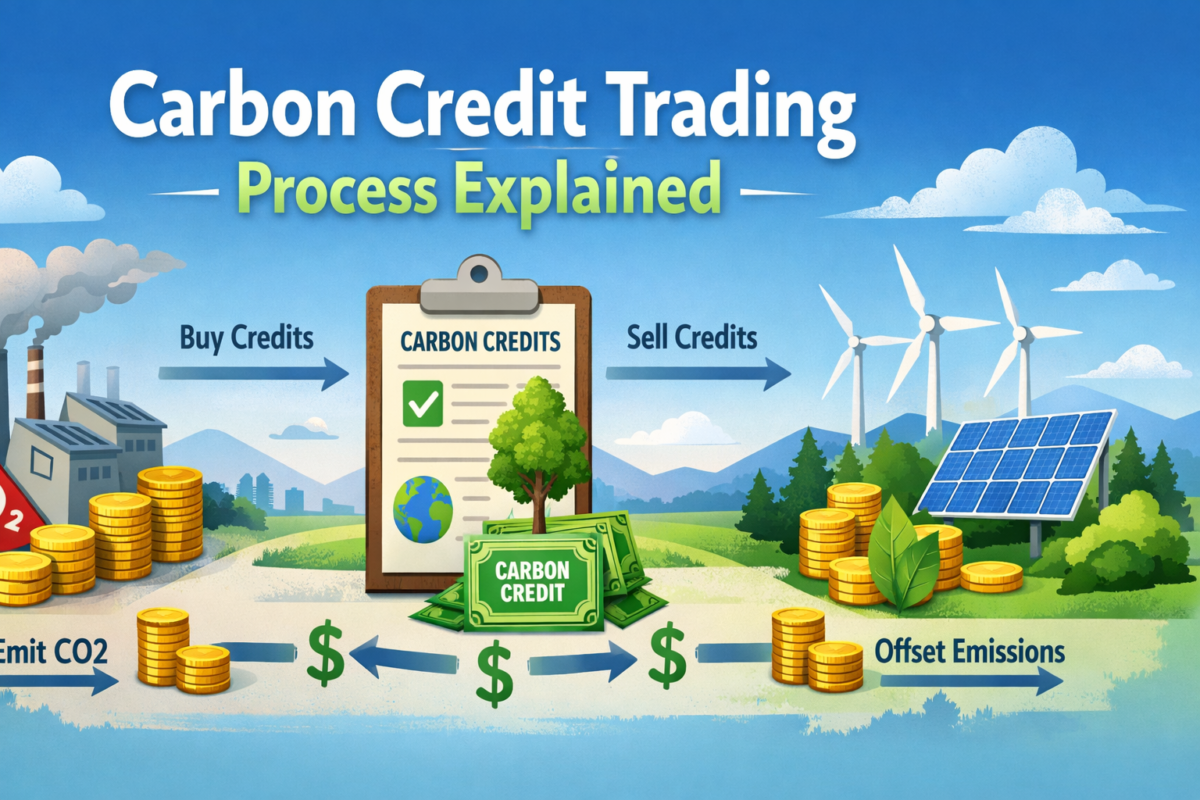
Carbon Credit Trading Process Explained
Carbon Credit Trading Process Explained
Carbon credit trading has become a major tool for addressing climate change and generating income in recent years. Countries like India are progressively implementing carbon credit schemes to lower greenhouse gas emissions and advance environmental sustainability as a result of the growing concern over global warming. An extensive examination of the carbon credit trading procedure, its advantages, and its operation within India’s expanding carbon market are given in this article.

Comprehending Carbon Credits
A permit that permits an entity to emit a certain quantity of carbon dioxide (CO₂) or comparable greenhouse gases (GHGs) is known as a carbon credit. Businesses and organizations buy carbon credits to offset their emissions, which encourages the cost-effective reduction of carbon emissions. Generally, one carbon credit is equivalent to one metric ton of CO₂.
The idea of carbon credits is linked to international initiatives to address climate change. Carbon credits encourage enterprises to adopt cleaner and more sustainable practices by giving lowering emissions a monetary value. With both voluntary and regulated channels for trading carbon credits, the Indian carbon credit market has grown rapidly.
The Operation of the Carbon Credit Trading Process
From project registration to trading and retirement, there are a number of crucial steps in the carbon credit trading process. Below is a summary of every step:
- Carbon Reduction Project Identification
Finding possible projects that lower GHG emissions is the initial stage in the carbon credit process. These initiatives can include forestry operations that absorb CO₂, like afforestation and reforestation, or renewable energy installations, like solar and wind power. Initiatives for energy efficiency and waste management are also eligible to receive carbon offsets.
- Project Validation and Registration
After a project has been found, it needs to be registered with a recognized organization that certifies carbon credits. The project’s compliance with established standards and techniques for estimating emission reductions is guaranteed by the registration. Third-party auditors carry out validation to verify the project’s legitimacy and compliance with environmental regulations.
- Observation and Confirmation
Following project registration, ongoing emissions reduction monitoring is required. Over time, data is gathered, and independent verification organizations evaluate the project’s true impact. Since only verifiable reductions are eligible for carbon credits, verified results are crucial. This stage guarantees the carbon trading process’s dependability and transparency.
India’s Carbon Market Types
India’s carbon markets are both voluntary and compliant:
- Compliance Carbon Market: Associated with government-mandated initiatives such as the Perform, Achieve, and Trade (PAT) program, which establishes emission reduction goals for particular sectors of the economy. In order to comply with laws, companies that fall short of their targets can purchase carbon credits.
- The voluntary carbon market enables businesses and people to voluntarily offset emissions, frequently for brand reputation or corporate social responsibility (CSR) objectives. India’s voluntary carbon market is expanding quickly, providing chances for carbon offset project innovation.
Advantages of Trading Carbon Credits
Trading carbon credits has several advantages for governments, corporations, and the environment.
- Environmental Sustainability: Carbon credits help reduce greenhouse gas emissions, improve air quality, and mitigate climate change by providing incentives for emission reduction programs.
- Economic Opportunities: Businesses can promote green technologies and generate new cash streams by monetizing carbon reduction programs.
- Corporate Responsibility: Companies can show their dedication to sustainability and ESG (Environmental, Social, and Governance) objectives by purchasing and retiring carbon credits.
- International Recognition: By trading carbon credits, Indian companies can support global climate objectives, such as the Paris Agreement.
Advantages of Trading Carbon Credits
Trading carbon credits has several advantages for governments, corporations, and the environment.
- Environmental Sustainability: Carbon credits help reduce greenhouse gas emissions, improve air quality, and mitigate climate change by providing incentives for emission reduction programs.
- Economic Opportunities: Businesses can promote green technologies and generate new cash streams by monetizing carbon reduction programs.
- Corporate Responsibility: Companies can show their dedication to sustainability and ESG (Environmental, Social, and Governance) objectives by purchasing and retiring carbon credits.
- International Recognition: By trading carbon credits, Indian companies can support global climate objectives, such as the Paris Agreement.
New Developments in India’s Carbon Credit Market
The carbon market in India is developing quickly, and a number of trends are influencing its future:
- Digital platforms: Carbon credit transactions are becoming more efficient because to blockchain technology and online marketplaces, which also guarantee transparency and lower fraud.
- Emphasis on Nature-Based Solutions: Reforestation, soil carbon sequestration, and reforestation are becoming popular carbon offset initiatives.
- Corporate Net-Zero Commitments: The voluntary carbon market is seeing a surge in demand as a result of numerous Indian corporations establishing aggressive net-zero goals.
India’s Prospects for Trading Carbon Credits
The market of carbon credits in India appears to have a bright future. India is anticipated to develop more voluntary and compliant carbon markets as international climate commitments expand. Technological developments, international partnerships, and government assistance will propel market expansion and present Indian companies with chances to profit financially while also helping to reduce carbon emissions worldwide.
Additionally, it is anticipated that instructional programs and awareness campaigns would increase involvement, particularly among startups and SMEs. The emergence of blockchain verification and digital carbon exchanges can guarantee efficiency and transparency, increasing accessibility to the carbon credit process for all parties involved.
In conclusion: Carbon Credit Trading Process Explained
Businesses, investors, and environmentalists hoping to support sustainable growth must comprehend the carbon credit trading mechanism. Every stage, from project registration to credit retirement, guarantees quantifiable and reliable emissions reduction and offset. Businesses now have the chance to take part in a system that encourages environmental responsibility, financial gains, and international recognition thanks to India’s rapidly expanding carbon market.
India may quicken its transition to a low-carbon economy by implementing carbon offset projects, trading carbon credits, and incorporating sustainability into business plans. In addition to reducing climate threats, the carbon credit process advances the nation’s goal of a cleaner, greener, and more sustainable future.
Carbon Credits Explained: Benefits, Mechanisms, and Opportunities in India
Carbon Credits Explained: Benefits, Mechanisms, and Opportunities in India