 Aksh
Aksh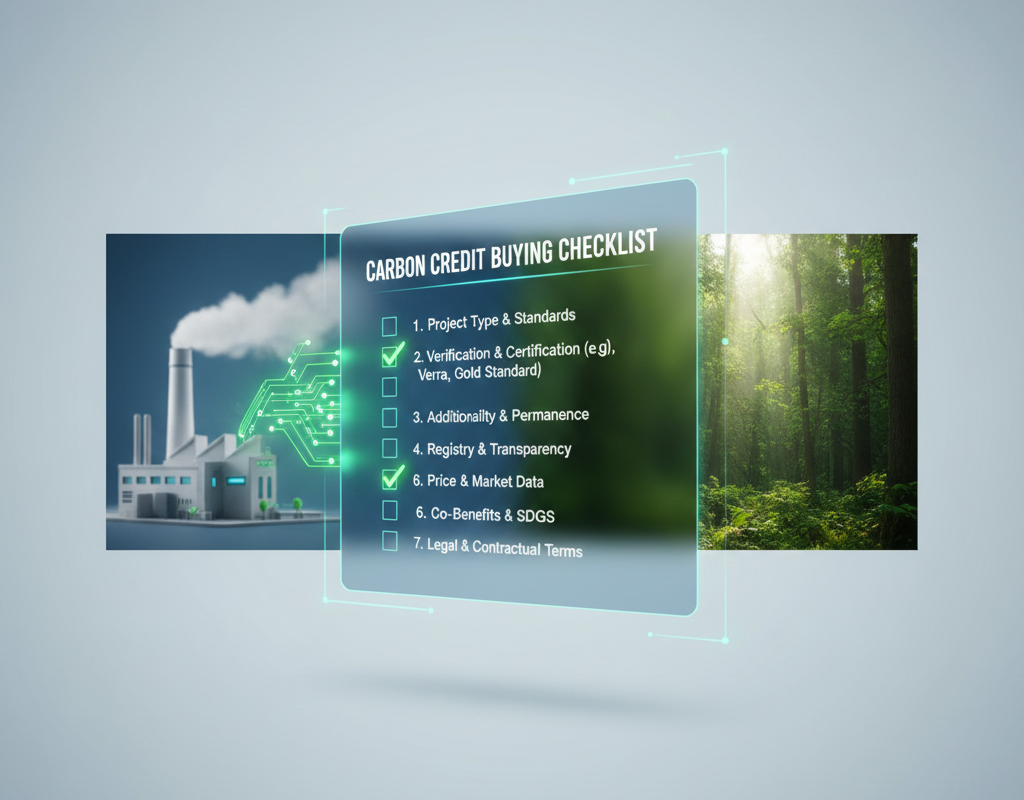
Carbon Credit Buying Checklist
Carbon Credit Buying Checklist
More companies and people are searching for methods to lessen their carbon footprint as climate change continues to affect our ecosystem. Purchasing carbon credits is among the best methods for reducing carbon emissions. By supporting initiatives that lower greenhouse gas emissions, carbon credits enable both individuals and businesses to offset their emissions. However, purchasing carbon credits necessitates significant thought to guarantee that your investment is sustainable, genuine, and successful.
To assist you in navigating the intricacies of the carbon credit market, this article offers a thorough purchase checklist. This book guarantees that you make well-informed judgments that are in line with your sustainability objectives, from comprehending various loan types to assessing project quality.

Carbon Credits: What Are They?
Understanding what carbon credits are is crucial before beginning the checklist. One ton of carbon dioxide (CO2) or its equivalent greenhouse gas (GHG) that has been eliminated or decreased from the atmosphere is represented by a carbon credit. These credits are given to projects that lower emissions, like energy efficiency programs, forestry projects, and renewable energy projects.
Individuals or businesses wishing to offset their emissions or to comply with local regulations may choose to purchase carbon credits willingly. Purchasing carbon credits helps companies achieve their corporate social responsibility (CSR) objectives and improve their sustainability credentials in addition to supporting environmental projects.
Why a Carbon Credit Purchasing Checklist Is Necessary?
The market for carbon credits is expanding quickly, and there are many projects and verification standards available. Although its expansion offers prospects, it also poses difficulties for purchasers:
- Numerous Credit Types: Carbon credits come in compliance and voluntary forms, each with its own rules and objectives.
- Quality Issues: Not all carbon credits are made equally; some might not be rigorously verified or might not actually improve the environment.
- Pricing Variability: The cost of carbon credits varies significantly based on the region, certification standard, and type of project.
Buyers may overcome these obstacles and make sure that investments are credible, meaningful, and in line with their environmental goals by using a carbon credit buying checklist.
Step 1: Establish Your Objectives for Carbon Reduction
Clearly defining your carbon reduction objectives is the first stage in your carbon credit purchasing process. Consider this:
- Are you compensating for personal, business, or both emissions?
- Are long-term sustainability projects or short-term offsets your goal?
- How many metric tons of CO2 equivalent do you hope to reduce?
You can ascertain the amount and kind of carbon credits you require by establishing specific goals. This aids companies in incorporating carbon offset plans into more comprehensive sustainability projects.
Step 2: Recognize the Various Carbon Credit Types
Carbon credits vary from one another. Making educated purchases requires knowing the many kinds of credits that are accessible. The primary categories are as follows:
- Businesses and individuals can purchase voluntary carbon credits to offset their emissions. Methane capture, reforestation, and renewable energy are among the projects.
- Compliance Carbon Credits: In areas with carbon pricing or emission trading programs, these credits are used to satisfy regulatory requirements.
- Project-Based Credits: Associated with particular projects, such as afforestation campaigns, solar power plants, or wind farms.
- Credits derived from certain industries, such as forestry, agriculture, or the reduction of industrial emissions, are known as sector-based credits.
Because each type of carbon credit has a distinct function, buyers must select one based on their goals and compliance needs.
Step 3: Confirm Standards and Certification
Making sure the credits are validated by accepted criteria is a crucial step in the carbon credit purchasing process. Credible certifications attest to the fact that carbon credits reflect actual, quantifiable, and extra emission reductions. Typical certification requirements consist of:
- The Verified Carbon Standard (VCS) is a voluntary carbon standard that is accepted worldwide.
- The Gold Standard guarantees the benefits of sustainable development as well as environmental integrity.
- Carbon credits authorized by the UN for compliance markets are known as the Clean Development Mechanism (CDM).
- The Climate, Community & Biodiversity (CCB) Standards emphasize the co-benefits of the environment and society.
Purchasing credits without the required certification can result in financial loss, reputational issues, and ineffective offsets.
Step 4: Assess the Credibility of the Project
Not every carbon offset initiative has a positive impact on the environment. When choosing credits, assess the legitimacy of the project by taking into account:
Furthermore, the initiative should reduce carbon emissions that would not have happened in the absence of the investment.
- Permanence: The initiative should result in long-term emission reductions. Forest initiatives, for instance, need to guarantee that trees are maintained for many years.
- Leakage: Make sure that decreases in emissions in one region don’t result in rises in other regions.
- Transparency: Clear, readable, and verifiable project documentation is essential.
Transparent carbon reduction tracking and yearly verification reports are common features of high-quality initiatives.
Step 5: Evaluate the Environmental and Social Co-Benefits
Carbon reduction is only one aspect of a robust carbon credit purchasing process. Numerous initiatives provide further environmental and social advantages:
- Generating employment in nearby communities
- Promoting ecosystem restoration and biodiversity
- Increasing the availability of clean water or electricity
Co-benefit credits support the sustainable development goals (SDGs) in addition to the environment. Give top priority to initiatives that reduce carbon emissions while also providing quantifiable benefits.
Step 6: Verify the Type and Location of the Project
The cost, dependability, and impact of carbon credits are influenced by the project’s location and nature. Think about the following:
- Location: While overseas initiatives broaden your portfolio, domestic ventures could be simpler to keep an eye on.
- Project Type: Common types include energy efficiency, methane capture, forestry, and renewable energy. Each has its own timetables, risk levels, and verification criteria.
Select initiatives that fit your risk tolerance and sustainability objectives.
In conclusion: Carbon Credit Buying Checklist
One effective strategy to fight climate change and show support for sustainability is to buy carbon credits. Navigating the carbon credit market, however, calls for considerable thought and research. By using this carbon credit purchasing guide, you can be sure that your investments are reliable, significant, and in line with your sustainability goals.
Every stage is crucial for obtaining carbon credits responsibly, from setting specific carbon reduction targets to confirming certifications, assessing projects, and monitoring offsets. Businesses and individuals can contribute significantly to a cleaner future and gain more environmental credibility by adopting a strategic strategy.
2 Comments