
 Aksh
Aksh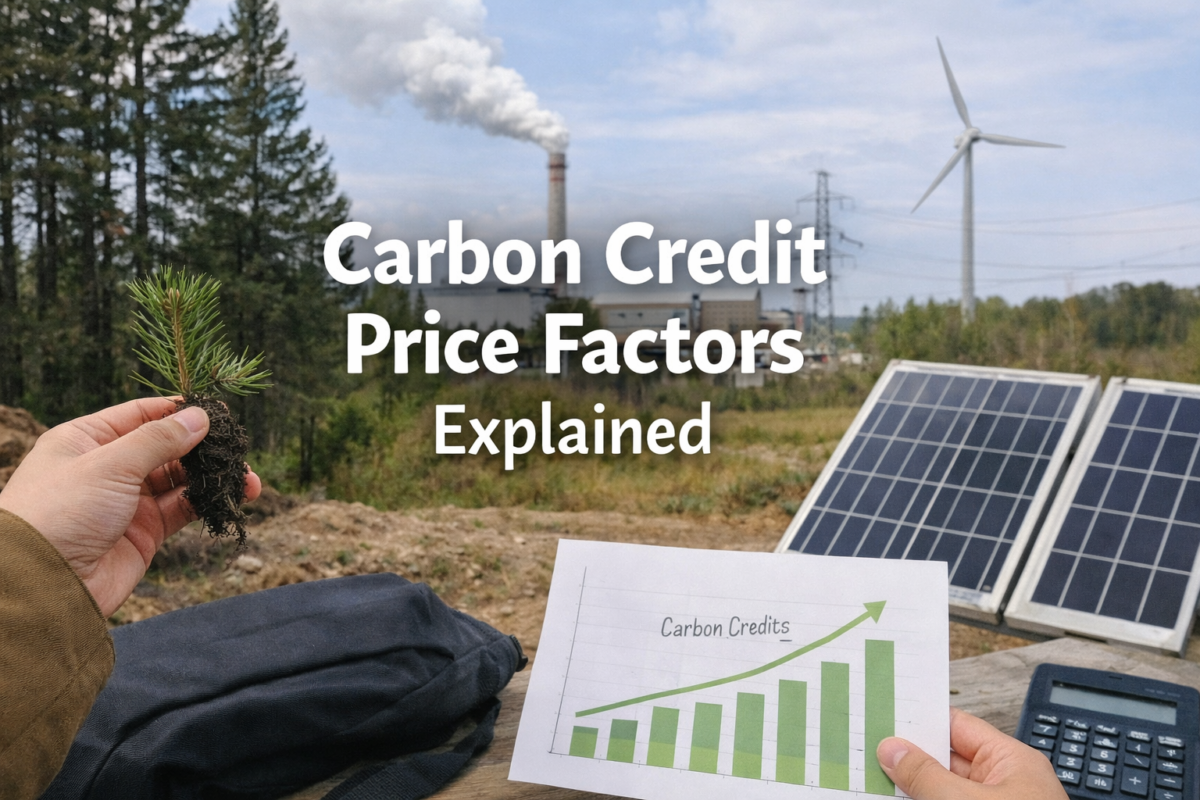
Carbon Credit Price Factors Explained
Carbon Credit Price Factors Explained
One of the most important financial tools in the worldwide battle against climate change is carbon credits. Carbon markets are growing more significant as nations, businesses, and organizations pledge to cut greenhouse gas emissions. What affects a carbon credit’s price is one of the most commonly asked issues in this developing field.
Businesses, project developers, investors, and legislators must all comprehend the elements that affect the price of carbon credits. There are no set prices. Regulatory frameworks, supply and demand, project type, verification standards, geopolitical changes, and market attitude are some of the factors that influence them. Understanding these dynamics is essential for making well-informed decisions in India, where sustainability activities are growing quickly.

Comprehending Carbon Credits
One metric ton of carbon dioxide (CO₂) or a comparable greenhouse gas that has been decreased, avoided, or eliminated from the atmosphere is represented as a carbon credit. These credits are produced by climate-positive projects like waste-to-energy schemes, afforestation campaigns, industrial efficiency improvements, and renewable energy installations.
Governments or regional agencies set mandated emission reduction schemes that manage compliance markets. The European Union Emissions Trading System, in which businesses are required to buy allowances or credits to cover their emissions, is a well-known example worldwide.
In contrast, voluntary markets let businesses and individuals to buy credits to offset emissions as part of their ESG or corporate sustainability pledges.
The carbon credit price variables vary slightly between markets, and each market has its own unique pricing algorithms.
Government Policies and the Regulatory Framework
Government regulations have a big impact on the price of carbon credits. Regulatory clarity frequently boosts investor confidence, which raises pricing.
Under the direction of the Ministry of Power and other regulatory bodies, India is aggressively developing its domestic carbon market. Demand for compliance rises when laws require emission reductions or implement carbon trading programs.
Stricter emission limitations usually result in higher prices in compliance marketplaces around the world. For instance, as emission allowances were tightened as part of the European Union’s Emissions Trading System reforms, prices gradually increased.
In the upcoming years, domestic price structures in India are predicted to be impacted by the projected expansion of carbon trading mechanisms.
Carbon Project Type and Quality
The cost of carbon credits varies. Pricing is significantly influenced by the kind of project that is producing the credit.
- Projects Using Renewable Energy
By replacing fossil fuel-based power generation, solar, wind, and hydroelectric projects create credits. Depending on market saturation, these credits may have moderate prices and are typically plentiful.
- Both planting and replanting
Because they provide extra environmental advantages like biodiversity preservation, water retention, and community development, nature-based solutions like afforestation and replanting sometimes fetch higher pricing.
- Methane Capture and Industrial Projects
High-impact credits can be produced by methane collection projects and industrial efficiency upgrades, particularly those that stop strong greenhouse gasses from entering the atmosphere.
Location and Authority
Pricing for carbon credits is also influenced by their place of origin.
Because there is less perception of risk, credits produced in nations with robust regulatory monitoring and open governance structures may fetch higher prices.
Global interest in Indian carbon initiatives is growing because of:
- Quick growth in renewable energy
- Potential for extensive afforestation
- Competitive project expenses
- Resolute climate pledges
It is anticipated that pricing credibility would increase as India fortifies its carbon trading infrastructure.
Vintage Carbon Credit
The year that the emission decrease took place is referred to as vintage.
Because they comply with modern environmental regulations and business climate goals, newer credits sometimes fetch higher rates. If legal frameworks change or market perceptions change, older credits could be undervalued.
In order to maintain environmental integrity and conformity with current climate research, buyers are favoring more recent vintages.
ESG Commitments Made by Companies
In many jurisdictions, reporting on environmental, social, and governance (ESG) issues is becoming required. Companies are under pressure from institutional investors to reveal and lower their carbon footprints.
The voluntary demand for premium carbon credits is increasing as ESG becomes a key component of business strategy. Price determinants for carbon credits are strongly impacted by this increase in demand, particularly for high-end, high-integrity projects.
To satisfy investor expectations, Indian businesses going global are increasingly buying verified credits.
Platforms for Trading and Market Liquidity
The ease with which carbon credits can be purchased or sold without materially altering the price is known as liquidity.
In general, prices are stabilized by increased liquidity. Markets that lack liquidity could be more volatile.
In India, the growth of digital trading platforms and structured carbon exchanges is anticipated to:
- Enhance the process of pricing discovery
- Boost openness
- Cut down on transaction expenses
- Increase the involvement of investors
Generally speaking, more accurate pricing mechanisms result from increased liquidity.
Worldwide Climate Accords and International Law
Market expectations are greatly influenced by international climate agreements.
Global frameworks for emission reduction obligations are provided by the Paris Agreement and the United Nations Framework Convention on Climate Change.
The demand for carbon credits often increases as nations fortify their Nationally Determined Contributions (NDCs). On the other hand, poor international coordination may lead to price instability.
The evolution and pricing trends of the domestic carbon market are directly impacted by India’s commitments under international climate agreements.
In conclusion: Carbon Credit Price Factors Explained
A complex interaction of environmental, technological, governmental, and economic factors shapes the price of carbon credits. Many factors affect market rates, ranging from the basics of supply and demand to international climate agreements and ESG concerns.
Understanding carbon credit price variables is crucial for strategic decision-making for players in India’s quickly changing carbon market. The most important factors influencing value as the market develops will be pricing clarity, regulatory certainty, and project integrity.
Those companies, investors, and project developers who keep up with these factors will be in the best position to take advantage of opportunities in the expanding Indian carbon credit market.
2 Comments