
 Aksh
Aksh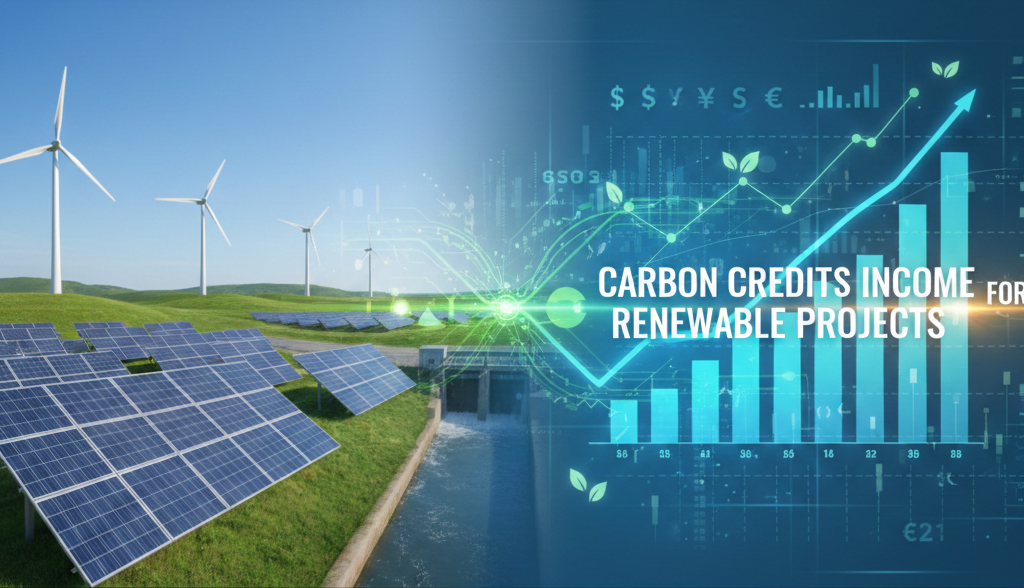
Carbon Credits Income for Renewable Energy Projects
Carbon Credits Income for Renewable Energy Projects
In addition to becoming an environmental movement, India’s shift to clean energy is also developing into a significant economic opportunity. In order to boost project feasibility and investor trust, renewable energy developers in the solar, wind, hydro, biomass, and waste-to-energy sectors are increasingly using carbon credit income as a secondary revenue stream.
The market for verified carbon credits is rising globally as a result of India’s commitment to aggressive climate targets and net-zero pathways. Projects utilizing renewable energy are in a unique position to profit from this growing market. Renewable developers are finding that carbon credits can significantly increase project revenues as regulatory frameworks develop and foreign purchasers look for reliable carbon offsets.

Recognizing the Financial Potential of Carbon Credits
One metric ton of carbon dioxide (CO₂) or its equivalent greenhouse gas is reduced or removed from the atmosphere to create a carbon credit. By substituting clean, non-emitting power sources for fossil fuel-based electricity generation, renewable energy projects provide carbon credits.
Emissions that would have been produced by coal or gas-based power plants are avoided when electricity is supplied to the grid by solar or wind power facilities. These averted emissions are measured, validated, and given out as carbon credits that can be traded.
Renewable developers can generate a quantifiable revenue stream by selling each validated credit on carbon markets.
The Benefits of Renewable Energy Projects for Earning Carbon Credits
Projects using renewable energy are inherently eligible to generate carbon credits because:
- They replace power derived from fossil fuels.
- They result in quantifiable and validated decreases in emissions.
- They last for a long time (20–25 years or longer).
- They support global sustainability and ESG objectives.
When additionality and compliance requirements are satisfied, projects utilizing solar, wind, hydro, biomass, and waste-to-energy can all be eligible under established carbon standards.
Renewable displacement offers substantial promise for reducing emissions in India, where coal still accounts for the majority of power generation. This might result in increased numbers of carbon credits being generated.
Carbon Credit-Generating Renewable Project Types
- Solar Power Initiatives
By substituting fossil fuel-based grid electricity, utility-scale solar parks, rooftop solar arrays, and captive solar plants can provide significant carbon credits.
- Projects Using Wind Energy
Because of their extended operational lifespans and steady generating capacity, wind farms consistently produce carbon credit volumes.
- Minor Hydro Projects
Small hydro and run-of-the-river projects lessen reliance on coal-based power, resulting in qualifying emission reductions.
- Waste-to-Energy and Biomass Initiatives
Because methane has a greater potential to cause global warming, these projects provide renewable energy while lowering methane emissions, which frequently results in higher carbon credit amounts.
India’s Voluntary Carbon Market and Compliance Market
In India, the Voluntary Carbon Market (VCM) is the main platform for renewable initiatives. In this marketplace:
- Businesses voluntarily buy credits to offset pollution.
- Demand is driven by ESG commitments.
- The quality of the project and the certification standard affect the price.
Under India’s Carbon Credit Trading Scheme (CCTS), which is subject to government regulations, the compliance market is developing and is anticipated to generate organized domestic trading opportunities.
Stability of Revenue and Long-Term Financial Effects
The economics of renewable projects are enhanced by carbon credit income in a number of ways:
- The Internal Rate of Return (IRR) is improved.
- increases the DSCR (debt service coverage ratio)
- shortens the payback period
- Draws in ESG-conscious investors
- Enhances cash flow over the long term
Carbon credits can generate an extra 5–15% of revenue for large-scale projects, greatly enhancing overall financial performance.
Rising Prices Due to Global Demand
International businesses are pledging to achieve net-zero goals. Industries like industry, energy, technology, and aviation are actively buying premium carbon credits.
India’s high-integrity renewable credits are becoming more and more popular due to:
- They provide quantifiable effects.
- They offer competitive prices.
- India’s monitoring and verification systems are robust.
- Large-scale emission reductions are supported by the increase of renewable capacity.
Carbon credit prices in premium voluntary segments are growing as a result of this increased demand.
Hazards and Difficulties with Carbon Credit Revenue
Carbon credit markets are profitable, but there are hazards involved:
- Volatility of prices
- Modifications to regulations
- Delays in verification
- Complexity of documentation
- Disputes over additionality
Expert carbon credit advising assistance reduces these risks and guarantees adherence to changing legal requirements.
In conclusion: Carbon Credits Income for Renewable Energy Projects
The income from carbon credits is changing the economics of renewable energy in India. Previously seen as an additional advantage, this has evolved into a strategic financial tool.
India’s renewable energy projects are in a unique position to take advantage of the growing demand for verified carbon offsets worldwide. With the correct knowledge, paperwork, and marketing plan, carbon credits can produce steady revenue over the long run and make a significant contribution to the global climate goals.
Carbon credit monetization is now a must for investors, developers of renewable projects, and sustainability-driven businesses in order to maximize financial rewards in a world that is decarbonizing.
Carbon Credit Trading Fees Explained: Complete Guide for Indian Carbon Markets
Carbon Credit Trading Fees Explained: Complete Guide for Indian Carbon Markets
2 Comments