
 Aksh
Aksh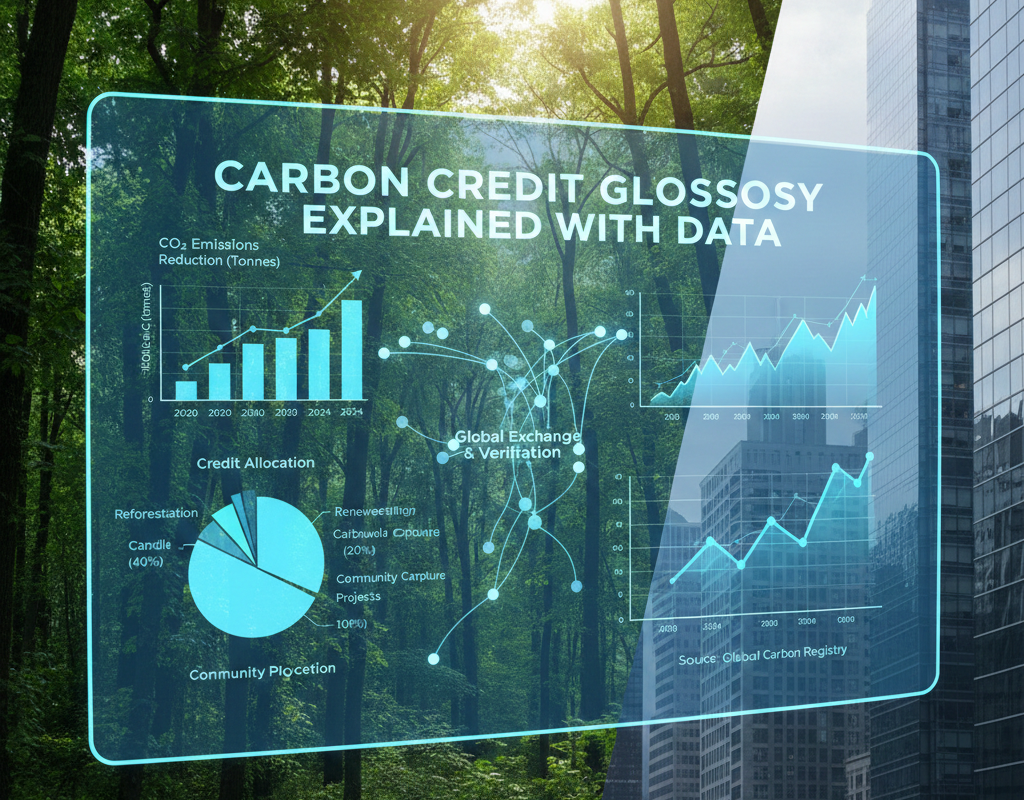
Carbon Credit Glossary & Data Insights
Carbon Credit Glossary & Data Insights
Understanding carbon credits has become essential for investors, companies, and environmentalists alike as global efforts to address climate change intensify. Government initiatives and corporate environmental aims are driving the growth of the carbon market in India. With the support of data insights, this thorough glossary of carbon credit words can assist you in navigating the intricate world of carbon finance.
Carbon Credits: What Are They?
One tonne of carbon dioxide (CO₂) or its equivalent greenhouse gas (GHG) can be released by the holder of a carbon credit, which is a tradable certificate or permit. The idea was first presented as a way to encourage carbon reductions under international agreements such as the Kyoto Protocol. Essentially, businesses can sell extra credits to organizations that surpass their emission restrictions if they lower their emissions below a predetermined threshold.
Data Insight: The World Bank reports that the global carbon market grew from $760 billion in 2022 to $851 billion in 2023, demonstrating the increasing use of carbon trading systems.

Important Words in the Glossary of Carbon Credits
Here is a detailed explanation of several key concepts associated with carbon credits, along with examples and context:
- Offset of Carbon
Reducing GHG emissions to make up for emissions generated elsewhere is known as a carbon offset. For instance, to offset its factory emissions, a business investing in a wind energy facility in India would buy carbon offsets.
Data Insight: One of Asia’s fastest-growing marketplaces, India produced more than 45 million verified carbon offsets in 2023.
- Trading in Carbon
The purchase and sale of carbon credits is known as carbon trading. It can take place in government-regulated compliance markets or in voluntary markets where businesses choose to lessen their carbon footprint.
Key Data: Growing corporate sustainability commitments are reflected in the $320 million in transactions that took place in the Indian voluntary carbon market in 2023.
- The carbon footprint
The total amount of greenhouse gases generated, either directly or indirectly, by a person, business, or product is measured by their carbon footprint. Before trading or offsetting carbon credits, it is important to understand your footprint.
- Carbon Standard Verified (VCS)
One of the most well-known criteria for validating carbon credits is the Verified Carbon Standard. To make sure they offer actual, quantifiable, and long-lasting emission savings, projects that satisfy VCS requirements are audited.
- Credits for Renewable Energy (RECs)
Certificates for power produced using renewable resources, such as wind, solar, and biomass, are known as renewable energy credits. One MWh of renewable energy supplied to the grid is equivalent to one REC. RECs frequently interact with carbon offset initiatives, although being distinct from carbon credits.
- Reduction of Emissions
The quantifiable drop in GHG emissions brought about by initiatives like energy efficiency, afforestation, or the use of renewable energy sources is referred to as emission reduction.
India’s Carbon Credit Project Types
With initiatives covering waste management, forestry, energy efficiency, and renewable energy, India boasts a diversified carbon credit ecosystem. This is a summary:
- Renewable Energy Projects: Carbon credits and energy certificates are produced by solar, wind, and biomass projects.
- Projects for Afforestation and Reforestation: Planting trees helps sequester carbon.
- Methane Capture Projects: Methane capture from farms or landfills lowers strong greenhouse gas emissions.
- Energy Efficiency Projects: Reducing emissions and energy consumption can be achieved by upgrading industrial processes or equipment.
- Waste-to-Energy Projects: By turning organic waste into bioenergy, carbon credits are produced and methane emissions are stopped.
- Data Insight: In 2023, forestry initiatives generated about 25% of India’s carbon credits, while 60% came from renewable energy projects. This shows a balance between clean energy and natural solutions.
How to Calculate and Confirm Carbon Credits
Accurate measurement, reporting, and verification are essential to the legitimacy of carbon credits (MRV). Usually, the procedure consists of:
- Calculating emissions without any intervention is known as baseline assessment.
- Project Implementation: Carrying out actions to reduce emissions.
- Tracking decreases with time through monitoring and reporting.
- Third-Party Verification: Accredited auditors certify that criteria such as VCS or Gold Standard are being met.
Snapshot of Data
- In India’s voluntary market, a carbon credit would typically cost $8–$12 per tonne of CO₂ in 2023.
- India issues 45–50 million tons of CO₂ equivalent in verified carbon credits per year.
Trends in the Indian and Global Carbon Markets
- Corporate Sustainability Fuels Growth: To reach ESG goals, multinational corporations doing business in India buy carbon credits.
- Government Policy Support: Energy efficiency and emissions trading are supported by India’s Perform, Achieve, and Trade (PAT) program.
- Technology Integration: Blockchain technology is being investigated for transparent tracking of carbon credits.
- Voluntary Market Expansion: As more startups and SMEs engage in voluntary carbon trading, liquidity and creativity are increased.
The Value of Knowing the Carbon Credit Terminology
A thorough comprehension of the carbon credit lexicon is necessary for:
- Companies: To use carbon trading and adhere to emission standards.
- Investors: To find lucrative carbon finance prospects.
- Policymakers: To create frameworks for climate action that work.
- Environmental Advocates: To encourage sustainable activities that are well-informed.
- Data Insight: According to a 2023 UN research, companies with explicit carbon credit plans cut their carbon footprint 15–20% more quickly than those without official carbon policies.
In conclusion: Carbon Credit Glossary & Data Insights
Businesses, legislators, and environmental stakeholders in India and around the world now need to understand carbon credits and the lexicon that goes along with them. Carbon credits provide a concrete route to economic opportunity, sustainability, and climate change mitigation with trustworthy data and open markets. Organizations may successfully navigate the expanding carbon market and make a significant contribution to a greener future by being knowledgeable about concepts like carbon offset, carbon trading, verified carbon standard, and carbon sequestration.
Carbon Footprint Tools Explained with Charts | Complete Guide for Businesses
Carbon Footprint Tools Explained with Charts | Complete Guide for Businesses
2 Comments