
 Aksh
Aksh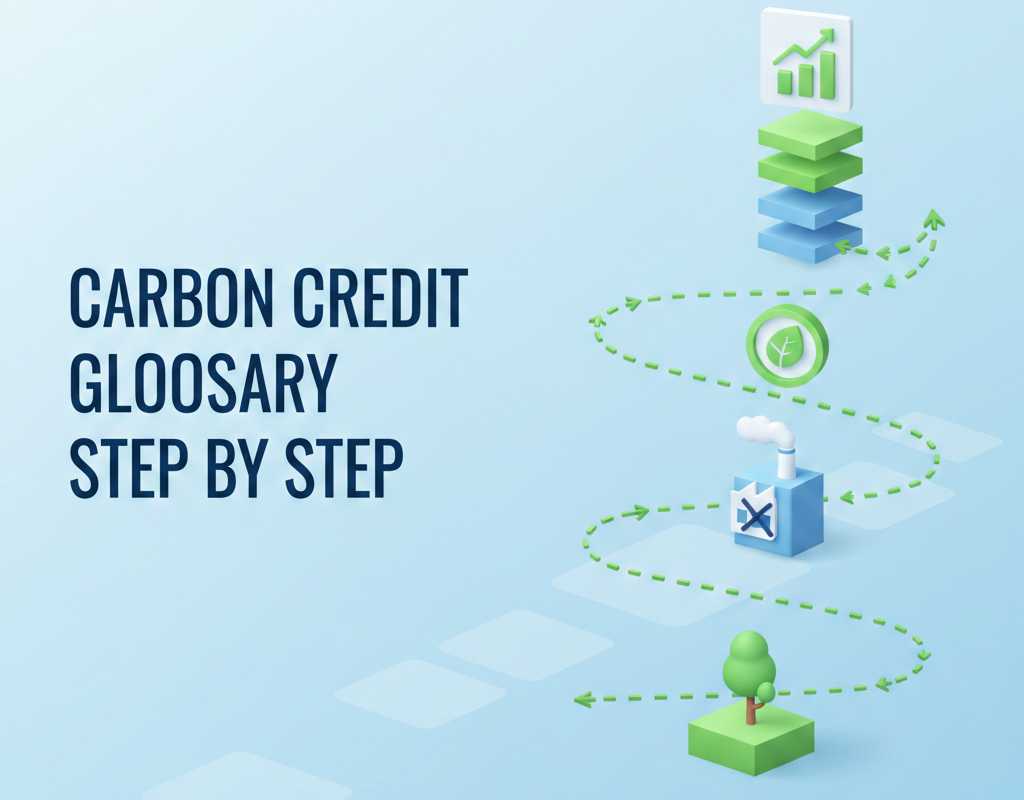
Carbon Credit Glossary Step by Step
Carbon Credit Glossary Step by Step
Carbon credits have evolved from a specialized environmental idea to a potent financial and sustainability tool in the worldwide battle against climate change. Carbon markets, climate finance, and ESG compliance are becoming more and more important for companies, investors, legislators, and sustainability experts as India speeds up its shift to net-zero goals.
It is necessary to be conversant with complicated vocabulary in order to comprehend carbon credits. The jargon can be intimidating, ranging from carbon offsets and renewable energy certificates to carbon registries and emission reduction units. This comprehensive dictionary of carbon credits breaks down these terminology in an organized manner, assisting users in gradually expanding their understanding from basic ideas to sophisticated carbon trading systems in India.

Step 1: Gaining a Basic Understanding of Climate Change
It’s important to comprehend the environmental issue that carbon credits are intended to solve before using them.
- Changes in Climate
Long-term changes in global temperatures and weather patterns are referred to as climate change, and they are mostly brought on by human activities like the burning of fossil fuels, deforestation, and industrial operations.
- GHGs, or greenhouse gases
Heat is trapped in the Earth’s atmosphere by greenhouse gasses. Carbon dioxide (CO₂), methane (CH₄), nitrous oxide (N₂O), and fluorinated gases are the main greenhouse gases. One of the main causes of global warming is carbon dioxide.
- Equivalent of Carbon Dioxide (CO₂e)
The influence of various greenhouse gases is measured in terms of their equivalent effect to carbon dioxide using the standard unit CO₂e. It makes it possible for industries to use uniform carbon accounting.
Step 2: What is a carbon credit?
Now that we know what emissions are, we can go on to the main idea.
- Credit for Carbon
One metric tonne of carbon dioxide (or an analogous greenhouse gas) that has been cut, prevented, or eliminated from the atmosphere is represented by a carbon credit.
In carbon markets, tradable instruments called carbon credits are used to offset emissions. Companies that cut emissions below the limit can sell excess credits, and companies that cut emissions over the limit can purchase credits.
- Offset of Carbon
A carbon offset is a system that funds initiatives that cut or eliminate greenhouse gas emissions in other places in order to make up for emissions. Offsets are frequently produced via energy efficiency, forestry, or renewable energy initiatives.
- Reduction of Emissions
Measurable drops in greenhouse gas emissions brought about by particular measures are referred to as emission reductions.
Step 3: Essential Terms for Carbon Trading
Navigating the Indian carbon market requires an understanding of trading jargon.
- Trading in Carbon
Organizations can purchase and sell carbon credits through carbon trading. It generates monetary rewards for lowering emissions.
- Trade Caps
A cap-and-trade system permits the trading of allowances while establishing an emission cap.
- Pricing of Carbon
By giving carbon emissions a monetary value, carbon pricing incentivizes polluters to cut back on their emissions.
Step 4: Terms for the Development of Carbon Projects
Verified projects are the source of carbon credits. The following are key terms:
- The Carbon Project
A carbon project is an endeavor aimed at lowering, preventing, or eliminating greenhouse gas emissions.
- Furthermore, additionality
Additionality guarantees that without carbon finance incentives, emission reductions would not have taken place.
- Initial
The anticipated emissions situation in the absence of the carbon project is represented by a baseline.
Step 5: Carbon Offset Project Types
India has enormous potential for a variety of projects:
- Projects Using Renewable Energy
initiatives to replace fossil fuel electricity with power produced by solar, wind, hydro, or biomass.
- Initiatives for Energy Efficiency
Initiatives that use better technology to cut down on energy use.
- Both planting and replanting
Initiatives to plant carbon-absorbing trees.
- Energy-to-Waste Initiatives
Initiatives that turn garbage into energy that can be used.
Step 6: Global Climate Frameworks
Global accords have an impact on carbon markets.
- Climate Change Framework Convention of the United Nations
International climate negotiations are supervised by the UNFCCC.
- The Paris Agreement
The goal of the Paris Agreement is to keep global warming well below 2°C.
- Article Six
International carbon trading arrangements between nations are made possible under Article 6 of the Paris Agreement.
Why It’s Important to Understand the Carbon Credit Glossary
Carbon literacy is crucial in light of India’s increased commitment to climate action. Knowing carbon credit jargon helps you make well-informed decisions, whether you are a business leader looking to comply with ESG regulations, an investor investigating carbon assets, or a legislator creating frameworks for climate finance.
Carbon markets are tools for economic transformation as well as environmental improvement. Carbon credits are changing India’s sustainability ecosystem, from the expansion of renewable energy to the creation of green jobs.
Businesses must remain ahead of the curve by becoming proficient in carbon credit language and compliance standards as India fortifies its carbon trading system and conforms to international climate agreements.
In conclusion: Carbon Credit Glossary Step by Step
Although the carbon credit ecosystem may seem complicated, it becomes strategic and manageable when dissected step by step. This carbon credit dictionary offers an organized approach to comprehending India’s carbon market environment, covering everything from fundamental climate ideas to sophisticated trading systems and ESG integration.
Carbon credits will become more and more essential to corporate strategy, financial investment, and environmental responsibility as the Indian carbon market develops in response to domestic policy reforms and international climate commitments.
Stakeholders can participate in carbon trading, climate finance, and sustainability reporting with confidence if they have a solid grasp of carbon credit language. India can speed its transition to a low-carbon, net-zero future and open up economic growth prospects in the green economy by gradually increasing its knowledge base.
Carbon Footprint Tools for Climate Action: Measuring, Managing and Reducing Emissions in 2026
Carbon Footprint Tools for Climate Action: Measuring, Managing and Reducing Emissions in 2026