
 Aksh
Aksh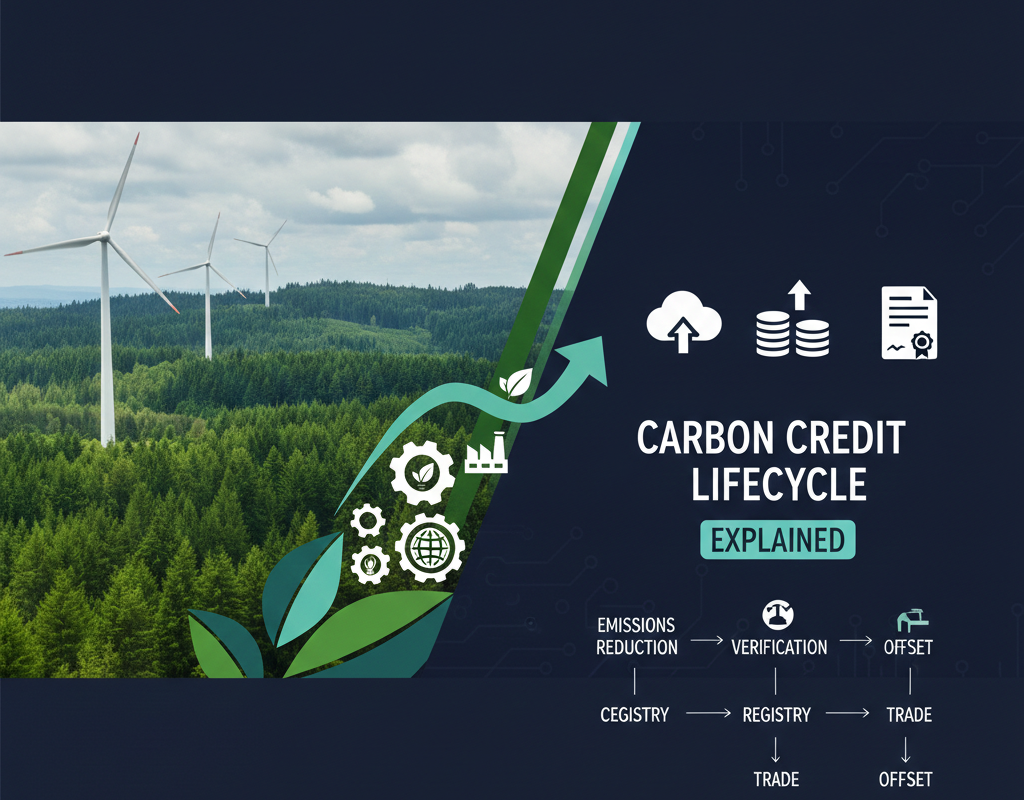
Carbon Credit Lifecycle Explained
Carbon Credit Lifecycle Explained
Carbon credits are a crucial instrument in the fight to prevent global warming and meet climate targets because they allow governments, corporations, and individuals to lower their carbon footprints. However, how does a carbon credit progress from creation to retirement, and what is the precise lifecycle of a carbon credit? This news article provides a thorough explanation of the carbon credit lifecycle, including each stage, its significance, and how it affects climate action.
One of the major issues of our time is climate change. There is an urgent need to reduce greenhouse gas (GHG) emissions, and carbon markets offer financial incentives to do so. The idea of carbon credits, which are tradable permits that reflect one metric ton of carbon dioxide equivalent (CO₂e) saved or removed, is fundamental to these markets.

Carbon Credits: What Are They?
Prior to dissecting the lifecycle, let’s clarify what carbon credits are. The reduction, avoidance, or removal of one metric ton of carbon dioxide equivalent (CO₂e) from the atmosphere is represented by a quantifiable, verifiable unit called a carbon credit.
Carbon offset projects that lower emissions through methane capture, energy efficiency, reforestation, renewable energy, and other methods generate carbon credits. In order to meet legal requirements or meet climate goals, these initiatives provide credits that organizations can purchase to offset their own emissions.
The Significance of the Carbon Credit Lifecycle
For several reasons, it is essential to comprehend the carbon credit lifespan, from project conception to retirement:
- It guarantees confidence and openness in carbon markets.
- It assists companies in accurately recording their offsets and emissions.
- By making it possible to invest in sustainable projects, it promotes climate finance.
- It keeps emission reductions from being counted twice.
- It improves carbon credits’ credibility and environmental integrity.
Let’s examine each step of the carbon credit lifecycle in more depth now.
Step 1: Identification and Design of the Project
Finding and creating a carbon offset project is the initial stage in the carbon credit lifecycle. This entails deciding on the kind of mitigation action, establishing project parameters, and projecting anticipated emission decreases.
Important components of this stage consist of:
- Project Conceptualization: Developers choose the project type (e.g., reforestation, waste methane capture, wind farm, solar power plant).
- Calculating the emissions that would arise in a business-as-usual situation in the absence of the project is known as the baseline emissions assessment. Baseline emissions serve as a benchmark for gauging decreases.
- Projects must demonstrate that they would not be possible without the carbon finance support (additionality), and they must evaluate their viability in terms of cost, technology, and environmental impact.
Step 2: Independent Third-Party Validation
An independent third-party auditor or validation organization must formally examine a project after it has been designed. The project’s design, additionality claim, baseline methodology, and adherence to carbon certification criteria are all evaluated during validation.
In the course of validation:
- Project documentation is submitted to a certification standard (e.g., Gold Standard, Verified Carbon Standard, etc.).
- The validator examines everything in light of predetermined standards.
- A validation statement attesting to the project’s compliance with the requirements is given if it passes.
To make sure the initiative is credible and able to produce actual, quantifiable emission reductions, validation is crucial.
Step 3: Signing up for a Carbon Registry
The project is listed on a carbon registry following validation. A system that tracks carbon projects and granted credits and is open to the public is called a carbon register. Double counting is avoided and traceability is guaranteed by registration.
At this point:
- The registry contains the project specifics.
- A special registration number is assigned to the project.
- The register keeps account of carbon credit issuance, ownership transfers, and retirement.
Because they offer a transparent record of each carbon credit’s lifecycle, registries are essential to the integrity and openness of carbon markets.
Step 4: Execution and Surveillance
The project enters the implementation and monitoring phase when validation and registration are finished, during which time emission reduction efforts are conducted locally.
Important tasks consist of:
- Putting clean energy systems into action.
- Reclaiming damaged areas or planting trees.
- Putting methane collecting devices into action.
- Tracking emissions and gathering information.
Accurate monitoring is essential during implementation. For projects to show that real reductions are taking place as intended, emissions data must be gathered on a regular basis.
This ongoing phase, which lasts the entire project, guarantees that emission reductions are actual, quantifiable, and verifiable.
Important Certification Criteria for the Lifecycle of Carbon Credits
The validation, verification, and issuance of carbon credits are governed by a number of standards. Although the lifetime is the main topic of this essay, it is crucial to highlight some of the generally accepted standards that guarantee credibility and quality.
Typical benchmarks consist of:
- Carbon Standard Verified (VCS)
- The Gold Standard
- Mechanism for Clean Development (CDM)
- The Climate Action Reserve
Every standard has its own procedures, prerequisites, and needs for monitoring. Selecting the appropriate criteria affects the credits’ market value and reputation.
Typical Carbon Offset Project Types
A variety of project types can produce carbon credits. These consist of:
- Renewable energy initiatives (hydro, solar, and wind)
- Initiatives related to forestry and land usage
- Capture of methane from landfills
- Destroying industrial gases
- Improvements in energy efficiency
Beyond lowering emissions, knowing the project type offers insight into the social and environmental co-benefits.
Conclusion: Carbon Credit Lifecycle Explained
Anyone involved in carbon markets or climate action must comprehend the described carbon credit lifecycle. Every step of the process, from project design to issue, trading, and retirement, guarantees that carbon credits provide quantifiable, actual emission reductions and support international sustainability objectives.
Businesses and investors can make well-informed decisions that promote climate solutions while fulfilling environmental commitments by understanding how carbon credits are generated, tracked, and retired.
Carbon Credits Explained for Businesses: Meaning, Benefits, Markets, and Strategy
Carbon Credits Explained for Businesses: Meaning, Benefits, Markets, and Strategy
1 Comment