
 Aksh
Aksh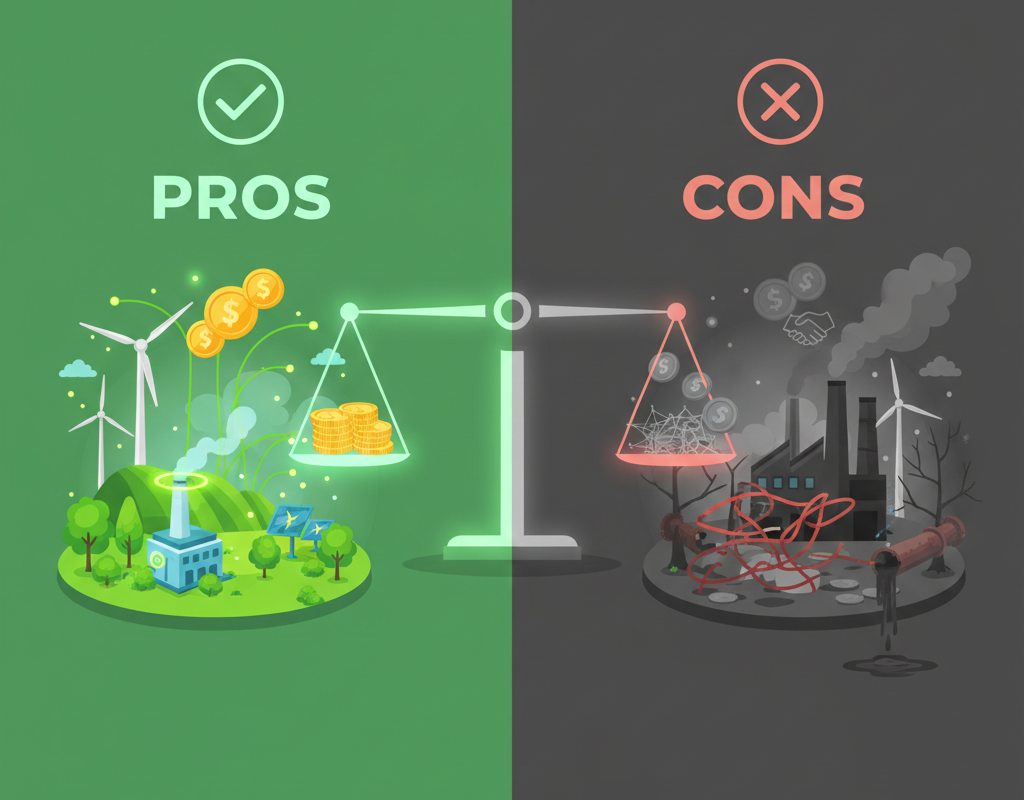
Carbon Credit Marketplaces Pros and Cons
Carbon Credit Marketplaces Pros and Cons
Marketplaces for carbon credits are becoming one of the most talked-about ways to support climate action. These marketplaces offer flexibility, funding for climate projects, and a framework where effect may be bought and sold as governments, businesses, and communities compete to cut emissions. However, rapid growth raises concerns regarding long-term sustainability, efficacy, fairness, and verification.
This article examines the benefits and drawbacks of carbon credit markets, offering a fair assessment of how they influence global climate goals, financial incentives, and environmental policies.

Carbon Credit Marketplaces: What Are They?
A carbon credit marketplace is a platform for the purchase, sale, and exchange of carbon credits, which are permits that signify the removal or reduction of one tonne of carbon dioxide equivalent. Government-mandated regulated compliance markets or voluntary markets where businesses and individuals buy credits to offset emissions are two examples of these marketplaces.
Simply put, these marketplaces facilitate the connection between purchasers looking to offset emissions or meet climate targets and climate projects that lower greenhouse gas emissions. Multinational firms, small and medium-sized businesses, and even individuals with an interest in sustainability are among the buyers.
The Significance of Carbon Credit Marketplaces
Reducing emissions at the source and funding the removal or avoidance of greenhouse gas emissions elsewhere are both necessary for mitigating climate change. Marketplaces for carbon credits allow:
- Funding for Climate Initiatives
Capital is required for projects like methane capture, renewable energy, and reforestation. Marketplaces facilitate climate innovation and community benefits by directing buyer dollars to initiatives that produce credits.
- Strategy for the Corporate Climate
Many businesses utilize carbon credits to offset emissions they are unable to quickly remove and establish net-zero goals. Enterprises exhibit their commitment to the environment by engaging in these markets.
- Carbon Pricing on a Large Scale
By turning emissions into a commodity and establishing a pricing mechanism for carbon, marketplaces enable greater involvement in emissions reduction.
Carbon Credit Marketplace Benefits
Although marketplaces have revolutionized climate financing, their benefits extend beyond simple trading. The main benefits that are attracting attention and investment worldwide are listed below.
- Encourages Climate Solutions Investment
Markets for carbon credits direct funds to initiatives that might otherwise have trouble obtaining support. Among the examples are:
- Initiatives for afforestation and reforestation
- Installations of renewable energy
- Methane collection in trash and agriculture
- Enhancement of soil carbon in agriculture
Solutions that directly lower or eliminate greenhouse gas emissions from the environment are scalable thanks to this investment.
Impact: By enabling communities and regions to take part in climate action, these investments result in tangible environmental results.
- Provides Businesses with Flexibility
Not every business can get rid of all pollutants right away. Decarbonization requires time and money for industries including heavy manufacturing, cement, and aircraft. These companies can invest in greener technologies and balance emissions by using carbon credit marketplaces.
Benefit: Adaptability in climate policy without imposing unreasonably high short-term cuts.
- Encourages Local and Global Climate Goals
Under the Paris Agreement, nations pledge to make Nationally Determined Contributions (NDCs). By directing private capital toward emission reductions that support these overarching objectives, carbon credit marketplaces aid in coordinating national and corporate initiatives.
Carbon Credit Marketplace Drawbacks
Although carbon credit marketplaces have many advantages, there are drawbacks and difficulties as well. Improving the way markets operate requires an understanding of these issues.
- The possibility of greenwashing and problems with credibility
Greenwashing, the practice of businesses buying credits to look environmentally conscious without really reducing emissions, is a prominent critique of carbon credit marketplaces.
- Certain credits might not reflect actual or further savings.
- Dubious credits can enter the market due to inadequate verification.
- Credibility and public trust are weakened by this.
- Difficulties in Quantifying Carbon Reductions
Accounting for carbon is complicated. Projects could overstate reductions or neglect to take emissions leakage—where emissions are displaced instead of decreased—into consideration.
As a result, false faith in progress is fostered and the impact of climate measures is diminished by inaccurate credits.
- Market Uncertainty and Pricing Volatility
Market fragmentation, regulatory changes, and imbalances in supply and demand can all cause volatility in carbon credit pricing. This raises questions for:
- Long-term investment planning by project developers
- Buyers setting aside money for carbon offsets
- Market behavior and policymakers’ alignment with climate goals
Professional Views on Enhancing the Market
Experts highlight enhancements to increase the impact of marketplaces:
- Verification Standardization
More credibility and less misunderstanding are guaranteed by standardized standards.
- Increased Regulatory Monitoring
Governments may make voluntary schemes more in line with broader climate policy and bolster compliance markets.
- Increased Openness
Public and stakeholder trust is increased by transparent reporting and transparency.
- Pay Attention to Co-Benefits
In addition to carbon savings, credits must to account for social and environmental advantages including biodiversity and local livelihoods.
Conclusion: Carbon Credit Marketplaces Pros and Cons
Marketplaces for carbon credits have many benefits as instruments for expanding climate funding, fostering innovation, and facilitating adaptable climate policies. But there are drawbacks to the system as well, such as problems with credibility, unstable prices, and possible abuse as green marketing.
Stronger criteria, reliable verification, open reporting, and a dedication to using credits in conjunction with direct emission reductions rather than in instead of them are ultimately necessary for these marketplaces to succeed.
Businesses, legislators, and communities can use carbon credit marketplaces efficiently, ethically, and in line with larger climate goals by being aware of both sides—the advantages and disadvantages.
Carbon Credits Explained: A Powerful Tool for Climate Action and Sustainable Growth
Carbon Credits Explained: A Powerful Tool for Climate Action and Sustainable Growth